Ancheng is a professional manufacturer of eco-friendly straws wholesale, offering high-quality solutions in paper, wheat stem, reed, and bamboo. Our straws are BRC and FSC certified, designed to be durable and 100% compostable. With large-scale production capacity and strict quality control, we provide reliable bulk supply for global catering chains, wholesalers, and the hospitality industry.
| Product | size | packaging |
|---|---|---|
| Bamboo straw | 8-20cm, custom | 5000pcs/ctn |
| Paper straw | 12-24cm, custom | 5000pcs/ctn |
| Wheat straw | 20cm, custom | 5000pcs/ctn |
| Reed straw | 20cm, custom | 5000pcs/ctn |
Our biodegradable straws are made from naturally renewable resources - wheat, bamboo, and reed. Each straw breaks down completely in industrial composting facilities, leaving zero harmful residue behind.
As a factory, we maintain competitive pricing through efficient manufacturing and direct distribution. Bulk ordering options and flexible payment terms help you maximize your investment while staying eco-friendly.
Every batch undergoes rigorous testing and holds key food-grade certifications. Our straws meet FDA standards and international safety requirements, ensuring complete peace of mind.
With 25+ years of manufacturing experience and state-of-the-art facilities, we ensure consistent quality and timely delivery. Our dedicated team maintains buffer stock for quick fulfillment.
Our food‑grade biodegradable straws come in retail‑friendly sealed packs, perfect for supermarket shelves and home use. Compatible with canned drinks, bottled beverages and homemade smoothies. Renewable bamboo and wood materials appeal to eco‑conscious consumers. Eco-friendly paper straws come in a variety of colors to suit different event themes. Customizable pack counts (25/50/100 units) and private labeling options allow retailers to expand sustainable disposable categories with steady, safe supply.
Ancheng biodegradable straws bring natural style to weddings, birthday parties and large events. Available in multiple lengths and flexible packaging, they suit cocktails, juices and sparkling drinks. Unlike thin substitutes, our straws feature reinforced walls for a sturdy feel. They are disposable and eco-friendly, reducing waste after the party.
Upgrade to our disposable straws that stay functional in cold beverages for over 12 hours without getting soggy. Available in standard 8mm and 10mm diameters, these 100% biodegradable straws are designed for high-volume soda and juice service. With food-grade ink printing and FSC certification, we provide global franchises a reliable, plastic-free alternative that satisfies both regulators and eco-conscious diners.
Our large-caliber straws are specifically engineered for bubble tea, thick milkshakes, and fruit smoothies. Featuring a sharp-cut end for easy film piercing and a smooth inner wall for effortless suction, they ensure a premium drinking experience. Free of plastic coating and chemical additives, they preserve the original flavor of beverages. Ancheng supports custom branding, allowing boutique shops to print unique patterns or logos directly on the straw to enhance social media appeal.
We provide full OEM services, including custom multi-color printing and laser-engraved logos on various eco-friendly materials. You can customize lengths, diameters, and choose between sharp or flat ends. Options include hygienic individual paper wrapping with your branding. Our straws are engineered for long-lasting durability in both hot and cold beverages while meeting global compostability standards.
We offer competitive prices directly from factory
We offer solution from design to product and package
We will never compete with you for your end customers
Comprehensive quality control from material to product
We turn your ideas to reality from design to package
2.5 billion pcs monthly production capacity
2.5 billion pcs monthly production capacity
Comprehensive quality control from material to product
Certificated by BRC/9001/SEDEX/BSCI


Our commitment to quality is backed by ISO9001, BRC, FDA compliance, and ASTM D5526 biodegradability certification, ensuring top-tier safety and environmental standards.


| Certification | Purpose | Market |
|---|---|---|
| BRC A+ | Packaging quality & safety | UK / EU |
| ISO 9001 | Quality management system | Global |
| SEDEX | Ethical trade audit | Global |
| FSC | Sustainable wood sourcing | Global |
| EUDR | Deforestation compliance regulation | EU |
| FDA | Food contact safety | USA |
| BSCI | Social compliance standard | Global |
| LFGB | Food safety standard | Germany / EU |
| DGCCRF | Product safety compliance | France |


I am very satisfied with Eco-Ancheng's bamboo disposable products. These products are not only environmentally friendly, but also of high quality, without any odor during use, and very comfortable to the touch. Their service attitude is very good, the response is timely, and the logistics is also fast. Overall, I am very satisfied with this purchase experience and will continue to choose Eco-Ancheng's products in the future.
We are thrilled to work with Eco Ancheng. Their bamboo and wooden utensils are beautifully crafted, and the team's dedication to sustainability aligns with our values. Their professionalism and the superior quality of their products make them a standout choice in the market. I look forward to continuing to use their products in my future events!
I recently had the pleasure of working with this company, and I must commend the manufacturer for their exceptional quality and professionalism. From the outset, it was clear that they prioritize both product excellence and customer satisfaction. Moreover, the manufacturer’s attention to detail is evident in every aspect of their service. Communication was prompt and professional.
Our standard MOQ is 100,000 pieces, but we’re flexible and can discuss your specific needs.
In industrial composting facilities, our straws fully decompose within 180 days.
Yes, our straws maintain structural integrity up to 185°F (85°C).
Typically 30-35 days after order confirmation, depending on specifications and quantity.
Yes, we offer free sample kits containing various straw types for testing purposes.
We accept T/T, L/C, and other major international payment methods.
Yes, all our straws meet FDA requirements and have food-grade certification.
We offer customization in material, size, color, logo printing, and packaging design. Contact our expert team to get more detail!
We implement strict QC measures throughout production and conduct multiple inspections before shipping. Kindly check our Quality Control Page for more details.
We offer both sea and air freight options, with full logistics support and tracking.
We can provide wholesale services disposable wooden and bamboo tableware to more than 30 countries
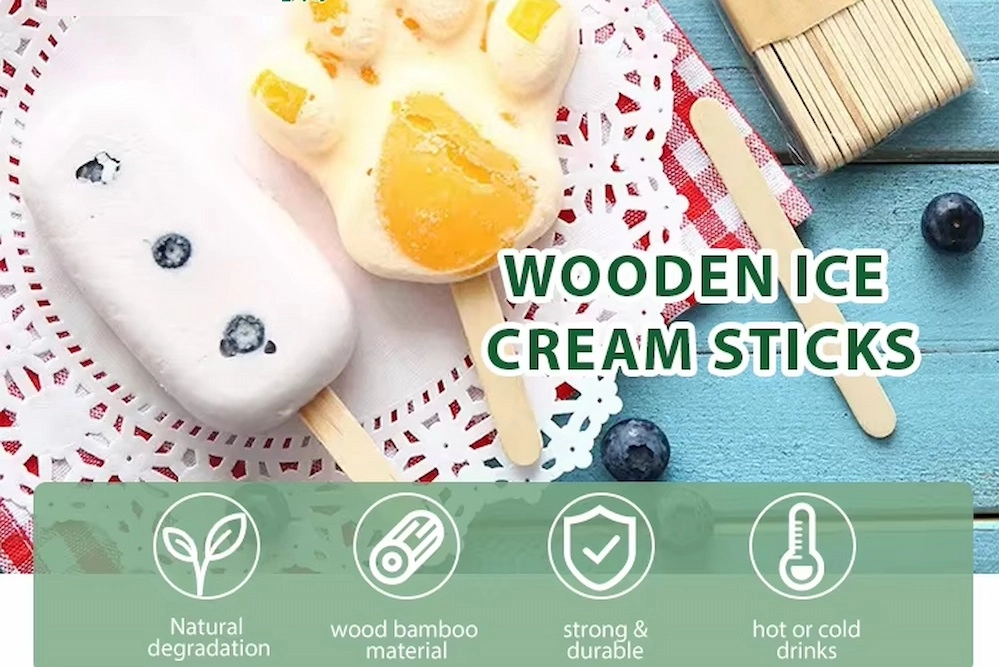
In the crowded frozen dessert retail market, packaging and product details determine shelf conversion. Most ice cream and popsicle brands focus on box packaging and flavor innovation but overlook one high-impact branding touchpoint: custom ice cream sticks. Your wrapper gets tossed away within seconds after opening, but the wooden ice cream stick stays in the customer’s hand throughout the whole eating experience. Every bite keeps your brand logo visible. This long-lasting exposure makes custom popsicle sticks a low-cost, free brand asset. It delivers consistent brand exposure on store shelves, in customer photos, and across social media. For retail packs, private-label lines, and seasonal promotional products, stick customization is a low-cost, high-return upgrade to elevate product grade and brand recognition. This guide breaks down every customizable element, available crafting techniques, retail-oriented design tips, material and color selection, certification, order specifications and best practices for frozen dessert brands and retailers. Why Custom Ice Cream Sticks Matter for Frozen Dessert Brands 1. Brand stays in consumers’ hands Ice cream packaging is quickly discarded once opened. But a custom printed popsicle stick remains with your customer while they enjoy the frozen dessert. Your logo is front and center during consumption — this prolonged brand impression beats many other one-time packaging elements. 2. Stand Out on Crowded Retail Shelves Frozen food shelves are filled with similar-colored packaging. A branded stick with your logo, brand color, or unique shape creates instant visual differentiation. When consumers pick up your ice cream, the custom stick reinforces brand memory at the final consumption moment. 3. Build Premium & Trustworthy Brand Image Standard generic sticks feel ordinary and mass-produced. Custom polished, splinter-free, branded sticks signal strict food-grade standards and refined product details, helping brands justify premium pricing and build consumer trust. 4. Free Organic Marketing & Social Sharing Consumers often take photos of ice cream before eating. A distinct custom stick becomes a natural social media element, driving organic shares, user-generated content (UGC), and word-of-mouth promotion with zero extra advertising cost. 5. Support Private Label & Seasonal Retail Campaigns Custom sticks allow retailers and brand owners to launch limited-edition, holiday-themed, or co-branded products without modifying ice cream molds or production lines, greatly improving market flexibility. 6. Eco-friendly selling point for modern shoppers Our wooden ice cream sticks are biodegradable and disposable, aligning with today’s consumer demand for sustainable packaging. This eco feature works great on retail product labeling and brand storytelling. Core Customization Options for Ice Cream Sticks We categorize customizable items into size & shape, material, branding craft, and packaging, covering all needs for mass retail and high-end customization. 1. Size & Shape Customization Different frozen desserts require matched stick specifications to avoid breakage, sinking, or unstable holding. Common standard and custom sizes cover mainstream retail demands: Standard lengths: 60mm, 70mm, 93mm, 114mm, 140mm for popsicles, bar ice cream, and family pack desserts Short sticks: customized small sizes for mini ice cream, kids’ desserts, and cup soft-serve Shape customization: flat polished edges, round ends, square ends, and special shapes (heart, arc, tailored cutouts for limited editions) Thickness upgrade: thickened or double sticks for heavy, large-volume ice cream bars to prevent breakage during freezing and transportation All size and shape customizations are compatible with existing food production equipment, requiring no mold replacement for brands. 2. Material & Color Customization Material determines safety, texture, sustainability, and retail positioning. Two mainstream materials for commercial customization: Birch wood sticks: smooth, splinter-free, stable texture, low cost, ideal for mass retail daily sales, fully food-contact safe and widely certified Bamboo sticks: renewable, fast-growing, fully compostable, perfect for eco-friendly brand positioning, green marketing campaigns, and high-end organic dessert lines Both materials support high-temperature freezing and humid frozen warehouse storage, resisting deformation and fiber lifting after thawing. Beyond natural wood tone, we can produce colored popsicle sticks. You can match your brand palette for limited-edition retail packs, kids’ dessert lines, or seasonal promotions. 3. Branding & Printing Customization Branding crafts are the core of customized sticks. Choose techniques based on order quantity, design complexity, and budget: Laser engraving: high-precision logo, text, or pattern engraving, no ink contact, 100% food-safe, durable, and fade-proof. Best for premium brands and small-batch high-end lines. Screen printing: cost-effective for large orders, suitable for simple logos, single-color or dual-color patterns, stable color output for mass retail products. Pad printing: flexible for small-batch customization and irregular stick surfaces, ideal for seasonal limited editions and trial orders. Digital printing: supports multi-color, gradient, and detailed complex patterns, perfect for holiday themes, cartoon IP co-branding, and eye-catching retail exclusive designs. Hot stamping: gold/silver foil stamping for luxury texture, upgrading product grade for gift boxes and high-end retail packs. Custom positions include single-sided or double-sided branding to ensure logo visibility from all consumer viewing angles. 4. Retail Packaging Customization For finished retail-ready products, stick outer packaging can also be fully customized: individual sealed packaging, bulk sterile packaging, custom carton logos, and label printing, unifying the overall brand style from internal accessories to outer retail packaging. We provide PPWR-compliant packaging solutions for EU customers to meet European packaging regulatory requirements. Planning Custom Ice Cream Sticks? Confirm size, logo, color and packaging before bulk production. Request Custom Support Order Specifications: MOQ & Production Lead Time When sourcing custom ice cream sticks wholesale, it is important to plan ahead: Minimum Order Quantity (MOQ): 1,000,000 pieces for custom printed or colored custom wooden ice cream sticks Production lead time: 30–45 days after design proof confirmation Our team will arrange pre-production proofing before mass manufacturing to verify color, logo and dimensions. Design Tips for Retail-Focused Custom Popsicle Sticks for Retail Packs 1. Keep Brand Design Concise & Recognizable Stick surface space is limited. Avoid overly complex patterns. Prioritize core brand logos, brand slogans, or iconic brand colors to ensure instant recognition at a glance. 2. Match Seasonal & Marketing Themes Launch themed custom sticks for summer promotions, Christmas, Halloween, and holiday limited packs. The subtle accessory upgrade can greatly improve product topicality and collection value, stimulating consumer repurchase. 3. Prioritize Food Safety & Practicality All customized printing inks and engraving processes must comply with food contact safety standards. Avoid rough edges and burrs to ensure a safe and comfortable eating experience, eliminating consumer safety concerns. 4. Balance Custom Cost & Shelf Effect For daily mass sales, choose screen printing and standard sizes for cost stability; for high-margin limited editions, select laser engraving, digital printing, colored sticks or special shapes to maximize premium value. 5. Plan timelines early With a 30–45 day lead time, finalize your custom stick design well before your product launch or seasonal campaign. How the Custom Order Process Works 1. Confirm the Application The supplier first needs to understand whether the sticks are for frozen dessert production, retail packs, food-contact use, craft packs, DIY kits or promotional products. This affects material, color, size, packaging and document requirements. 2. Confirm Size and Shape Buyers should provide the target dimensions or send mold/product information for reference. For ice cream bars and popsicles, mold fit and handle exposure are especially important. 3. Review Logo and Packaging If the project includes logo printing, colored sticks or private label packaging, buyers should send artwork files, color requirements and packaging expectations early. Simple designs usually work better on small wooden surfaces. 4. Approve Samples Samples help buyers check size, smoothness, logo effect, color, packaging and practical usability. For frozen dessert brands, the sample should be tested with the real mold or product whenever possible. 5. Start Bulk Production and Delivery After sample approval, the buyer confirms quantity, carton packing, shipping marks and delivery plan. For custom ice cream sticks, Ancheng’s MOQ is 1,000,000 pcs and the lead time is generally around 30-45 days. Common Mistakes to Avoid in Stick Customization 1. Overlooking material moisture resistance: ordinary low-quality sticks easily deform and lift fibers in frozen environments, damaging product reputation 2. Overly complicated designs leading to blurry printing and increased defective rate 3. Ignoring minimum order quantity (MOQ) requirements, causing inventory waste for brands 4. Inconsistent color matching between stick printing / colored sticks and retail packaging, resulting in disjointed brand visual effects 5. Forgetting regional packaging rules: If selling in EU markets, confirm PPWR packaging requirements with your supplier upfront. Why Choose Ancheng as Your Ice Cream Stick Manufacturer Ancheng supports one-stop customization from size, shape, material, and branding to retail packaging, with stable food-grade certification, consistent batch quality, and flexible MOQ solutions for enterprises. As a reliable manufacturer, Ancheng provides strict quality inspection for smooth, splinter-free sticks, stable freezing resistance, and professional pre-production design proofing to avoid mass production errors, ensuring retail product stability and brand consistency. From concept design to finished bulk shipment, we provide a one-stop custom wooden sticks service for private label frozen dessert brands. Ready to implement custom ice cream sticks? Natural or colored sticks with private label packaging support. Contact Ancheng Today FAQ 1. Can Ancheng make custom ice cream stick sizes for my mold? Yes. Ancheng supports custom sizes for wooden ice cream sticks. Buyers should provide target dimensions, mold information, product type and sample requirements before confirmation. 2. Can I print my logo on wooden ice cream sticks? Yes. Ancheng supports logo printing or marking according to the artwork and sample result. Buyers should confirm logo size, position and visual effect during sample review. 3. Can colored popsicle sticks be used for food products? Colored popsicle sticks can be supported, but buyers should confirm the intended food-contact application before production. For craft, DIY and education retail packs, color options can be planned around the desired pack style. 4. What is the MOQ for custom ice cream sticks? Ancheng’s MOQ for wooden ice cream sticks is 1,000,000 pcs. Final details depend on size, color, logo and packaging requirements. 5. How long is the lead time for custom ice cream sticks? Lead time is generally around 30-45 days after order details and samples are confirmed. The final schedule may vary by customization level and production arrangement. 6. Can Ancheng make private label retail packs? Yes. Ancheng can support retail packs, private label packaging and carton marks according to buyer requirements. Buyers should prepare pack count, artwork, label requirements and target sales channel. 7. Should I choose bulk cartons or retail packs? Bulk cartons are suitable for factories and distributors that use or repack the sticks. Retail packs are better for supermarkets, ecommerce, craft channels, DIY kits and private label consumer products. Conclusion Custom ice cream sticks are a low-cost, high-value branding tool for frozen dessert brands. Unlike quickly discarded packaging, custom popsicle sticks keep your brand in customers’ hands while they enjoy your product. Through targeted customization of size, material, custom color, printing craft, and retail packaging, brands can achieve shelf differentiation, premium image building, and free social marketing. Whether for daily retail mass sales, private label cooperation, or seasonal limited-edition promotions, personalized ice cream sticks bring lasting brand value and market competitiveness. Related Products Mini Wooden Popsicle Sticks 2.4’’ Wooden Ice Cream Sticks 2.6’’ Bamboo Popsicle Sticks 3.5’’ Bamboo Ice Cream Stick 5.5’’
2026-09-14
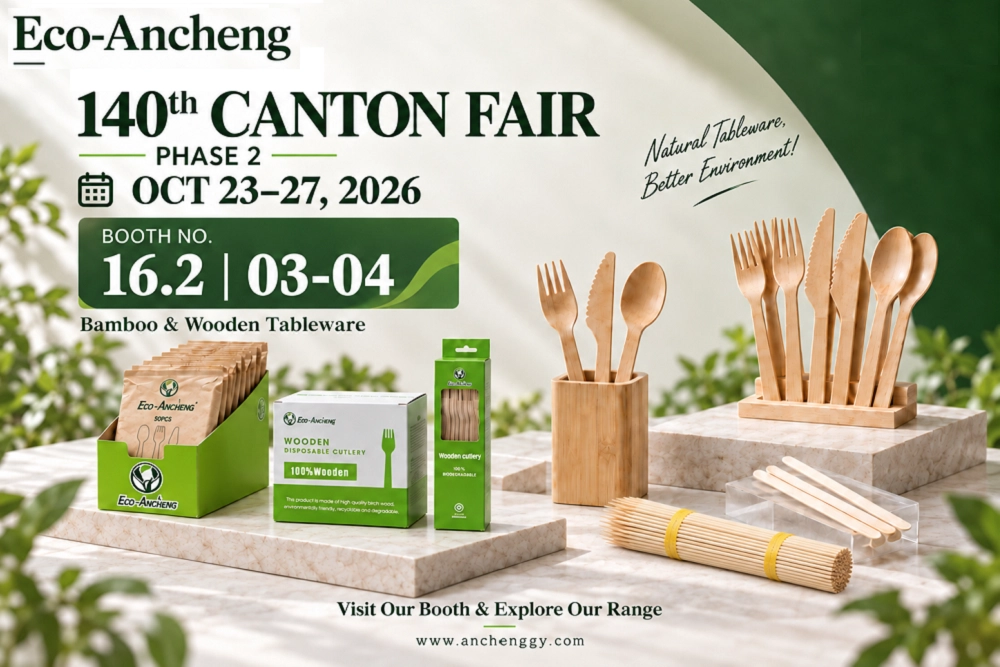
Planning your sourcing trip to the 140th Canton Fair? Meet Eco-Ancheng in Phase 2! As a leading manufacturer and exporter of eco-friendly disposable tableware and sustainable food service packaging, we are excited to invite global buyers and partners to explore our latest collection. Event Details & Booth Location Connect with our team in person to discuss your wholesale and custom packaging requirements: Dates: October 23–27, 2026 Phase: Phase 2 (140th Canton Fair) Booth Number: 16.2I03-04 Explore Our Comprehensive Sustainable Tableware Range At our exhibition space, you will have the unique opportunity to experience our premium eco-friendly product lines firsthand. We specialize in sustainable alternatives that help businesses reduce their environmental footprint without compromising on quality or durability. Product Category Key Offerings & Materials Wooden & Bamboo Cutlery High-quality birchwood and bamboo knives, forks, spoons, and sporks. Durable, smooth, and splinter-free. Bamboo Chopsticks Eco-friendly disposable chopsticks crafted from natural bamboo, offering hygienic and sturdy performance. Toothpicks & Skewers Natural bamboo toothpicks and decorative food skewers for appetizers, grilling, and culinary presentation. Disposable Takeout Containers & Meal Boxes Eco-conscious lunch boxes and food packaging solutions designed for secure food transport and presentation. Coffee Stirrers & Straws Uniform wooden coffee stirrers and natural alternative straws built to withstand hot and cold beverages. Custom Packaging Solutions Tailored branding, custom box designs, and flexible bulk retail packaging to match your market needs. Why Meet With Us at the Fair? Navigating the global shift away from single-use plastics requires a reliable manufacturing partner who understands international compliance, quality control, and scalable supply chains. When you visit our booth, you can: 1. Examine Product Quality Firsthand: Feel the strength, finish, and texture of our sustainable tableware lines. 2. Discuss Custom OEM/ODM Orders: Talk directly with our team about custom dimensions, private-label branding, and specific packaging requirements. 3. Secure Flexible Wholesale Solutions: Learn about our competitive factory-direct pricing and mixed container shipping options. Extend Your Sourcing Trip: Visit Our Factory In addition to meeting our team at Booth 16.2I03-04 during Phase 2 of the Canton Fair, we warmly invite international clients and partners to schedule a visit to our manufacturing facility. Seeing our production lines, raw material selection, and rigorous quality control processes firsthand provides complete confidence in our ability to support your long-term supply chain needs. Book a Meeting in Advance To ensure our team can dedicate ample time to discuss your business objectives and custom inquiries, we welcome you to book a consultation ahead of time. Send us a message or contact our sales department directly to reserve a specific meeting slot at our booth. We look forward to meeting you in Guangzhou! Let’s Meet at the 140th Canton Fair! Secure your spot at Booth 16.2I03-04 to explore premium tableware solutions. Book a Meeting with Us A look back at our last Canton Fair: A Perfect Finale: Ancheng at the 139th Canton Fair
2026-09-14
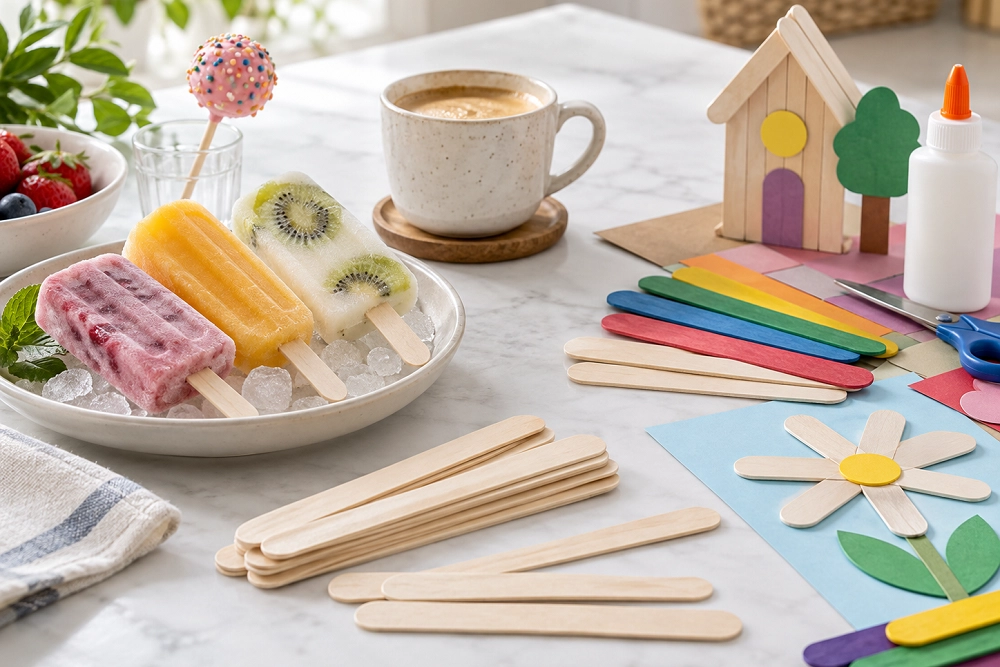
Learn the difference between food grade wooden sticks and ordinary craft sticks, and how B2B buyers choose wooden sticks for food, craft, DIY and retail channels. Wood sticks look simple at first glance. A wooden ice cream stick, a wooden craft stick and a wooden lollipop stick may all appear to be small flat pieces of wood with rounded edges. For B2B buyers, however, the final use makes a major difference. If the stick touches ice cream, candy, cake pops, coffee or food samples, it should be sourced as a food-contact product. If it is used for school projects, model making or craft retail packs, surface smoothness, size consistency and safe handling still matter. This comprehensive buying guide will thoroughly explain the essential differences between food-grade wooden sticks and ordinary craft sticks, clarify industry compliance rules, analyze common purchasing risks, and provide professional inspection standards for bulk orders. As a professional birch wood stick manufacturer with complete international food safety certifications, Ancheng adopts a unified full food-grade production standard for all products, including both natural wooden sticks and colored craft sticks, helping global buyers avoid sourcing traps and obtain stable, safe, and high-quality bulk wooden stick supplies. What Are Food-Grade Wooden Sticks? Food-grade wooden sticks refer to wooden accessories specially produced and certified for direct food contact scenarios. They are mainly used in commercial frozen food production, dessert making, food decoration, and edible product packaging. Unlike ordinary wooden products, food-grade wooden sticks must strictly comply with international food contact material regulations throughout the entire production process, from raw material screening to finished product packaging. An eligible bulk food-grade wooden stick must meet the following core production standards: 1. Strict Premium Birch Wood Raw Material Screening Qualified food-grade sticks only select high-quality natural birch wood as the core material. Birch wood features low resin content, uniform wood texture, low moisture content, and no peculiar smell. During the raw material selection stage, manufacturers need to eliminate deformed, mildewed, cracked, and high-water-content wood materials to ensure the foundation of food safety. Strict raw material screening also ensures that the finished wooden sticks are not easy to break, deform, or breed bacteria during long-term transportation and storage. 2. Complete High-Temperature Sterilization Process All Ancheng food-grade wooden sticks undergo a professional high-temperature sterilization process before leaving the factory. This step completely removes residual bacteria, microorganisms, and organic impurities on the wood surface, ensuring that each batch of products meets food hygiene standards. Ordinary craft sticks do not have this core sterilization process, which is the biggest safety gap between the two types of products. 3. Precision Polishing and Strict Dimensional Tolerance Control Food-grade wooden sticks for commercial factory production need to adapt to automated assembly lines. Therefore, the surface polishing and dimensional error control are extremely strict. All edges and corners are finely polished to avoid burrs, sharp edges, and wooden thorns. The unified dimensional tolerance ensures that the sticks will not jam the machine, damage production equipment, or affect the yield rate of finished food products during mass automated production. 4. Complete International Food Safety Certification System Formal export food-grade wooden sticks must support multiple international food safety certifications to meet the customs inspection and market access requirements of different countries and regions. Ancheng’s full range of wooden sticks is certified by FDA, LFGB, DGCCRF, and BRCGS, covering mainstream markets in Europe, America, Southeast Asia, and the Middle East, which can fully meet the compliance requirements of global bulk orders. 5. Hygienic Dust-Proof Export Packaging Food-grade wooden sticks adopt independent dust-proof and moisture-proof carton packaging to avoid secondary pollution during long-distance ocean transportation and warehouse storage. The standardized 10,000pcs/ctn packaging specification not only ensures product hygiene but also optimizes container loading efficiency and reduces overall logistics costs for bulk buyers. Need Food Grade Wooden Sticks in Bulk? Wood sticks for ice cream, lollipops, foodservice, craft and retail channels. Explore Our Eco-Catalog What Are Craft-Grade Wooden Sticks? Ordinary craft-grade wooden sticks are universal wooden accessories developed for daily manual creation, student art courses, model making, and ordinary DIY projects. Positioned as ordinary industrial and handicraft accessories, they do not have strict food safety production requirements and are only suitable for non-food contact scenarios. Most suppliers in the industry produce craft-grade sticks with cost reduction as the core goal, so their production standards are significantly lower than food-grade products: In terms of raw materials, craft sticks usually use common miscellaneous wood or low-grade wood materials with loose texture and unstable moisture content, which cannot avoid natural defects such as wood knots and fine cracks. In terms of technology, only simple rough polishing is carried out, and fine burrs and uneven edges are allowed. More importantly, ordinary craft sticks do not have a mandatory sterilization process, and there may be residual microorganisms and bacteria on the surface. Food-Grade Wooden Sticks VS. Ordinary Craft Sticks For bulk purchasers, the difference between food-grade and craft-grade sticks is not in appearance, but in production logic, safety standards and market applicability. The following detailed comparison table covers all core evaluation dimensions of B2B bulk orders, helping buyers quickly complete product screening and supplier evaluation. Evaluation Dimension Food-Grade Wooden Sticks Ordinary Craft-Grade Sticks (Other Suppliers) Raw Material Selection High-quality pure birch wood, low resin, low moisture, no mildew, no impurities Ordinary mixed wood, loose texture, unstable quality, allow minor defects Sterilization Process Professional high-temperature sterilization, microbial removal treatment No mandatory sterilization process Surface Treatment Fine full polishing, no burrs, no sharp edges, smooth and safe Simple rough polishing, partial burrs and uneven edges are acceptable Dimensional Tolerance Strict tolerance, suitable for automated food production lines Large error range, only suitable for manual DIY use Safety Certifications FDA, LFGB, DGCCRF, BRCGS full food safety certification No food contact safety certification Packaging Standard Hygienic dust-proof and moisture-proof export carton, no secondary pollution Ordinary logistics carton, no hygiene protection measures Applicable Scenarios Commercial food production + premium children's craft wholesale Ordinary manual crafts only, forbidden for food contact Safety Risk Zero food safety risk, compliant with global market access Bacterial residue risk, non-compliant for food export The key point is simple: food-grade wooden sticks can be used for craft purposes, but ordinary craft sticks should not be assumed suitable for food contact. Can Craft Sticks Be Used for Commercial Food Production? This is one of the most frequently asked questions by bulk buyers, and the unified professional answer is: Ordinary craft sticks cannot be used for any commercial food production and export food products. Many small and medium-sized buyers ignore industry standards because of the low price of craft sticks, and finally face serious losses after shipment. 1. Ordinary craft sticks have not been sterilized, and there may be harmful microorganisms remaining on the wood surface, which will directly cause food contamination and endanger end consumers’ health. 2. European and American customs and market supervision departments have strict inspection mechanisms for food contact accessories. Once uncertified craft sticks are found in food products, the entire batch of goods will be detained, returned or destroyed, resulting in huge economic losses. 3. Once food safety problems occur, buyers will face brand reputation damage, consumer complaints and even legal liability risks. Therefore, for any B2B order involving food contact scenarios, food-grade certified wooden sticks are an indispensable basic requirement and cannot be replaced by ordinary craft sticks. Can Food-Grade Wooden Sticks Be Used for Craft Wholesale Business? Absolutely yes, and it has become a new premium trend in the global craft wholesale industry. With the continuous improvement of global consumer safety awareness, ordinary low-standard craft sticks can no longer meet the market demand of high-end DIY kits, children’s art supplies and premium handmade products. More and more craft wholesalers are beginning to choose food-grade wooden sticks as upgraded accessories. Food-grade wooden sticks have a smoother surface, more uniform specifications, no burrs, no peculiar smell, and pass strict safety certification, which can completely eliminate the safety hazards of children’s manual creation. Ancheng’s colored craft sticks further enrich the product advantages: our colorful sticks are not only bright in color and uniform in coloring, but also use food-safe, environmentally friendly pigments, which maintain full food-grade safety standards while meeting the creative color needs of DIY crafts. It is precisely based on this dual-standard advantage that Ancheng’s wooden sticks can perfectly cover two major B2B markets: industrial food production and premium craft wholesale, helping buyers expand more high-quality business channels. Ancheng Food-Grade Wooden Sticks Solution for Global B2B Bulk Orders As a professional wooden stick manufacturer focusing on global export business, Ancheng abandons the industry’s differentiated graded production mode. All products adhere to the highest food-grade safety standards, bringing stable and reliable bulk supply solutions for global buyers. Core Product Advantages 1. Unified Food-Grade Standard: All natural birch sticks and colored craft sticks are sterilized and certified, dual-purpose for food and crafts. 2. Complete International Certifications: Support FDA, LFGB, DGCCRF, and BRCGS certification documents to meet global market access. 3. High-Quality Birch Wood Material: Natural log processing, smooth texture, strong toughness, not easy to break or deform. 4. Professional Customization Service: Includes size, shape, natural or colored sticks, logo printing, pack count, retail packaging and carton marks. Bulk Order Policy Custom MOQ: 1,000,000 pcs Production Lead Time: 30–45 days Standard Packing: 10,000pcs per export carton, safe and convenient for long-distance transportation Natural or Colored Wooden Sticks? Choose the right stick style for food, craft, education or retail projects Ask for free sample Buyers’ Pre-Shipment Inspection Checklist for Wooden Sticks To help global buyers avoid defective products and non-compliance risks in bulk orders, we have sorted out a complete pre-shipment inspection standard, which can be used as the core evaluation basis for supplier audits and product inspection: 1. Certification Verification: Request suppliers to provide valid food safety certification documents, including FDA, LFGB, DGCCRF and BRCGS, to confirm that the products meet local market access standards. 2. Process Confirmation: Verify that the products have passed formal high-temperature sterilization treatment to ensure no microbial residue. 3. Raw Material Inspection: Check the wood texture, color and surface flatness to ensure no mildew, cracks, knot and peculiar smell. 4. Surface Quality Inspection: All sticks are smoothly polished without burrs, sharp edges and splinters. 5. Colored Stick Special Inspection: Confirm that the pigment is food-safe grade, no fading, no peculiar smell, and compliant with food contact regulations. 6. Packaging Inspection: Check whether the outer packaging is dust-proof, moisture-proof and intact to avoid secondary pollution during transportation. FAQs 1. What is the essential difference between food-grade wooden sticks and ordinary craft sticks? The core difference lies in production standards and safety compliance. Ordinary craft sticks have no sterilization process and food safety certification, only suitable for common manual DIY. Food-grade wooden sticks adopt strict raw material screening, high-temperature sterilization and international certification, which can be safely used for food contact and high-end craft projects. All Ancheng sticks are unified food-grade products without low-grade craft versions. 2. Are common craft sticks on the market food safe? Most ordinary craft sticks from regular suppliers are not food-safe. They lack food contact certification and sterilization treatment, and there are potential bacterial and chemical residue risks, so they cannot be used for commercial food production and export sales. 3. Can Ancheng colored craft sticks touch food directly? Yes. Ancheng colored wooden sticks use food-safe, environmentally friendly pigments and pass the same sterilization and certification process as natural wooden sticks. They are fully compliant food-grade products, which can be used for both DIY crafts and food decoration scenarios. 4. What certifications can Ancheng provide for bulk orders? We can provide complete and valid FDA, LFGB, DGCCRF, and BRCGS food safety certification documents to support global customs clearance and market sales of bulk orders. 5. Why do high-end craft wholesalers prefer food-grade wooden sticks? Food-grade sticks have better surface quality, a higher safety factor, no hidden dangers for children’s use, and complete market compliance qualifications, which can help craft sellers improve product competitiveness, avoid market supervision risks and obtain higher profit margins. Conclusion In the B2B wooden stick sourcing industry, appearance similarity does not represent consistent quality standards. The essential gap between food-grade wooden sticks and ordinary craft sticks determines the safety, compliance and market value of your final products. Choosing unqualified craft sticks for food production will bring huge hidden risks to customs clearance, product safety and brand reputation. Ancheng always adheres to the highest unified food-grade production standard. Whether it is natural birch wooden sticks or colorful craft sticks, all products have passed international authoritative food safety certification and strict sterilization treatment, which can fully meet the dual needs of global food factory mass production and high-end craft wholesale business. If you are looking for stable, compliant, high-quality bulk wooden stick suppliers, welcome to contact Ancheng for free certification consultation, product samples, professional size matching and competitive bulk quotation solutions. Related Products Wooden Craft Sticks 4.5’’ Large Wooden Popsicle Sticks 3.7’’ Wooden Ice Cream Sticks 2.6’’ Wooden Ice Cream Stick Wholesale
2026-09-10

Factory: Qian Renqiao Industrial Park, Shucheng County, Luan City, Anhui Province, China
Office: Building 11, Max Science Park, Shushan Dist, Hefei, Anhui, China
Copyright ©2026 Anhui Ancheng Bamboo and Wood Tableware Co., Ltd. Privacy Policy


 Index
Index Product
 Resources
 About
About