For buyers of eco friendly foodservice supplies, the choice between factory direct sourcing and trading companies depends on scale, customization depth, quality control needs, and compliance risk. Factory direct sourcing offers better cost transparency, stable quality, stronger customization, and clearer accountability, especially for long-term and high-volume procurement. Trading companies can be useful for small orders, mixed SKUs, or teams with limited import experience, but they add layers that reduce traceability. Buyers should evaluate suppliers based on materials, food contact compliance, production capacity, quality systems, and export capability rather than price alone. A manufacturer with direct production and international service capability provides the most balanced solution.
The landscape of the foodservice industry in 2026 is defined by a massive shift away from single use plastics. As governments across the globe implement strict bans on plastic utensils and packaging, the demand for sustainable alternatives has reached an all time high. For businesses involved in the distribution of catering supplies or those running large restaurant chains, the choice of a supplier is no longer just about the lowest price. It is about legal compliance, supply chain stability, and brand reputation.
When you look for a partner to provide eco friendly foodservice supplies, you will encounter two primary types of entities: the factory direct manufacturer and the trading company.

Factory direct sourcing means buyers partner directly with a manufacturing entity that designs, produces and packages eco-friendly foodservice supplies in its own facilities. Such manufacturers hold full control over every production stage, from raw material sourcing to finished product delivery, and maintain in-house teams for research and development, quality control and after-sales service. Ancheng, a leading biodegradable tableware manufacturer specializing in bamboo and wooden disposable tableware, exemplifies this model with a 10000+ square meter factory, 100+ employees and a complete production line covering log processing, molding and packaging.
Trading company sourcing involves working with an intermediary that does not have its own production facilities. Trading companies act as a link between buyers and multiple unassociated manufacturers, sourcing products from various suppliers to fulfill customer orders. Their core value lies in resource integration, offering buyers access to a range of products without the need to contact multiple factories individually. However, they have no control over production processes, quality standards or raw material sourcing for the eco-friendly foodservice supplies they provide.
Eco-friendly foodservice supplies have unique requirements that amplify the differences between the two models. These products must meet strict food safety regulations, sustainable sourcing standards and biodegradability or compostability certifications across different global markets. Unlike standard industrial products, they demand traceability of raw materials, compliance with international food contact standards and consistent quality to avoid regulatory penalties or brand reputational damage. This makes the transparency and control inherent in factory direct sourcing far more valuable for eco-friendly foodservice supply procurement.
When evaluating factory direct and trading company sourcing for eco-friendly foodservice supplies, buyers must assess each channel against core procurement metrics. The following comparison is based on real-world sourcing data and the operational characteristics of leading biodegradable tableware manufacturers and trading companies in the global market.
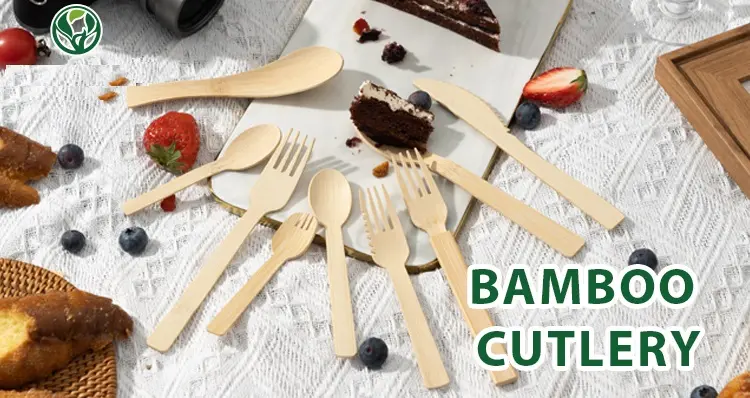
Factory direct sourcing eliminates all intermediate markup layers, offering transparent pricing based on actual production costs and order volume. For bulk orders such as bamboo cutlery wholesale or biodegradable utensils bulk, manufacturers like Ancheng provide tiered pricing structures that lower per-unit costs as order quantities increase. There are no hidden fees, and buyers can negotiate long-term pricing agreements to lock in cost stability for disposable tableware wholesale orders.
Trading companies add their service fees and profit margins to the factory price, resulting in a final cost that is typically 15% to 30% higher for the same eco-friendly foodservice supplies. Pricing is often opaque, with no clear breakdown of production costs, shipping fees or certification expenses. Negotiation space is limited, as trading companies have to maintain their own profit margins while covering the costs of sourcing from multiple factories. For large-volume orders, these cost differences accumulate significantly, impacting a buyer’s overall profit margin for sustainable foodservice products.
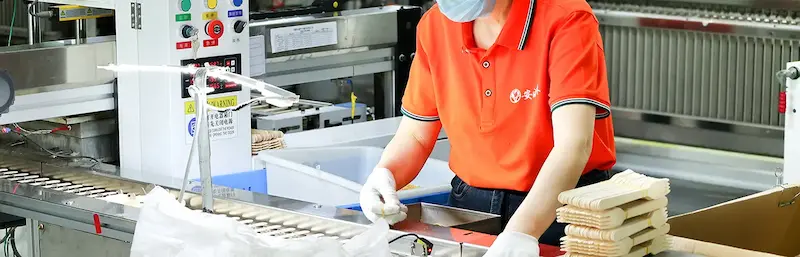
In the foodservice industry, product safety is non-negotiable. Utensils and containers come into direct contact with food, which means they must meet strict hygiene standards. A factory direct manufacturer like Ancheng maintains a rigorous quality control system that spans the entire production cycle.
When a factory manages its own production, it can monitor the moisture content of the wood to prevent mold. They can ensure that the polishing process is thorough so that wooden spoons and forks are smooth and free of splinters. They also manage the sterilization process, ensuring that every batch of bamboo cutlery wholesale orders is safe for consumer use.
Trading companies often struggle with consistency. Since they might source the same product from three different small factories to fill a large order, the quality can vary between boxes. One batch might be perfect while the next has issues with thickness or finish. For a professional buyer, this inconsistency is a risk to your brand. Dealing directly with the source ensures that the product you receive today is exactly the same as the one you receive six months from now.
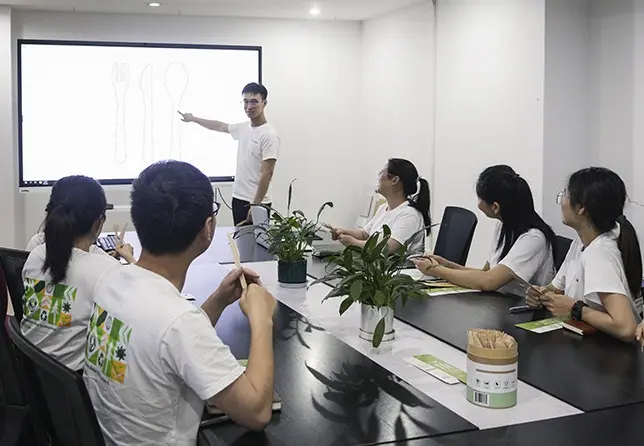
Factory direct sourcing offers full customization flexibility for eco-friendly foodservice supplies, catering to the unique branding and functional needs of buyers. Manufacturers with in-house R&D and design teams can convert buyer ideas into design drawings, complete mold development and produce custom samples in a short timeframe. Customization options cover product shapes, sizes, logos, packaging and even material formulations for biodegradable tableware. Ancheng’s customized service includes rapid sample production and iterative adjustments until the client is satisfied, with the ability to develop bespoke products for specific industries such as airlines and food manufacturers.
A trading company acts as a messenger in this process. They must take your request and explain it to the factory. If there is a misunderstanding, it takes much longer to fix because of the extra layer of communication. Many factories also prioritize their direct clients over orders coming through trading companies. By going direct, you get a faster response for your custom projects and more flexibility in design.
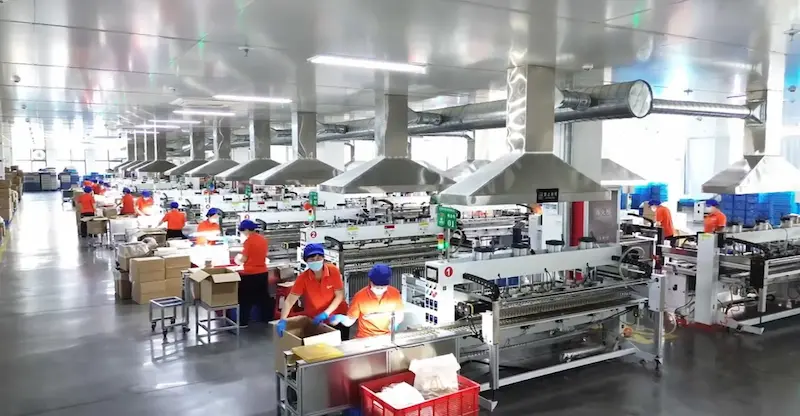
Factory direct sourcing ensures high supply chain stability for eco-friendly foodservice supplies, supported by dedicated production capacity and inventory management. Leading manufacturers maintain large-scale production capabilities to meet peak demand for disposable tableware wholesale orders; Ancheng, for instance, has a monthly production capacity of 2.5 billion pieces, with sufficient raw material stock and automated production lines to avoid supply disruptions. Manufacturers also have the ability to adjust production schedules based on buyer demand, ensuring on-time delivery for long-term contracts.
Trading companies face significant supply chain risks for eco-friendly foodservice supplies, as they rely on multiple independent factories for inventory. Production delays, raw material shortages or quality issues at any one factory can impact order fulfillment, and trading companies have no backup production capacity to mitigate these risks. Inventory levels are often inconsistent, with limited stock for bulk orders and long lead times for restocking. For buyers with regular, large-volume needs for biodegradable tableware, this instability can lead to stockouts and disrupt business operations.
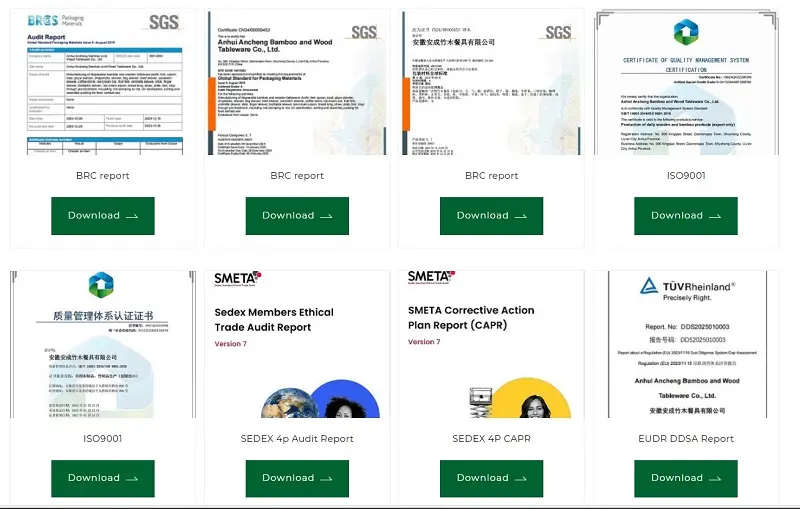
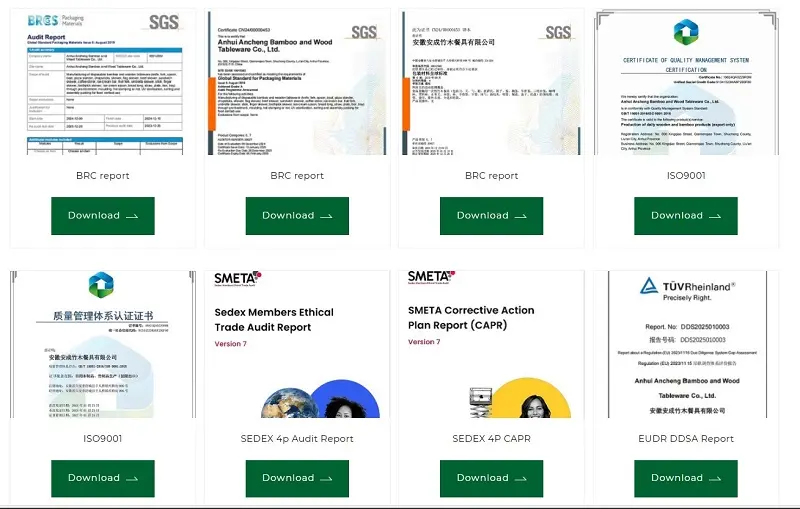
Factory direct sourcing provides complete, verifiable regulatory compliance documentation for eco-friendly foodservice supplies, a critical requirement for global trade. Biodegradable tableware manufacturers hold direct certifications from international bodies and can provide original test reports and compliance documents for their products. Ancheng’s products pass SGS testing and hold certifications including US FDA, EU 1935/2004, LFGB and FSC, with all documentation traceable and updatable to meet the regulatory requirements of different markets such as Europe, North America and the Middle East.
Trading companies typically provide second-hand or copied compliance documentation for eco-friendly foodservice supplies, with no direct access to the original test reports or certification records from manufacturers. Documentation may be incomplete, outdated or not specific to the exact products being supplied, leading to regulatory non-compliance in target markets. Verifying the authenticity of certifications is difficult, and buyers may face customs clearance issues or regulatory penalties due to insufficient or invalid documentation for bamboo cutlery wholesale or biodegradable utensils bulk orders.
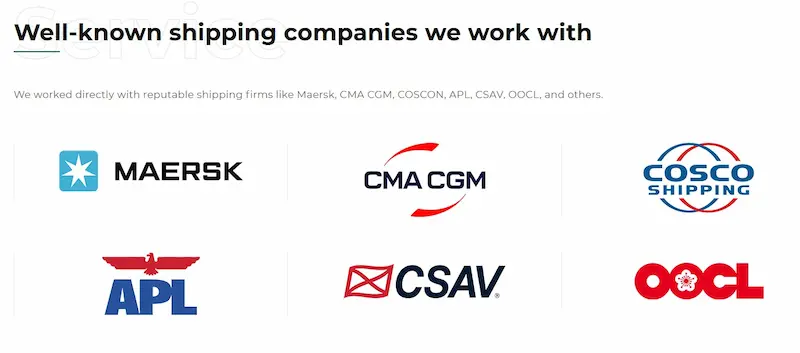
Factory direct sourcing offers flexible, cost-effective logistics and shipping solutions for eco-friendly foodservice supplies, with established partnerships with global freight providers. Manufacturers negotiate long-term shipping contracts with sea, air and land transportation companies to secure favorable rates and reliable delivery services. Ancheng, for example, has long-term cooperation with leading freight companies including MSK, APL, OOCL, COSCO, DHL and UPS, and can tailor shipping solutions to the buyer’s location, order volume and delivery timeline, with full visibility of shipping status and direct coordination for any logistics issues.
Trading companies outsource logistics and shipping for eco-friendly foodservice supplies to third-party providers, with limited ability to negotiate favorable rates or customize shipping solutions. Shipping costs are often higher, as trading companies add their own logistics fees to the actual shipping expenses. Communication for logistics issues is indirect, with buyers having to contact the trading company first, which then relays the request to the logistics provider, leading to delayed resolutions. For international bulk orders of disposable tableware, this can result in longer delivery times and higher shipping risks.

Factory direct sourcing allows buyers to communicate with production engineers, quality managers, and logistics teams. Technical questions receive precise answers, and issues can be traced to root causes quickly.
This is particularly valuable when resolving performance issues or modifying specifications. Clear communication reduces misunderstandings and shortens problem resolution cycles.
Trading companies act as communication bridges. While this can simplify interactions for inexperienced buyers, it also introduces delays and potential misinterpretation.
Technical details may be simplified or lost in translation between buyer, trader, and factory. This increases the risk of specification errors, especially for customized products.
The optimal sourcing channel for eco-friendly foodservice supplies depends on the buyer’s specific needs, including order volume, customization requirements, sourcing timeline and long-term business goals. The following scenario-based strategies help buyers match their needs to the right sourcing model, with actionable guidance for different business types and procurement scenarios.
Buyers with consistently large-volume orders, such as disposable tableware wholesale companies, global retail chains and catering groups, benefit most from factory direct sourcing. These buyers require stable pricing, consistent quality and large production capacity to meet the demands of their own distribution networks. Factory direct partnerships allow for long-term pricing agreements, customized product development for brand differentiation and full control over supply chain reliability. Ancheng’s cooperation with global brands including Starbucks, Tesco, Metro and Costco demonstrates how factory direct sourcing meets the high-volume, high-standard needs of large-scale buyers, with the ability to fulfill monthly bulk orders for bamboo cutlery, biodegradable plates and wooden utensils while maintaining global regulatory compliance.
Buyers with specific customization needs, such as branded foodservice companies, airlines and specialized food manufacturers, must choose factory direct sourcing. These buyers require unique product designs, packaging and branding to align with their brand identity and industry-specific requirements. A biodegradable tableware manufacturer with in-house R&D and design capabilities can translate these needs into tangible products, with the flexibility to adjust designs and production processes as needed. Trading companies lack the technical expertise and direct production control to deliver the customized eco-friendly foodservice supplies these buyers need, and the associated delays and costs make them an unviable option.
Small and medium-sized buyers with low to medium order volumes, short-term sourcing needs or no customization requirements can opt for trading company sourcing, provided they conduct strict supplier verification. These buyers may prioritize convenience over cost, as trading companies offer one-stop access to a range of eco-friendly foodservice supplies without the need for direct factory negotiations. However, buyers must verify the trading company’s factory partnerships, request original compliance documentation and conduct small-batch sample testing before placing bulk orders to mitigate quality and compliance risks. For buyers looking to scale their orders over time, starting with a small factory direct trial order is a viable alternative to build a long-term partnership with a biodegradable tableware manufacturer.
Buyers with emergency sourcing needs, such as last-minute event catering or temporary stock replenishment, can use trading company sourcing for its fast order fulfillment. Trading companies typically maintain small inventories of popular eco-friendly foodservice supplies and can ship orders quickly, without the production lead times required by factories. However, buyers must accept higher costs and limited product options for this convenience, and should still verify basic product quality and compliance for even short-term orders to avoid regulatory issues. For non-urgent short-term needs, factory direct sourcing with a small minimum order quantity is a more cost-effective option for buyers willing to wait for standard production lead times.
For buyers choosing factory direct sourcing for eco-friendly foodservice supplies, thorough due diligence is critical to ensure the manufacturer meets their quality, compliance and supply chain requirements. The following steps provide a structured framework for verifying a biodegradable tableware manufacturer’s capabilities, with a focus on actionable checks for global buyers.
Request detailed factory information including factory size, production lines, employee count and monthly production capacity to confirm the manufacturer can meet your bulk order needs for bamboo cutlery wholesale or biodegradable utensils bulk. Ask for production facility photos or video tours to verify the existence of a complete production line and in-house manufacturing capabilities. For large-scale disposable tableware wholesale buyers, conduct an on-site factory audit to assess production efficiency, quality control processes and raw material sourcing practices in person.
Request original copies of all relevant certifications and test reports for the eco-friendly foodservice supplies, including food safety certifications (FDA, LFGB, EU 1935/2004), sustainability certifications (FSC) and quality management certifications (ISO 9001). Verify the authenticity of certifications by cross-checking with the issuing bodies’ official databases. Ask for product-specific test reports from third-party labs such as SGS to confirm compliance with biodegradability, compostability and food contact safety standards for the exact products you intend to source.
Assess the manufacturer’s in-house R&D and design team capabilities by requesting examples of previous customized eco-friendly foodservice supply projects. Ask about the timeline for mold development, sample production and design adjustments to confirm the manufacturer can meet your customization deadlines. For complex customization needs, request a small prototype sample to test the manufacturer’s technical ability to deliver on your design requirements for bamboo cutlery, biodegradable plates or other disposable tableware products.
Request information on the manufacturer’s raw material sourcing practices to confirm sustainable and stable supply of bamboo, wood and other eco-friendly materials. Ask about backup raw material suppliers and production contingency plans to mitigate supply chain risks such as raw material shortages or production line downtime. Verify the manufacturer’s logistics partnerships and shipping capabilities by requesting examples of previous international shipments to your target market, including delivery timelines, shipping costs and customs clearance support.
Initiate a trial inquiry or small sample order to test the manufacturer’s communication response time and after-sales service quality. Evaluate the manufacturer’s ability to provide clear, timely answers to your questions about product specifications, pricing and shipping. Assess the efficiency of their sample production and delivery process to gauge how they will handle your bulk orders for eco-friendly foodservice supplies. A manufacturer with prompt, professional communication and efficient sample service is more likely to deliver reliable after-sales support for long-term partnerships.
For buyers who choose trading company sourcing for eco-friendly foodservice supplies, proactive risk mitigation is essential to avoid cost, quality and compliance issues. The following steps help buyers minimize risks while leveraging the convenience of trading company sourcing for their sustainable procurement needs.
Request written proof of the trading company’s authorization to source from its partner manufacturers for eco-friendly foodservice supplies. Ask for the contact information of the underlying factories to verify the partnership directly, and confirm that the factories have the necessary production capabilities and certifications for the products you intend to buy. Avoid trading companies that cannot provide clear factory information or authorization documents, as these may be untrustworthy intermediaries with no genuine manufacturing partnerships.
Insist on original, product-specific compliance documentation for the eco-friendly foodservice supplies, including certification copies and third-party test reports directly from the manufacturer. Reject copied or generic documentation, and cross-verify the authenticity of all certifications with the issuing bodies. For bamboo cutlery wholesale and biodegradable utensils bulk orders, ensure the documentation matches the exact product specifications, including material composition, dimensions and production batch information.
Before placing a bulk order, request a small sample batch of the eco-friendly foodservice supplies and conduct independent quality and compliance testing. Test the samples for food contact safety, biodegradability and structural integrity to confirm they meet your standards and regulatory requirements for your target market. For high-risk products, hire a third-party lab to conduct testing to ensure objectivity and accuracy. Only proceed with a bulk order if the sample batch passes all relevant tests.
Draft a detailed contract with the trading company that clearly outlines all terms for the eco-friendly foodservice supply order, including product specifications, quality standards, delivery timelines, shipping costs and payment terms. Explicitly define responsibility for quality issues, shipping delays and regulatory non-compliance, including compensation and product replacement terms. Include a clause that allows for order cancellation or refund if the products fail to meet the agreed-upon standards or regulatory requirements for your target market.
For first-time partnerships with a trading company, limit your initial order volume for eco-friendly foodservice supplies to minimize financial risk. Use the small initial order to test the trading company’s product quality, delivery reliability and after-sales service before committing to a large bulk order. Gradually increase order volume only if the trading company consistently meets your standards for product quality and order fulfillment for multiple consecutive orders.
An optimal sourcing partner combines direct manufacturing with professional export service. This model provides production control, quality consistency, and compliance transparency while reducing the operational burden for buyers.
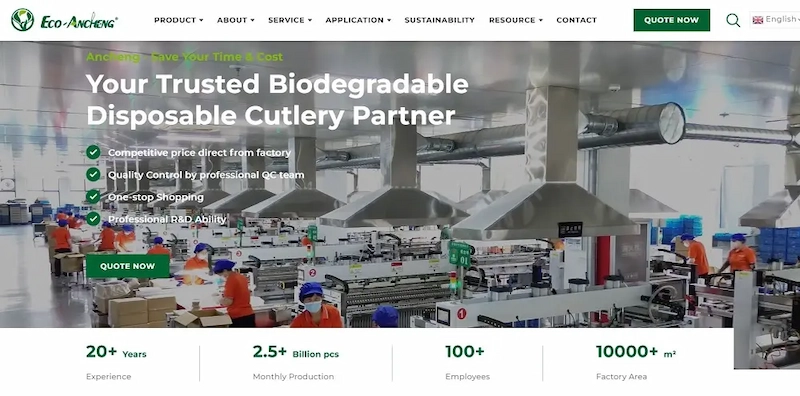
With over 20 years of experience, Ancheng is a leading biodegradable tableware manufacturer that epitomizes the strengths of factory direct sourcing for eco-friendly foodservice supplies. As a one-stop solution provider, we integrate massive production capacity, global regulatory compliance, flexible customization and reliable supply chain services, perfectly meeting the bulk sourcing needs of disposable tableware wholesale, bamboo cutlery wholesale and biodegradable utensils bulk buyers worldwide.
Our 10000+ square meter factory, 100+ employees and complete production line enable a monthly output of 2.5 billion pieces, fulfilling large bulk orders for global clients. We adopt zero-waste production and sustainable forestry sourcing, aligning with global sustainability standards for eco-friendly products.
Quality and compliance are our core. All products pass SGS testing and hold international certifications including US FDA, EU 1935/2004, LFGB, FSC and ISO 9001. Our professional QC team implements full-process quality control with no chemical additives, and we provide original, traceable compliance documents for all orders, ensuring smooth global customs clearance and zero regulatory risks.
Customization is our key advantage. Our in-house R&D and design team delivers rapid mold development and sample production, supporting full customization of product shapes, logos and packaging for branded customers, airlines and food manufacturers— a service unavailable via trading companies, with iterative adjustments until customer satisfaction.
We offer reliable logistics and supply chain support, with long-term partnerships with MSK, APL, DHL and other global freight companies. We provide tailored sea, air and land shipping solutions, real-time production and logistics tracking, and flexible production scheduling for long-term partners to meet peak demand and avoid stockouts.
We also provide value-added services like free samples, tailored product and packaging advice, industry trend updates and quick after-sales responses. Our cooperation with global top brands such as Starbucks, Tesco, Metro and Costco attests to our reliable capabilities in meeting multinational corporations’ high standards for quality, compliance and supply chain stability, a standard we extend to all buyers of all sizes.
The transition to a plastic free world requires reliable partners who are committed to sustainability. While trading companies offer a service, they cannot match the depth of control, the transparency of certifications, or the economic efficiency of a factory direct manufacturer.
In 2026, the successful buyers are those who move closer to the source. By establishing a direct relationship with a manufacturer, you secure the future of your business in an increasingly regulated and competitive global economy.


Hello, I'm Sven Wang, the Manager of Ancheng. With extensive expertise in raw materials and production processes, I'm dedicated to advancing sustainable tableware and constantly improving eco-friendly options for the modern catering industry. You can trust that Ancheng is committed to providing the highest quality. Welcome!

Factory: Qian Renqiao Industrial Park, Shucheng County, Luan City, Anhui Province, China
Office: Building 11, Max Science Park, Shushan Dist, Hefei, Anhui, China
Copyright ©2026 Anhui Ancheng Bamboo and Wood Tableware Co., Ltd. Privacy Policy


 Index
Index Product
 Resources
 About
About