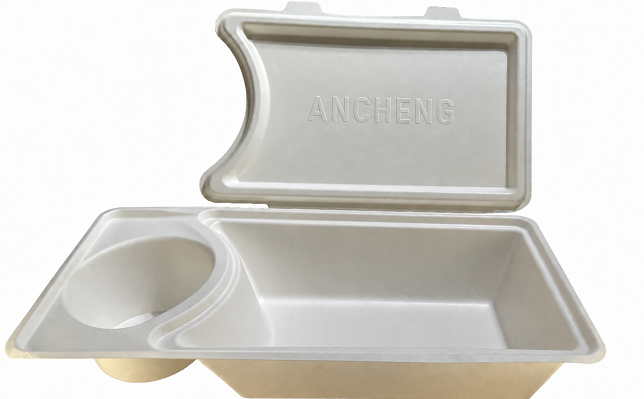
A U.S. Amazon seller approached Ancheng to develop a custom sugarcane bagasse meal box combining a main food compartment and an integrated drink cup holder.
The client required a food container with a hinged lid, a round cup holder and an embossed logo. Because the product would be packed and sold in nested stacks, it also needed to remain compact, easy to separate and stable during packaging and handling.
The first samples confirmed the overall product concept, but testing a packed stack of 25 containers revealed two structural issues: the nested products were difficult to separate without damaging the cup holders, and the cup-holder side did not remain level with the main clamshell section when stacked.
Ancheng adjusted the cup-holder geometry and added supporting bumps to improve both separation and stacking alignment. The customer approved the revised sample package and placed a formal order.
The customer sells food packaging products through Amazon in the United States. To expand its product range, the customer wanted to develop a distinctive molded fiber package that combined a clamshell meal box with an integrated beverage holder.
The product needed to make it easier for consumers to carry a meal and drink together. It also required custom dimensions, a unique structure and a logo formed directly into the mold.
The customer’s proposed product included two connected sections:
- A rectangular clamshell compartment for food
- A round integrated holder for a beverage cup
- A hinged bagasse lid
- Custom product dimensions and shape
- A molded customer logo inside the lid
- A structure suitable for stacking, packing and online distribution
Ancheng translated the customer’s concept into a custom mold and prepared samples for evaluation.
The problem was not obvious when inspecting a single container. It appeared when the products were nested and packed together.
The customer reported that the original 25-piece sample stack could not be separated easily. Pulling the containers apart placed excessive stress on the integrated cup holders and could cause them to tear.
The original cup holder had a top diameter of 8.5 cm and a bottom diameter of 7.5 cm. This relatively small difference produced insufficient taper, causing the cup holders to nest too tightly.
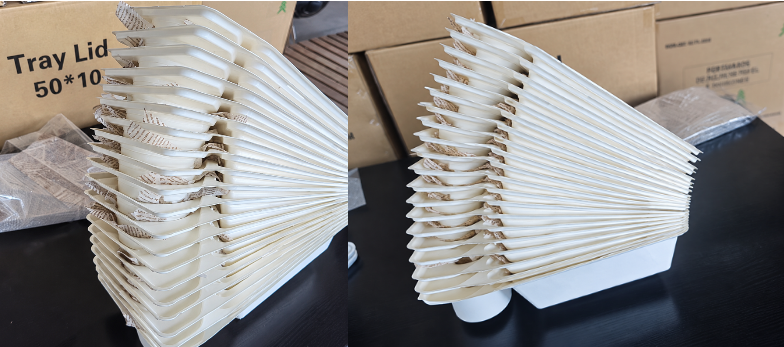
The cup-holder section and the main clamshell section also did not remain fully parallel when the containers were stacked.
Because the cup-holder side sat higher than the main food-container section, the stack could become uneven, with one side higher than the other. This affected packing stability and created uneven pressure on the molded container.
Simply increasing the spacing between every container was not an ideal solution. Excessive gaps between the left and right sections could make the clamshell easier to distort. The revised design therefore needed to improve separation while maintaining sufficient structural support.
Ancheng retained the cup holder’s 8.5 cm top diameter but reduced its bottom diameter from 7.5 cm to 6.5 cm.
The smaller bottom diameter increased the taper of the cup holder, reducing the contact area between nested products and making individual containers easier to separate.
The revised 6.5 cm base remained large enough to support the intended beverage cup while addressing the excessive nesting of the original design.
Ancheng added molded supporting bumps to control the spacing between nested containers.
These bumps helped keep the cup-holder section and the main clamshell section aligned at a similar height when stacked. The revised structure prevented the stack from becoming noticeably higher on one side and lower on the other.
This adjustment improved stacking stability without creating an excessive gap that could weaken or distort the clamshell.
The cup-holder geometry and supporting structures were incorporated into an updated mold design.
The modifications included:
- Retaining the 8.5 cm cup-holder opening
- Reducing the cup-holder base to 6.5 cm
- Increasing the taper for easier separation
- Adding supporting bumps for more level stacking
- Preserving the main food-compartment capacity and overall product format
- Maintaining the custom embossed logo area
The updated design was reviewed with the customer before another sample package was prepared.
A revised sample package of 25 containers was produced so the customer could evaluate the product under the same stacked and packed conditions in which the original issue had appeared.
The evaluation focused on:
- Separation between individual containers
- Cup-holder integrity during separation
- Alignment of the cup-holder and clamshell sections
- Stability of the complete stack
- Compatibility with the intended beverage cup
- Overall molded shape and appearance
The improved samples met the customer’s requirements and were approved.
The revised design resolved the problems identified during the first packed-sample evaluation.
By adjusting the cup-holder taper and adding supporting bumps, Ancheng improved the separation of nested containers while keeping the two sides of the product more evenly aligned during stacking.
The customer confirmed the improved sample package and placed a formal order for the customized bagasse meal boxes.
The final product included:
- A bagasse food compartment
- An integrated beverage cup holder
- Improved nesting and separation
- More stable stacked alignment
- A custom hinged structure
- An embossed customer logo
The project provided the customer with a differentiated food-packaging product designed for its Amazon retail program.
Ancheng supports custom sugarcane bagasse food-container projects for wholesalers, online sellers, foodservice operators and private-label brands.
Our customization capabilities include compartment layout, product capacity, cup-holder structures, lid design, molded logos, custom molds, PET lids and retail or bulk packaging.
Share your intended food format, capacity, dimensions, cup size, order quantity, packaging requirements and destination market. Our team can evaluate the structure and prepare a practical sampling and manufacturing solution.

Factory: Qian Renqiao Industrial Park, Shucheng County, Luan City, Anhui Province, China
Office: Building 11, Max Science Park, Shushan Dist, Hefei, Anhui, China
Copyright ©2026 Anhui Ancheng Bamboo and Wood Tableware Co., Ltd. Privacy Policy


 Index
 Product
 Resources
 About