Wooden cutlery quality control requires looking beyond basic dimensions and surface appearance. A reliable pre-shipment inspection evaluates raw-material condition, moisture content, surface finish, structural forming, functional strength, packaging accuracy, and the critical boundary between natural wood variation and genuine defects.
For bulk buyers, importers, and foodservice brands, the first step is clearly defining rejection criteria. Subjective terms like “smooth,” “natural color,” or “high quality” leave too much room for dispute unless backed by signed golden samples, defect reference photos, and measurable tolerances.
This guide breaks down the most common defects in disposable birch wood cutlery, how inspectors detect them, and how to build a practical inspection checklist before your shipment leaves the factory.
A comprehensive finished-product inspection covers five core areas:
1. Appearance and Hygiene: Mold, contamination, oil stains, open cracks, and abnormal odors.
2. Surface Safety: Splinters, burrs, sharp edges, and rough or incomplete polishing.
3. Dimensions and Forming: Total length, width, thickness, curvature, and functional profile accuracy.
4. Functional Performance: Bending resistance, fork tine integrity, spoon bowl depth, and knife cutting performance.
5. Packaging Accuracy: Piece counts, set composition, wrapper seals, barcodes, labels, and outer carton integrity.
Acceptance criteria should always match the end-use application. A wooden dessert teaspoon does not require the same structural rigidity as a heavy-duty dinner fork, while a takeaway knife must be tested against the specific food it is intended to cut.
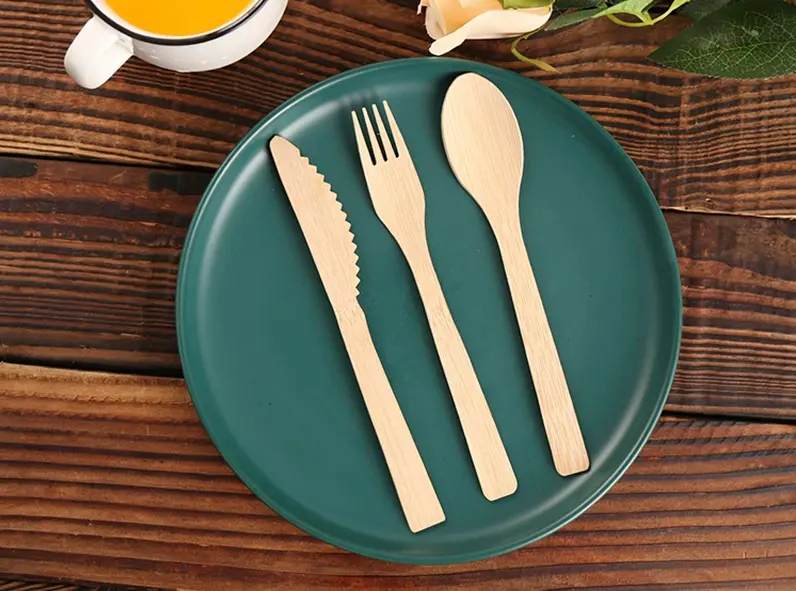
Birch is a natural raw material; grain patterns, wood tones, and minor visual marks will never be 100% uniform across every piece. Attempting to eliminate all natural variation increases sorting waste and unit costs without improving safety or usability. Instead, buyers should establish clear boundaries between acceptable wood characteristics and functional or hygienic defects.
Light variations in natural birch wood tone
Normal, continuous wood grain patterns
Small, closed pin knots or marks that do not weaken the structure
Minor shade differences between individual utensils
Slight cosmetic variations that do not affect dimensions or food contact
Fuzzy, damp-looking, or spreading spots
Green, grey, or black discoloration linked to moisture or odor
Open cracks or splits
Loose or projecting wood fibers
Sharp splinters on any surface or edge
Missing, broken, or incomplete fork tines
Malformed spoon bowls or uneven knife blades
Musty, smoky, or chemical odors
Severe warping or twisting
Dirt, machine oil, or foreign matter
A dark natural grain line is not automatically mold. It becomes a rejection trigger when accompanied by elevated moisture, spreading discoloration, soft/loose fibers, or a musty odor. Always rely on approved and rejected physical reference samples rather than generic labels like “A-grade” or “B-grade,” which lack universal industry definitions.
Review Wooden Cutlery Quality Before Bulk Production
Choose forks, spoons, knives or custom sets with flexible packaging.
In standard B2B quality control, defects are categorized into Critical, Major, and Minor. These classifications must be agreed upon before mass production, as the exact same flaw can carry different severity depending on its location.
Defect Class |
Definition |
Typical Wooden Cutlery Examples |
|---|---|---|
Critical |
Poses a direct health, safety, hygiene, or legal compliance risk to the end user. |
Active mold, insects, foreign matter, sharp mouth-contact splinters, severe contamination, or strong chemical odor. |
Major |
Renders the utensil unusable, structurally weak, or materially non-compliant with specifications. |
Through-cracks, broken fork tines, severe warping, out-of-tolerance dimensions, poor forming, or wrong set composition. |
Minor |
Affects visual appearance slightly without impacting safety, hygiene, or normal use. |
Light cosmetic marks, acceptable natural tone variation, or minor print-position shifts on wrappers. |
A slightly rough patch at the base of a handle may be classified as a Major defect, whereas a sharp projecting splinter on a spoon rim or fork tine is a Critical safety defect.
Use the matrix below to align your internal QC team or third-party inspection agency on what to check and how to verify it:
Defect Type |
Where to Check |
Why It Matters |
Practical Inspection Method |
|---|---|---|---|
Splinters & Burrs |
Both faces, side edges, fork tines, and spoon rims |
Can scratch or injure the user's hands or mouth |
Inspect under bright light; gently wipe surfaces with a clean cloth or gloved hand to detect snagging fibers. |
Cracks & Splits |
Handle, neck, spoon bowl, and knife blade |
May split open or snap under normal eating pressure |
Rotate each sampled piece and inspect both front and back faces as well as all edges. |
Mold-Like Spots |
Entire utensil surface and inside inner bags |
Indicates high moisture, poor drying, or contamination |
Check spot color, fuzziness, surrounding fibers, and smell immediately upon opening packs. |
Warping / Twisting |
Full length of the utensil |
Affects automated packing, stacking, and usability |
Place the utensil on a flat reference surface and compare curvature against the signed sample. |
Broken Fork Tines |
Fork head and tine bases |
Prevents piercing food; creates loose wood fragments |
Count tines on every sampled fork and inspect tips and bases for hairline fractures. |
Poor Spoon Forming |
Bowl depth, rim, and neck transition |
Reduces scooping capacity and liquid/food retention |
Compare bowl depth, symmetry, and reverse-side curvature with the approved sample. |
Poor Knife Profile |
Blade edge and serrations |
Reduces cutting efficiency on intended foods |
Inspect serration uniformity along the full blade and conduct an agreed reference-food cut test. |
Missing Material |
Edges, corners, and formed curves |
Weakens structural integrity or leaves sharp edges |
Compare the full perimeter silhouette against the approved drawing or physical sample. |
Over-Polishing |
Thin edges, tine tips, and bowl rims |
Alters dimensions and makes edges brittle or overly thin |
Measure thickness at critical points and compare edge profile with the golden sample. |
Dust or Residue |
Utensil surfaces and inside inner bags |
Creates an unclean appearance and food-contact hygiene concern |
Shake inner packs and inspect surfaces under angled bright lighting. |
Abnormal Odor |
Utensils and freshly opened inner packs |
Signals moisture damage, smoke exposure, or chemical taint |
Perform a smell check immediately after opening sealed sample bags. |
Incorrect Dimensions |
Length, handle width, head width, thickness |
Impacts packaging fit, dispenser compatibility, and spec compliance |
Measure sampled units using calibrated digital calipers or go/no-go gauges. |
Incorrect Quantity |
Inner bags, retail boxes, and master cartons |
Causes inventory discrepancies and customer complaints |
Count individual pieces in sampled inner packs and verify pack count per carton. |
Damaged Packaging |
Wrapper seals, inner bags, and master cartons |
Exposes wooden cutlery to humidity and contamination in transit |
Inspect heat seals for gaps and check outer cartons for crushing, dampness, or torn tape. |

High-resolution catalog photos rarely reveal tactile surface flaws. Inspectors must evaluate surface quality physically across:
Both front and back faces
All side edges
Fork tine tips and the narrow spaces between tines
Spoon bowl rims
Knife blades and serrated teeth
The neck transition between the handle and formed head
Run a clean, protected hand or lint-free cloth gently along the utensil. Raised fibers that catch or scratch indicate insufficient tumbling or polishing. Conversely, inspectors must watch for over-polishing—excessive material removal can make spoon rims paper-thin or weaken fork tines.
Different utensils fail at different stress points. Tailor your checklist to the exact SKU:
1. Wooden Forks: Verify tine count, alignment, and spacing; check for chipped tips, rough slots between tines, neck cracks, and overall curvature. Test piercing strength on foods matching the end use.
2. Wooden Spoons & Teaspoons: Check bowl depth, symmetry, rim smoothness, and handle straightness. Always inspect the reverse side—a spoon can look properly shaped from the front while having an incomplete curve or thin spot on the back.
3. Wooden Knives: Inspect blade shape, serration consistency, blade thickness, warping, and cracks at the handle-to-blade transition. Evaluate cutting performance against an agreed reference food.
4. Wooden Sporks: Combine spoon and fork criteria—verify both bowl depth and the completeness of the shortened tines. A spork with a good bowl but chipped tines is a functional reject.
5. Pre-Packed Cutlery Sets: Verify utensil combination, piece count, napkin inclusion, condiments/accessories, item orientation, wrapper seal integrity, print alignment, barcode scannability, and absence of foreign debris inside the wrapper.

Inspectors should verify sampled pieces against the approved technical drawing, signed physical sample, purchase order, and packaging specification. Beyond total length, measure functional zones including handle width, spoon bowl depth/width, fork head width, blade thickness, and intended curvature. Acceptable tolerances must be locked in before production begins.
Improper moisture management is the root cause of most post-shipment quality claims. Excess or uneven moisture leads to:
Mold growth inside sealed cartons during ocean freight
Warping, twisting, and dimensional shifts
Cracking and brittleness during use
Musty or sour odors
At Eco-Ancheng, incoming birch veneer is strictly controlled within 8%–12% moisture content, with finished-product targets narrowed further depending on the utensil profile and order specification. Moisture readings should be taken across multiple production stages—incoming raw wood, semi-finished blanks, post-drying/polishing, and finished goods prior to carton sealing—using multi-point batch sampling rather than a single showroom reading.
Visual checks alone cannot detect hidden structural weaknesses. Simple, repeatable on-site tests help catch brittle batches:
1. Manual Bending Check: Gently flex sampled utensils by hand to spot hairline cracks or premature snapping. Use this as a comparative check against your golden sample rather than a formal lab breaking-strength figure.
2. Simple Drop Check: Drop sampled units from an agreed height onto a hard surface to check for chipped edges, broken tines, or splitting.
3. Reference-Food Use Check: Test forks for piercing, spoons for scooping/holding, and knives for cutting using an agreed reference food. Document the exact food type and test method so results remain consistent across batches.
Source Quality-Controlled Birch Wood Cutlery
Define dimensions, surface requirements and packaging checks with our team
Inspecting 100% of a container load is rarely practical. Instead, buyers and third-party agencies rely on statistical sampling under ISO 2859-1:
1. Define the total production lot size.
2. Select the Inspection Level (typically General Inspection Level II).
3. Find the Sample Size Code Letter and required sample quantity.
4. Confirm Critical, Major, and Minor defect definitions.
5. Set agreed AQL thresholds (e.g., Critical: 0, Major: 2.5, Minor: 4.0, adjusted to buyer risk).
6. Pull random samples across multiple cartons and pallets.
7. Tally defects by category and compare against Accept/Reject numbers.
Remember: AQL determines how many defects are allowed in a sample—it does not define what counts as a defect. Without clear defect definitions agreed beforehand, inspectors and factories may classify the exact same wood mark differently.

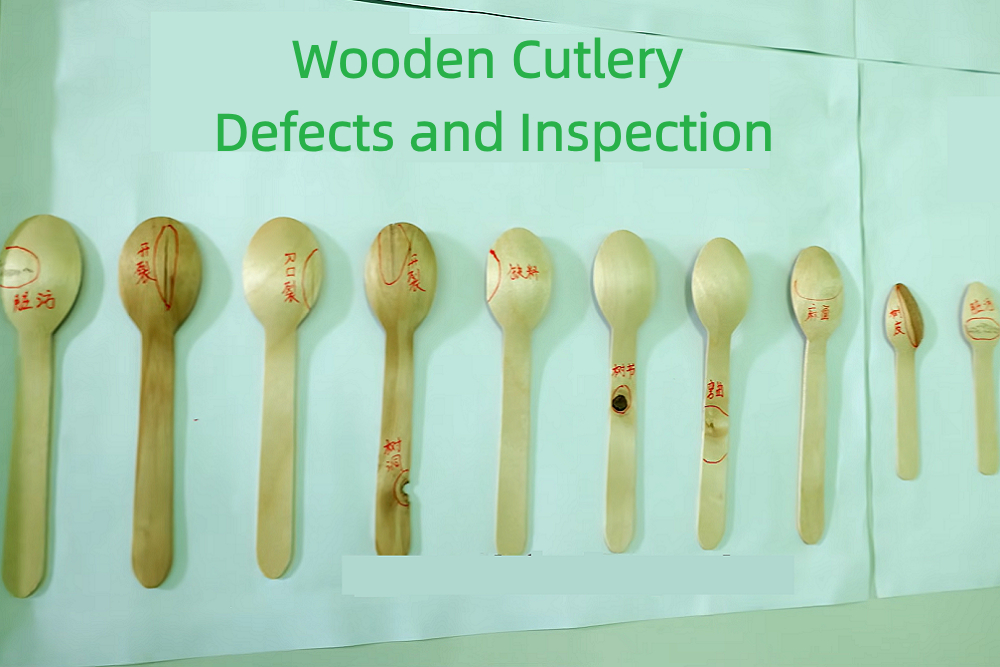
Written descriptions often fall short when evaluating natural wood. In Eco-Ancheng’s inspection workshops, physical examples of non-conforming knives, forks, spoons, and mini utensils are displayed with marked defect zones so sorters and QC staff can recognize recurring flaws immediately. Buyers should still maintain their own signed golden samples and defect photos for order-specific alignment.
Quality checks continue after the utensils pass inspection. Inspectors should pull cartons from different pallets and production shifts to verify:
Inner-pack counts and set compositions
Wrapper cleanliness and airtight/secure seals
Product specs, customer private-label artwork, and batch codes
FSC® certification claims (where applicable)
Barcode scan readability and accuracy
Outer-carton shipping marks, gross/net weight, and moisture condition
A reliable pre-shipment report should document: supplier/factory details, PO and item codes, total lot vs. packed quantities, sampling standard (ISO 2859-1), inspection level, AQL limits, defect breakdown by class, caliper measurements, moisture meter readings, functional test outcomes, packaging/barcode checks, and clear overall scale + close-up defect photos.
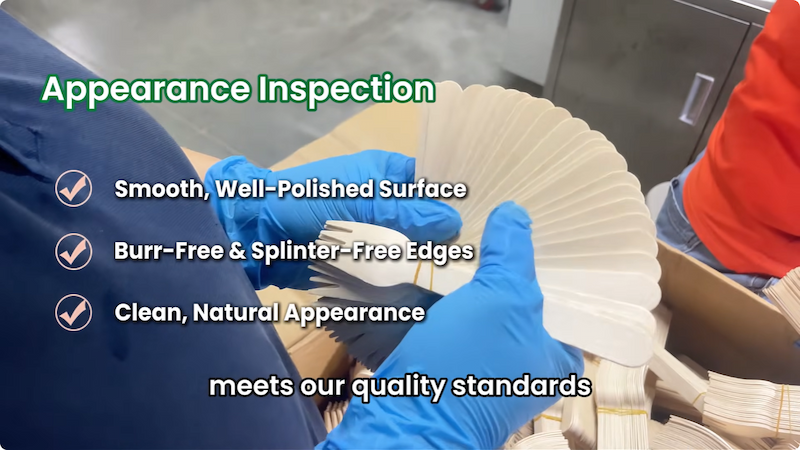
At Eco-Ancheng, quality assurance is built into every stage of production—from raw birch logs to final container loading:
1. Incoming Material Inspection: Every batch of birch wood is inspected before warehousing for dimensions, moisture (8%–12%), insect damage, decay, mold-like stains, bark residue, cracks, and odor. For FSC®-certified orders, wood species, scientific names, supplier certificates, and batch volumes are verified against chain-of-custody records.
2. First-Piece & In-Process Checks: Production begins only after first-piece sign-off, which is repeated after any material batch change, blade replacement, or machine adjustment. QC inspectors conduct routine line checks every two hours covering dimensions, cutting edges, forming, and cleanliness.
3. Polishing & Forming Control: Both faces and all edges are inspected for burrs, splinters, over-polishing, and dust residue, while formed utensils are benchmarked against approved profile gauges.
4. Automated + Manual Defect Screening: Automated sorting is paired with manual visual screening. Rejected pieces are immediately segregated into marked bins to prevent accidental mixing.
5. Finished-Product & Pre-Shipment Audit: Finished lots undergo dimensional, moisture, bending, drop, and food-use checks alongside full barcode, labeling, and carton verification prior to dispatch.
Buyers often confuse laboratory compliance reports with pre-shipment batch inspections, though they serve entirely different purposes:
1. Lab Testing & Regulatory Compliance: Under frameworks like EU Regulation (EC) No 1935/2004 (and FDA food-contact standards), laboratory test reports verify that the birch wood material is safe for food contact—free from harmful chemical migration, sensory taint, or microbiological hazards.
2. Pre-Shipment Batch Inspection: Confirms that your specific production lot meets physical specifications, visual quality, functional strength, packaging accuracy, and carton counts.
A lab certificate for a single sample cannot guarantee that a 40-foot container has zero broken fork tines or accurate box counts. Likewise, a visual inspection cannot replace chemical or microbiological lab testing. Serious bulk buyers rely on both.
Active mold, foreign contamination, strong chemical or musty odors, and sharp splinters on mouth-contact surfaces are the most critical defects, as they pose direct health and safety risks.
Not necessarily. Birch naturally varies in grain and tone. Color variation only becomes a defect when it falls outside your approved sample range or is accompanied by moisture, mold, cracks, or structural weakness.
Inspectors examine both faces and all edges under bright lighting, then gently wipe the utensil with a clean cloth or gloved hand to catch protruding fibers—paying close attention to fork tines, spoon rims, and knife blades.
While exact targets depend on product thickness and destination climate, Eco-Ancheng generally controls incoming birch wood at 8%–12%, with finished products held to strict order-specific moisture limits to prevent mold and warping in transit.
No. AQL is a statistical sampling method rather than a 100% zero-defect guarantee. It provides a transparent, mathematically sound basis for accepting or rejecting a production lot based on agreed risk tolerances.
No. Grade names are not standardized across factories. Always back up your purchase order with a signed golden sample, dimensional drawings, defect reference photos, and written AQL criteria.
Effective wooden cutlery quality control starts well before an inspector opens a carton. By aligning early on material specifications, dimensional tolerances, acceptable wood variation, defect classifications, and AQL sampling plans, buyers can prevent costly disputes and shipment delays.
Eco-Ancheng produces natural, uncoated birch wood forks, spoons, knives, sporks, teaspoons, and custom pre-packed cutlery sets for global foodservice brands and distributors. Contact our team today to request free physical samples, technical specifications, food-contact compliance documents, or tailored pre-shipment inspection support for your next bulk order.
Compare Samples Before Mass Production
Evaluate the finish, dimensions and performance for your foodservice application.

Hello, I'm Sven Wang, the Manager of Ancheng. With extensive expertise in raw materials and production processes, I'm dedicated to advancing sustainable tableware and constantly improving eco-friendly options for the modern catering industry. You can trust that Ancheng is committed to providing the highest quality. Welcome!

Factory: Qian Renqiao Industrial Park, Shucheng County, Luan City, Anhui Province, China
Office: Building 11, Max Science Park, Shushan Dist, Hefei, Anhui, China
Copyright ©2026 Anhui Ancheng Bamboo and Wood Tableware Co., Ltd. Privacy Policy



 Index
 Product
 Resources
 About