For EU foodservice buyers, importers and distributors sourcing single‑use tableware, the EU Deforestation‑free Products Regulation (EUDR, Regulation (EU) 2023/1115) has reshaped procurement decisions for wood‑based disposable cutlery.
Birch wood cutlery delivers lightweight, fine‑textured performance, yet it falls under strict EUDR due‑diligence obligations. 100 % solid bamboo tableware, by official EU delegated act clarification, is explicitly excluded from the EUDR commodity scope as a non‑wood forest product (NWFP). This makes bamboo a compelling option for buyers looking to reduce heavy EUDR administrative burdens.
However, “EUDR‑exempt” does not equal “zero compliance risk”. Many market players mistakenly treat bamboo as a universal regulatory safe harbour. This buyer guide draws on official EU legal texts, FSC‑published guidance, and an independent third‑party gap assessment completed for Chinese manufacturer Anhui Ancheng, to deliver actionable, real‑world sourcing advice for European operators.
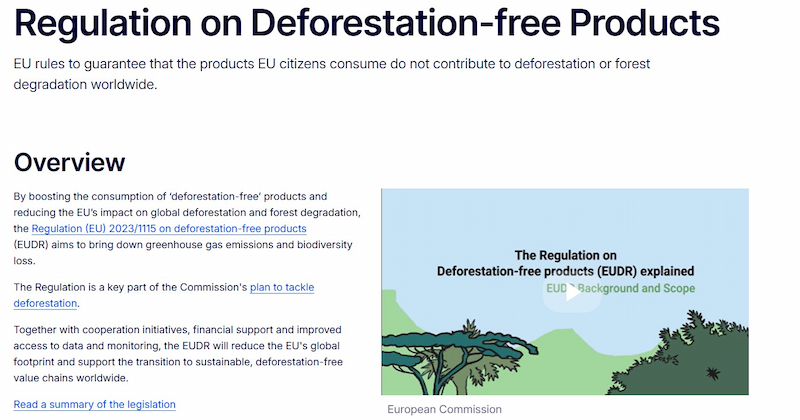
Source: European Commission
EUDR regulates seven core commodities: cattle, cocoa, coffee, oil palm, rubber, soy and wood.
For products within scope, the central conditions are not limited to completing paperwork. The relevant commodity must be deforestation-free, produced in accordance with the relevant laws of the country of production and covered by a due diligence statement where required. For wood, the deforestation-free requirement also addresses forest degradation after the Regulation's cut-off date of 31 December 2020. Buyers should therefore establish both the product scope and the importing company's role and size.
EUDR Key Application Timelines:
1. Large‑ and medium‑sized EU operators: compliance starts 30 December 2026
2. Micro‑small operators previously covered by EUTR: compliance starts 30 December 2026
3. Other micro‑small operators: compliance starts 30 June 2027.
Even before these formal deadlines, major European retailers and foodservice chains already require suppliers to provide traceability evidence for wood‑origin goods in tender and order processes.
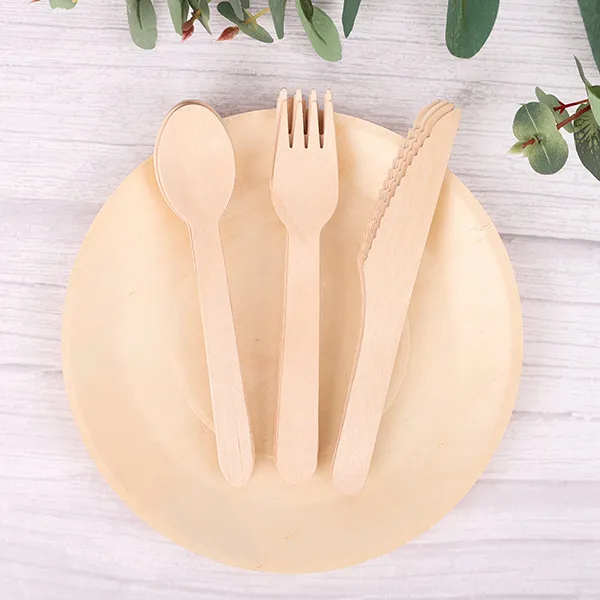
For disposable tableware buyers, two Annex I headings deserve particular attention:
4419: Tableware and kitchenware, of wood
4421: Other articles of wood
Disposable wooden forks, knives, spoons and plates may be classified as wooden tableware. Other smaller foodservice articles, including certain wooden sticks, stirrers, skewers or picks, may be classified differently depending on their design and intended use.
This is why one general statement such as "all disposable wooden products use code 4419" would be unsafe. A wooden spoon and a flat wooden ice cream stick do not necessarily share the same CN code. The importer should confirm the code used in its customs declaration and compare that code with the current Annex I.
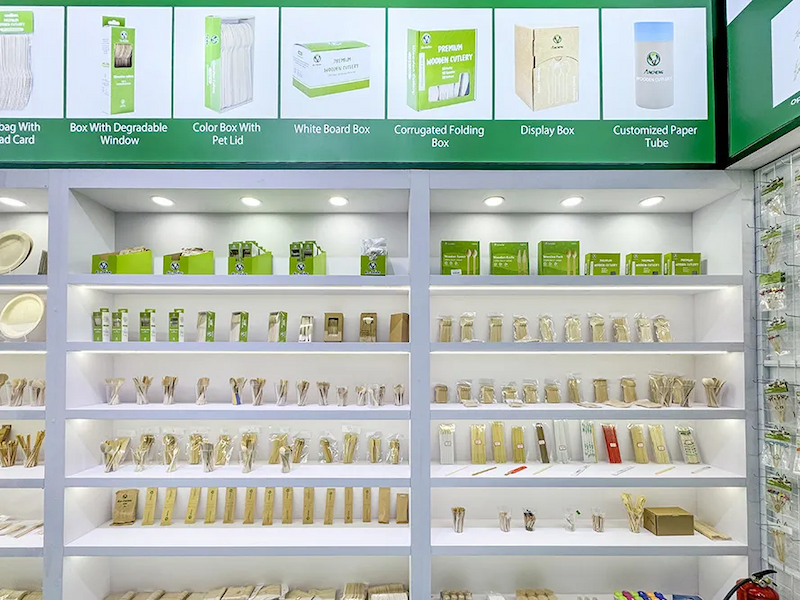
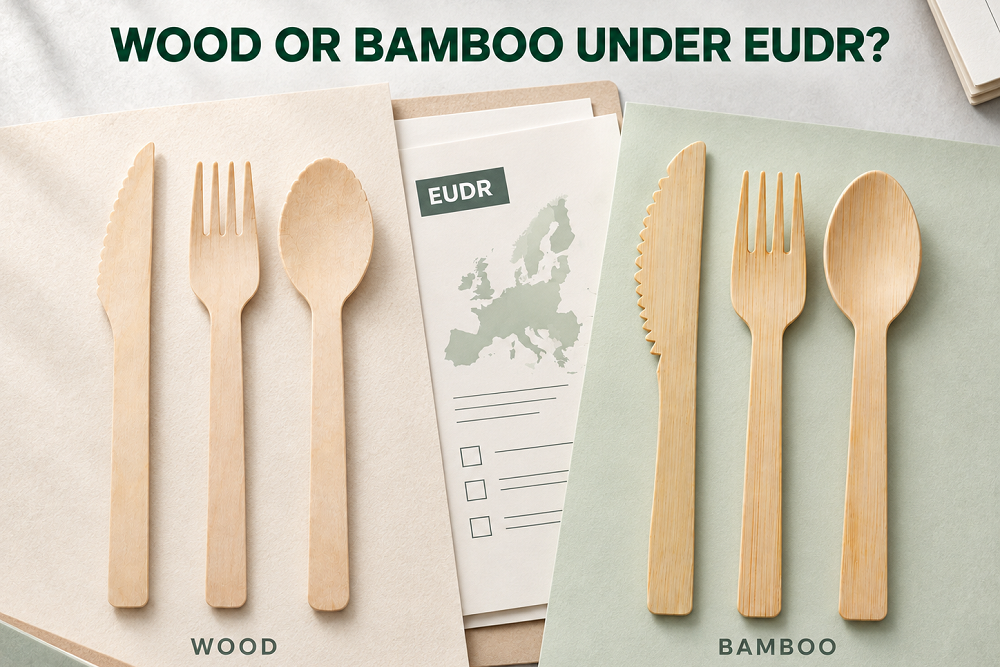
Bamboo is botanically a grass, even though solid bamboo products can look and perform like wooden products. Earlier EUDR discussions caused uncertainty because bamboo tableware can appear within customs chapters commonly associated with wood.
The latest rule is clearer. Commission Delegated Regulation (EU) 2026/2102 adds an Annex I note stating that the EUDR does not apply to bamboo, rattan and other materials of a woody nature, including relevant products to the extent that they are made from those materials.
For buyers, this creates a practical distinction:
1. A 100% bamboo fork is not treated as a wood product merely because it resembles wooden cutlery.
2. A 100% bamboo skewer or pick is not brought into the EUDR wood scope only because customs nomenclature places some bamboo articles in Chapter 44.
3. If an article contains any wood component, that wood portion is fully subject to EUDR obligations. The bamboo fraction does not grant blanket exemption for the whole item.
Ancheng's bamboo tableware is made from 100% bamboo rather than a bamboo-and-wood mixture. This gives buyers a clearly defined material option when comparing EUDR scope, foodservice performance, and documentation needs.
Being outside the EUDR wood scope does not mean that a bamboo product is free from every regulatory requirement. EU buyers still need to review food-contact suitability, product safety, packaging configuration, labelling and any environmental claims made in the target market. It simply means that pure bamboo should not be assigned the same EUDR wood due diligence path as wood.
EUDR should influence a material decision, but it should not be the only deciding factor. Buyers with an established wooden tableware range do not necessarily need to replace it. If the birch supply chain is traceable and the EU operator can manage the required information and DDS process, wood remains a practical choice with familiar appearance, stable production and broad product availability.
Pure bamboo can be attractive when a new programme wants a natural material without placing the product itself in the EUDR wood category. It may also suit brands that prefer a firmer utensil or a more visible bamboo grain. Buyers must still check food-contact documents, specifications, quality and packaging rather than treating EUDR exclusion as a complete compliance shortcut.
Comparing Wood and Bamboo for an EU Program?
Consult with industry experts in Ancheng
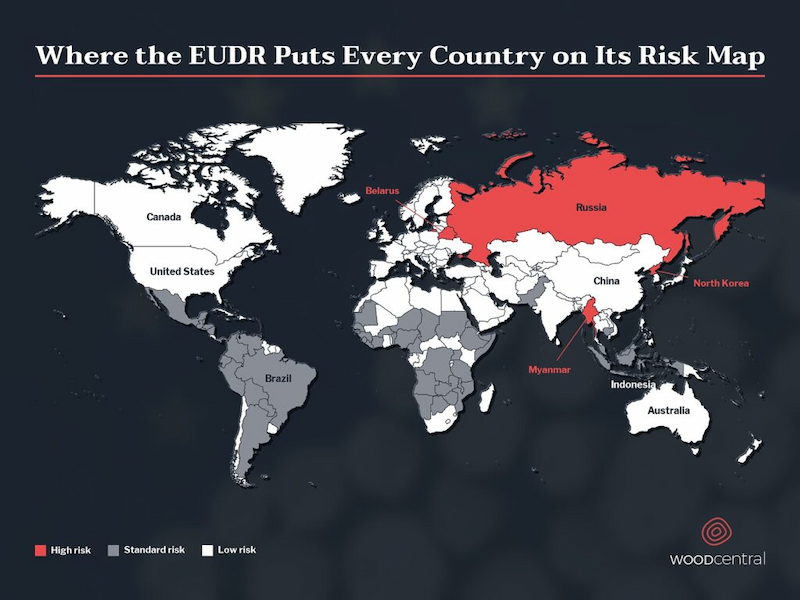
source: Wood Central
China appears in the EU's current list of low-risk countries under the EUDR benchmarking system. This matters because eligible products produced entirely in a low-risk country may qualify for simplified due diligence.
Simplified due diligence is useful, but the phrase can be misunderstood. It does not mean "no due diligence," and it is not an automatic import exemption.
According to the European Commission's country classification guidance, an operator sourcing from a low-risk country may use the simplified route only when it is satisfied that the relevant products were produced entirely in low-risk countries and were not mixed with materials of standard-risk, high-risk or unknown origin.
Under this route, the operator must still meet the Article 9 information requirements and maintain a due diligence system. Enforcement check frequency for low‑risk‑country imports is set at 1 % of operators. The main simplification is that a full Article 10 risk assessment and Article 11 risk mitigation are generally not required unless the operator receives information suggesting non-compliance or circumvention.
For Ancheng's Chinese birch products, the low-risk classification is relevant because the wood comes from China and the tableware is manufactured in China. Buyers should nevertheless verify the shipment-specific source record rather than relying only on the factory address. If a future product uses imported wood harvested in another country, the applicable risk level follows the actual country of production of the relevant commodity, not simply the country where the finished fork or plate was manufactured.
Low-risk sourcing can reduce the depth of the risk-assessment stage, but the underlying product information remains important. For a wooden tableware order, an EU operator may need information covering:
| Information Area | Practical Application to Disposable Wooden Tableware |
|---|---|
| Product description | Identify the product type, item code, dimensions and relevant CN or HS code |
| Wood identification | Record the common species name and full scientific name used in the product |
| Quantity | Match pieces, net mass or other required units with the commercial shipment |
| Country of production | Identify where the relevant wood was produced or harvested, not only where the finished product was packed |
| Geolocation | Obtain the required location information for the plots where the relevant wood was produced |
| Production period | Connect the raw material information with the applicable production or harvest period |
| Legality information | Maintain evidence that production complied with relevant laws in the country of production |
| Supply-chain records | Link suppliers, batches, purchase records and finished orders so that the material can be traced |
| DDS information | The responsible operator submits the due diligence statement and passes the reference information through the supply chain where required |
The exact file should be confirmed for the product and shipment. Buyers should avoid treating an old test report, an FSC logo or a general supplier declaration as a substitute for the complete EUDR information set.
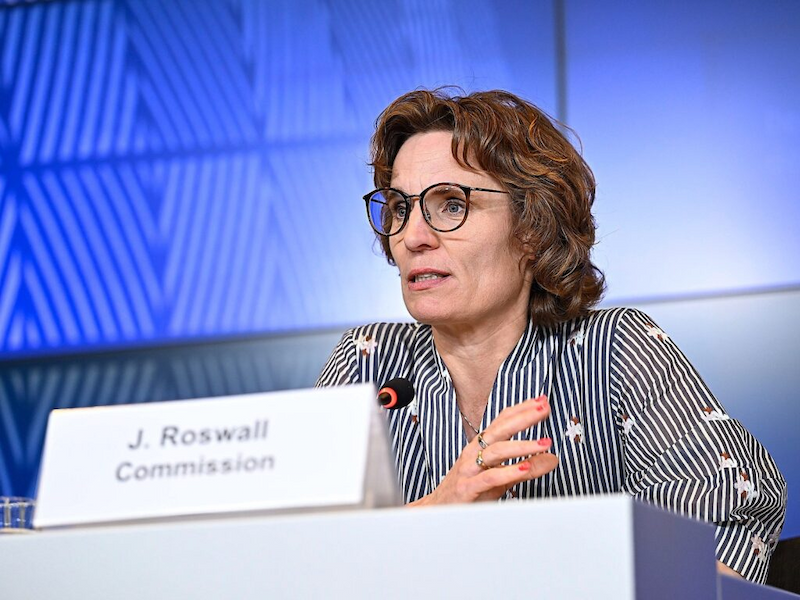
Source: Council of the European Union, CC BY 4.0
For most direct imports from a Chinese manufacturer, the EU company that first places the relevant product on the EU market is the key operator. Once due diligence is complete and the operator has concluded that there is no or only negligible risk, it submits a due diligence statement through the EUDR Information System.
The current rules place the primary submission responsibility on the first operator placing a relevant product on the EU market or exporting it. Downstream operators and traders generally have lighter obligations, although their company size, position in the chain and any substantiated concern can affect what they must verify or retain.
This distinction matters in supplier communication. A non-EU manufacturer can support the process with material, origin, geolocation, legality and traceability information, but that support should not be described as replacing the EU operator's legal responsibility.
The Commission's roles and responsibilities guidance should be checked alongside the legal text when a buyer is uncertain whether it is an operator, downstream operator or trader.
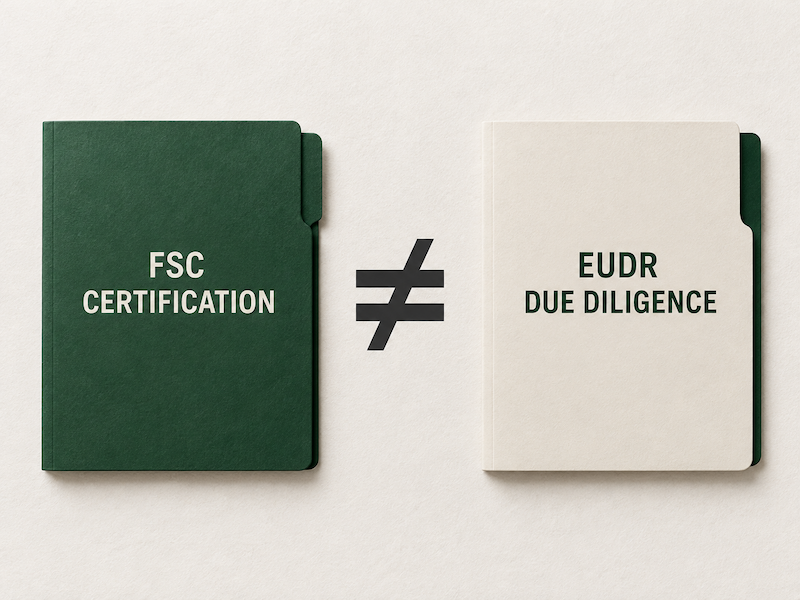
A widespread industry misunderstanding is that an FSC certificate fulfils EUDR legal obligations. According to official FSC guidance: FSC Chain‑of‑Custody or Forest‑Management certification cannot replace EUDR operator due‑diligence, but delivers robust supporting audit evidence.
What FSC traceability can deliver:
Verified botanical Latin species names
Valid FSC certificate numbers per batch
Batch quantity and volume reconciliation
Cross‑checks to align physical goods against purchase contracts, commercial invoices and product‑group lists.
What FSC does not automatically deliver for EUDR:
Geolocation GPS coordinates of each harvest plot
Formal proof that no deforestation occurred after 31 December 2020.
The EU‑based operator remains legally accountable to collect, validate and file all required EUDR Article 9 information, even when sourcing FSC‑certified material. FSC‑verified sourcing substantially lowers supply‑chain risk assessment workload but does not transfer or eliminate EU legal liability.
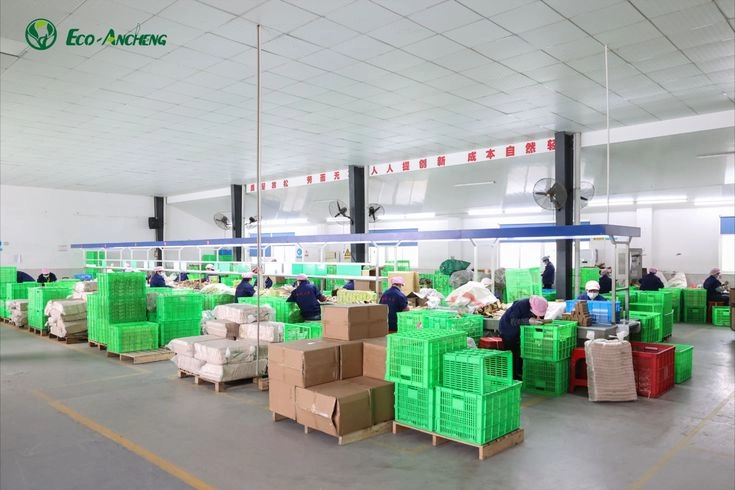
Eco Ancheng has built and implemented a complete internal management system aligned with EUDR requirements, which has undergone independent third‑party assessment.
Key verified system features:
1. Clear organisational roles and responsibilities for the dedicated EUDR due‑diligence team; a formal zero‑deforestation policy is rolled out internally via staff training and communicated to upstream suppliers through formal supplier commitment agreements.
2. Complete supply‑chain mapping is performed on EUDR‑relevant product lines. The factory carries out regular supply‑chain risk assessment and develops documented risk‑mitigation plans accordingly.
3. Physical material segregation on production site: dedicated, clearly labelled raw‑material storage zones and separate production runs for EUDR‑relevant wood‑based products are maintained to avoid cross‑mixing with non‑EUDR materials.
4. Internal audits and formal management reviews are conducted periodically to keep the due‑diligence system effective. A grievance mechanism is established to capture and handle deforestation‑related supply‑chain concerns, and shared with internal teams and business partners.
Please note: Ancheng’s internally established and assessed due‑diligence system enables the factory to compile, verify, and hand over complete traceability packages to EU customers. The Chinese manufacturer does not submit the official EUDR due‑diligence statement; that remains the statutory duty of the European operator.
European small‑to‑mid‑sized foodservice operators and distributors without dedicated compliance teams are actively shifting purchasing volume away from birch‑wood cutlery toward 100 % solid bamboo, to mitigate EUDR administrative overhead. Nevertheless, birch‑wood tableware maintains stable demand within premium foodservice segments thanks to its desirable lightweight tactile qualities.
Large importers & international foodservice chains: equipped with in‑house compliance capacity, continue purchasing wood‑based tableware. Their priority is suppliers that can deliver complete, auditable EUDR traceability packages, with FSC records as added value.
Small‑and‑medium‑sized buyers: primary objective is minimising EUDR regulatory workload. 100 % solid‑bamboo cutlery fits this requirement, yet buyers must not overlook food‑contact material due‑diligence.
Most publicly available EUDR buyer resources only highlight bamboo’s EUDR exemption. Far fewer publications emphasise the residual food‑contact enforcement risks. This creates an information gap: bamboo is a practical path out of EUDR administrative complexity, but it is not a complete regulatory safe harbour.
They may be. Wooden tableware and kitchenware under heading 4419 remain in Annex I. The buyer should confirm the exact classification, wood species and transaction before deciding the applicable obligations.
The 2026 Annex I update expressly excludes bamboo from the EUDR commodity wood. A product made entirely from bamboo therefore does not enter scope merely as a wood product.
No. Low-risk sourcing may allow simplified due diligence, but the operator still has information and due diligence system obligations. The responsible operator must handle the applicable DDS process unless a specific legal exception applies.
The EU company first placing the relevant product on the EU market is generally the operator responsible for due diligence and DDS submission. The non-EU supplier can provide supporting supply-chain information.
Ordinary wood or paper packaging presented with the tableware and used exclusively to support, protect or carry it is generally outside the EUDR scope. However, wooden or paper packaging imported or sold as a product in its own right may be covered if its material and CN classification are listed in Annex I. Buyers should assess the packaging and the tableware separately rather than assuming that one determines the EUDR status of the other.
EUDR fundamentally transforms disposable‑tableware procurement for European buyers. Birch‑wood cutlery delivers excellent product performance yet carries heavy traceability obligations, even when sourced from low‑risk‑country suppliers such as China. 100 % solid bamboo offers a legally‑confirmed EUDR‑exempt pathway, but only when buyers verify genuine solid‑bamboo composition and full EU food‑contact compliance.
Work closely with your manufacturer to clarify documentation deliverables early in the quotation and order cycle. Leverage supplier‑built EUDR‑aligned internal due‑diligence management systems and FSC records as supporting evidence, while never forgetting your organisation’s ultimate legal responsibilities as an EU market operator.
Need to purchase compliant disposable tableware?
Factory prices, high quality, OEM customization

Hello, I'm Sven Wang, the Manager of Ancheng. With extensive expertise in raw materials and production processes, I'm dedicated to advancing sustainable tableware and constantly improving eco-friendly options for the modern catering industry. You can trust that Ancheng is committed to providing the highest quality. Welcome!

Factory: Qian Renqiao Industrial Park, Shucheng County, Luan City, Anhui Province, China
Office: Building 11, Max Science Park, Shushan Dist, Hefei, Anhui, China
Copyright ©2026 Anhui Ancheng Bamboo and Wood Tableware Co., Ltd. Privacy Policy



 Index
Index Product
 Resources
 About
About