For cafes, bars, restaurant groups, distributors and private-label buyers, the right specification of straw depends on four factors: the drink, the serving container, the straw material and the service format.
This guide explains the common straw sizes used in foodservice and shows how to choose a practical diameter and length before placing a bulk order.
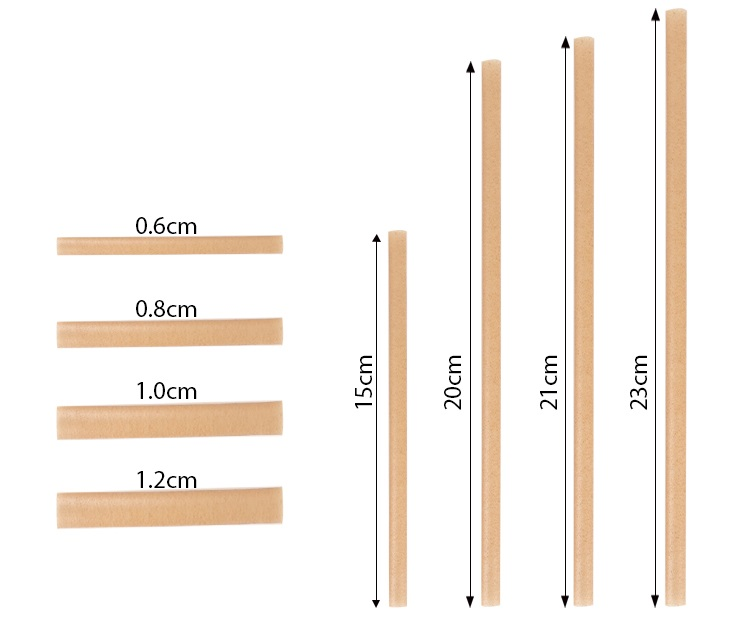
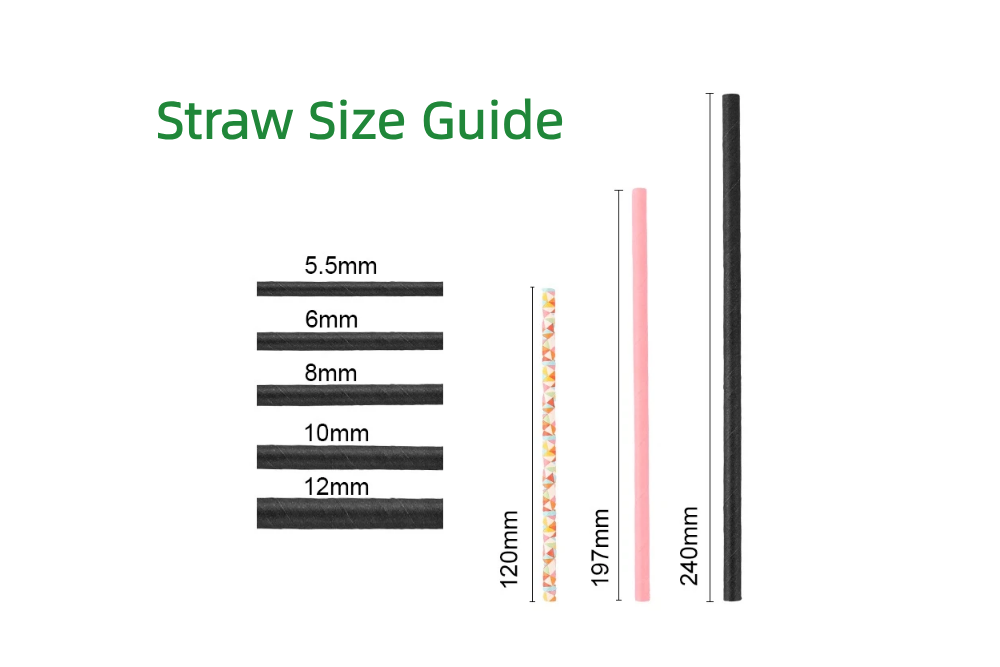
A straw specification is usually written as diameter x length. For example, `8 x 210mm` normally describes a straw with an 8mm diameter and a length of 210mm.
However, buyers should confirm whether the stated diameter is the inner diameter or outer diameter. The difference matters when a straw must pass through a lid opening or allow fruit pieces and tapioca pearls to move through the tube. Some suppliers quote the internal bore, while others use the total outside measurement.
The main dimensions and construction details are:
Inner diameter: the usable opening through which the drink passes.
Outer diameter: the total width of the straw, including its wall.
Length: the measurement from one end of the straw to the other.
Wall thickness: affects rigidity, durability and the difference between inner and outer diameter.
Cut style: straight, angled or pointed ends may be used for different cups and service formats.
Dimensional tolerance: the permitted variation between individual straws in a production batch.
Paper straws can usually be manufactured to relatively controlled dimensions. Natural are different: their hollow channels are created by the plant, so the internal diameter and wall thickness may vary even when the products are sorted into the same size grade.
| Straw Category | Common Diameter | Common Length | Typical Applications |
|---|---|---|---|
| Cocktail or sip straw | 3–5mm | 120–150mm | Cocktails, spirits, tasting drinks and small glasses |
| Standard drinking straw | 5–7mm | 180–210mm | Water, soda, juice, iced tea and iced coffee |
| Medium or jumbo straw | 7–8mm | 200–230mm | Iced lattes, slushies and light smoothies |
| Smoothie or milkshake straw | 8–10mm | 200–250mm | Smoothies, milkshakes, frappes and blended drinks |
| Boba or extra-wide straw | 12–13mm | 200–240mm | Bubble tea, thick beverages and drinks with toppings |
Diameter primarily depends on viscosity and inclusions. Viscosity describes how easily a liquid flows; inclusions are solid ingredients such as pulp, crushed ice, jelly or tapioca pearls.

Short, narrow straws work well in lowball glasses, cocktails and tasting portions. They provide a controlled sip and do not overwhelm a small glass visually. Depending on the presentation, bars may use one straw or a pair of thin straws.
Paper is well suited to consistent cocktail dimensions and decorative colours. Naturally slim wheat straws can also suit cocktails and clear cold drinks, although their bore will not be as uniform as a manufactured tube.
For low-viscosity drinks without large pieces, approximately 5-7mm is the most versatile range. It provides adequate flow without using the extra material and packaging space required by a wide straw.
An opening around 7-8mm can make thicker iced drinks easier to consume while remaining manageable for many takeaway lids. This range is useful for iced lattes, slushies, blended juices and light smoothies without large fruit pieces.
Before adopting one size across the menu, test it with the thickest recipe in this group. A straw that performs well with an iced latte may still clog when used with a smoothie containing seeds or coarse pulp.
Thick blended drinks generally need a wider bore to reduce suction effort. An 8-10mm straw is a practical starting point for smoothies, milkshakes, frappes and similar drinks.
Paper straws can be produced in these controlled diameters with a wall structure selected for the intended drink and service time. Selected bamboo or reed straws may also have a suitable opening, but buyers should order them by a graded inner-diameter range rather than assume that every natural tube has an identical bore.
Bubble tea normally requires an extra-wide straw because tapioca pearls, jelly and fruit pieces must pass through the tube. A common market direction is approximately 12mm or wider, but the correct size depends on the actual topping.
A frequently repeated figure is that standard tapioca pearls may be around 8-10mm. That does not mean a 10mm straw will work: the opening needs clearance around the topping, and irregular pearls can be larger than their nominal size. Testing the largest finished topping is more reliable than choosing from the menu description alone.
Not Sure Which Straw Size Fits Your Drinks?
Match the diameter, length and material to your cups and beverage menu.
Diameter follows the drink, but length follows the container.
The most useful measurement is the effective insertion depth: the distance from the lid opening or rim to the lowest point the straw needs to reach. If the straw sits at an angle, measure along that approximate insertion path rather than using only the cup’s vertical height.
These ranges leave approximately 30–50mm of accessible straw above the rim or lid in many common applications.
| Effective Insertion Depth | Practical Straw Length | Common Container Examples |
|---|---|---|
| 70–100mm | 120–150mm | Tasting cups, short cocktail glasses and small drink cups |
| 100–140mm | 150–180mm | Cans, short tumblers and compact beverage cups |
| 140–170mm | 180–210mm | Standard takeaway cups, bottles and medium tumblers |
| 170–210mm | 210–250mm | Tall cold cups, dome-lid cups and large takeaway drinks |
| More than 210mm | Confirm with the actual container | Oversized tumblers, novelty cups and custom beverage packaging |
Material affects dimensional consistency, wall thickness, flexibility, care and suitable applications.
| Material | Size Characteristics | Suitable Size Direction |
|---|---|---|
| Paper | Diameter and length can be produced relatively consistently | Cocktail, standard, smoothie and boba sizes |
| Bamboo | Naturally hollow, rigid and often wider, with variation in bore | Standard cold drinks, juices and selected thicker drinks |
| Wheat | Naturally slim and lightweight, with variation between stalks | Cocktails, water, juice and other thin cold drinks |
| Reed | Natural hollow structure with more varied bore and wall thickness | Cocktails, juices and everyday cold drinks |
Paper provides the widest scope for controlled diameter and length customization. It is suitable for individual paper wrapping, branded retail packs and applications ranging from short cocktail straws to wide boba straws.
Size should be confirmed together with the paper structure. A longer or wider tube may require a different winding structure or wall specification to maintain rigidity during normal use. More layers are not automatically better; the construction should match the diameter, beverage and target performance.
Bamboo straws are rigid, reusable products with visible natural texture. The plant structure creates differences in internal opening, external diameter, wall thickness and colour.
Wheat straws are made from naturally hollow wheat stems. Their slim profile makes them most appropriate for water, juice, cocktails and other relatively thin cold beverages. Natural variation is part of the product, so buyers should evaluate sorting, broken stems, blocked openings and usable bore rather than judge the order only by nominal length.
Reed straws provide a natural hollow tube and are available in short cocktail lengths as well as longer drinking formats. They may feel more substantial than wheat straws, but their bore, straightness and wall thickness still require grading.
A straw can match the beverage and still fail if it does not fit the closure.
Confirm both the straw's outer diameter and the usable lid opening. A nominal 12mm straw will not pass through a lid hole designed for a standard 6mm straw. Tight openings can scrape printed surfaces, crush paper tubes or make the straw difficult to move.
Dome lids increase the distance between the drink and the top of the closure, which can require a longer straw. Flat lids may need less additional length but can hold the straw at a different angle. Test the complete cup-and-lid combination rather than the cup alone.
Bubble tea and sealed juice cups often need an angled or pointed straw. For paper products, the tip geometry and tube rigidity should be developed together. Standard disposable straws should not be assumed suitable for piercing film unless the specific product has been designed and tested for that purpose.
A specification table narrows the options, but a real-use test should decide the final size. Use the actual beverage, toppings, cup, lid and service conditions.
Confirm that customers can drink comfortably without excessive effort or an uncontrolled flow. Test the beverage at its normal serving temperature because viscosity can change as a drink warms or melts.
Use the largest tapioca pearls, fruit pieces, jelly or crushed ice expected in normal production. An average-size topping is not a sufficient test for blockage.
Insert the straw through the actual lid and check movement, stability and exposed height. Confirm that the outer diameter does not damage the closure or straw surface.
For sealed cups, check whether the tip pierces cleanly without bending, crushing or producing loose material. Repeat the test across several units rather than relying on one successful sample.
For disposable paper straws, test their durability in liquids and how well they hold up over the time it takes to finish your drink.
For bamboo, wheat and reed, inspect a meaningful group of samples. Compare inner bore, outer diameter, straightness, wall thickness, cracks and end finishing. The approved range should be recorded for mass production.
Check individual wrapper sealing, dispenser performance, pack count, carton protection and retail presentation using the final straw specification.
Ancheng supplies paper, bamboo, wheat and reed straws for foodservice, hospitality, distribution and private-label programs.
Ancheng paper straws cover standard drinking, cocktail, smoothie and bubble tea applications. Diameter, length, straight or angled cut, paper structure, colour, printing and packaging can be coordinated for the project. Including custom diameters in the approximately 5- 12 mm range, with special lengths available beyond common foodservice formats.
The standard MOQ for Ancheng paper straws is 100,000 pieces; final packing and lead time depend on the specification.
Ancheng's bamboo straw range includes lengths of approximately 3.1, 4.7, 5.9, 7 and 8.27 inches, equivalent to about 79, 119, 150, 178 and 210mm. Custom length, logo engraving and packaging are available. Because bamboo is natural, the bore should be confirmed as a range during sampling.
Wheat straw options include approximately 5.5, 7 and 7.87 inches, or about 140, 178 and 200mm. These sizes support cocktails and common cold-drink service. Length, diameter grading, bundle quantity and private-label packaging can be coordinated for wholesale orders.
Ancheng's reed straw range covers approximately 3.1 to 8.27 inches, or about 79 to 210mm. This provides short options for samples and cocktails as well as longer formats for everyday drinks.
A 180- 210 mm straw often works with standard cups, but 16oz cups are not all the same height. Measure the actual cup with its lid and confirm the required exposed length before ordering.
It may work for very small toppings, but common tapioca pearls generally require approximately 12mm or more. Test the largest finished pearl or topping rather than relying only on its nominal size.
Bamboo, wheat and reed are plant stems rather than manufactured tubes. Growing conditions and the position of the stem affect the bore and wall thickness. Sorting and an approved size range are therefore more practical than expecting every straw to have an identical diameter.
The best straw size is not simply the most common option in a supplier's catalogue. Diameter must match the drink and its toppings; length must match the real cup and lid; and material must provide suitable dimensions and performance for the service model.
Begin with a common market range, then test the proposed straw with the actual beverage, container, closure and packaging. This approach gives bulk buyers a specification that can be sampled, inspected and repeated more reliably.
Need Custom Straws for Your Brand?
Choose paper, bamboo, wheat or reed with custom sizes

Hello, I'm Sven Wang, the Manager of Ancheng. With extensive expertise in raw materials and production processes, I'm dedicated to advancing sustainable tableware and constantly improving eco-friendly options for the modern catering industry. You can trust that Ancheng is committed to providing the highest quality. Welcome!

Factory: Qian Renqiao Industrial Park, Shucheng County, Luan City, Anhui Province, China
Office: Building 11, Max Science Park, Shushan Dist, Hefei, Anhui, China
Copyright ©2026 Anhui Ancheng Bamboo and Wood Tableware Co., Ltd. Privacy Policy




 Index
 Product
 Resources
 About