Under the EU Packaging and Packaging Waste Regulation (PPWR), buyers need clear information about the packaging used for each order, including OPP bag, paper sleeve, printed box and shipping carton.
The PPWR, formally Regulation (EU) 2025/40, will generally apply from 12 August 2026. For EU importers, distributors and private-label brands, a general statement such as “eco-friendly packaging” is no longer enough. Buyers increasingly need material information, supporting test evidence and supplier documentation connected to the actual packaging they purchase.
Ancheng has prepared packaging material information and obtained SGS test reports for our packaging, including OPP bags, PE bags, paper boxes, and cardboard boxes, etc. We can also support customers with paper-sleeve options, packaging design and carton optimization.
This guide explains what buyers should request from a supplier, what different documents can demonstrate and how Ancheng supports a practical PPWR review before mass production.
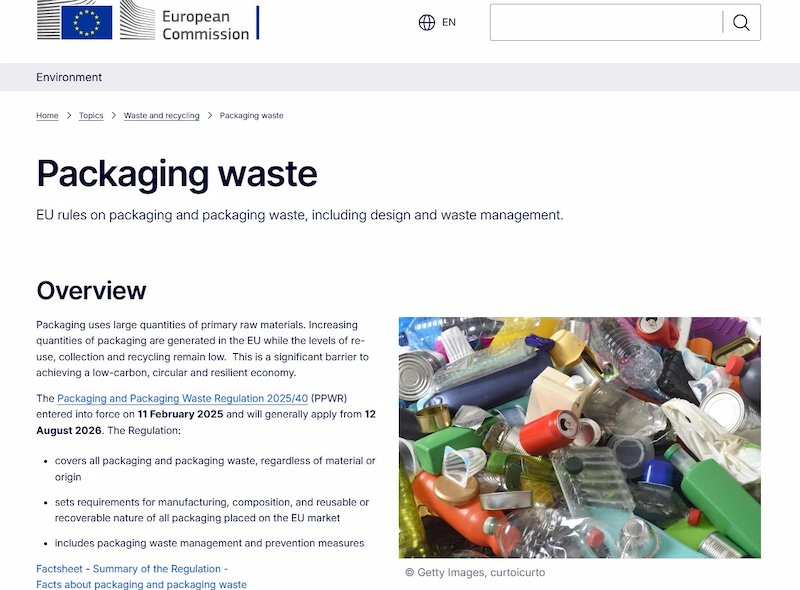
The PPWR introduces EU-wide requirements covering the full life cycle of packaging, including its composition, design, use and eventual treatment as waste. It replaces the previous Packaging and Packaging Waste Directive as the main EU packaging framework.
The regulation affects businesses throughout the supply chain, including packaging manufacturers, suppliers, brand owners, importers, distributors and businesses responsible for extended producer responsibility, or EPR.
For buyers of disposable bamboo and wooden cutlery, the first practical question is not simply whether the cutlery is sustainable. It is whether the complete packing configuration can be properly described and supported.
A typical order may include:
- an OPP or PE inner bag;
- a paper sleeve or paper pouch;
- a printed retail box;
- a barcode label;
- a corrugated shipping carton;
- tape, ink, adhesives and other packaging components.
Each component may contribute to the packaging material declaration, technical documentation, chemical review, waste reporting or future recyclability assessment.
The PPWR also phases in additional requirements over time. These include packaging minimization, recyclability, recycled content in certain plastic packaging, harmonized labelling and limits on excessive empty space. Buyers should therefore establish a reliable packaging data system now rather than wait until every later deadline arrives.
Need PPWR Packaging Documents for Your Cutlery Order?
Let us support your packaging documentation.
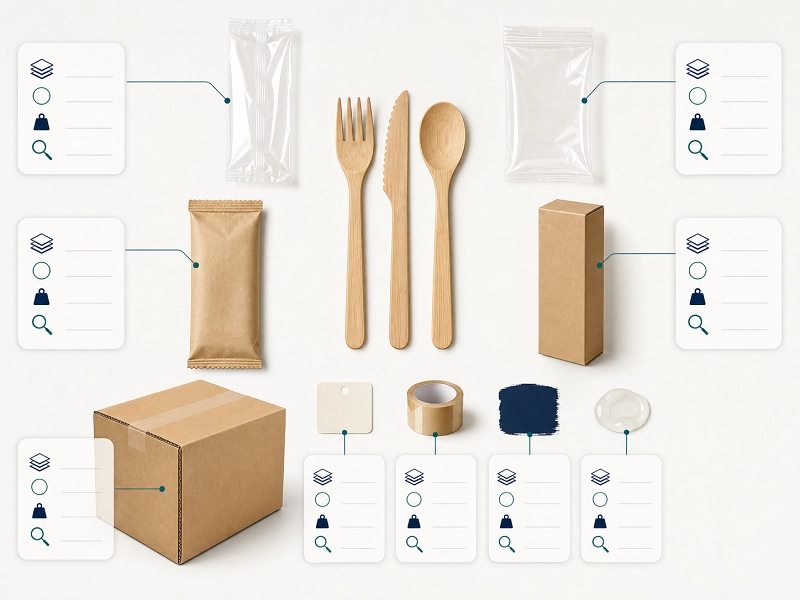
The most useful starting point is a packaging Bill of Materials, commonly called a packaging BOM or packaging material list.
A packaging BOM identifies the components used to pack a specific product. Depending on the packaging format, it may record:
- component name;
- material type;
- plastic resin or paper grade;
- layer or coating structure;
- dimensions and thickness;
- unit weight;
- ink, adhesive or coating information;
- supplier or internal material code;
- available declaration or test evidence;
- the product SKU or order to which the packaging applies.
A simple purchasing file could look like this:
| Packaging component | Information to request | Possible supporting evidence |
|---|---|---|
| OPP inner bag | Material, thickness, dimensions and weight | Material specification and available SGS report |
| PE bag | Material, dimensions and weight | Material specification and available SGS report |
| Paper box | Paper structure, printing and weight | Box specification and available SGS report |
| Paper sleeve | Paper type, dimensions, printing and weight | Material specification or supplier declaration |
| Shipping carton | Board type, carton dimensions, weight and packing quantity | Carton specification and packing plan |
| Labels, ink, adhesives and tape | Materials used in the approved design | Relevant supplier information where used |
For importers, accurate packaging weights are also important for national EPR registrations and packaging-volume reporting. The business responsible for EPR may differ from the manufacturer responsible for packaging conformity, so these roles should be confirmed for the intended sales model.
Laboratory reports can provide important evidence, but buyers should check exactly what a report covers. A report is not automatically a complete “PPWR certificate.” It normally applies only to:
- the identified sample;
- the listed test items;
- the method and detection limits shown;
- the material or specification represented by that sample.
For the packaging materials discussed in this article, two areas are especially relevant.
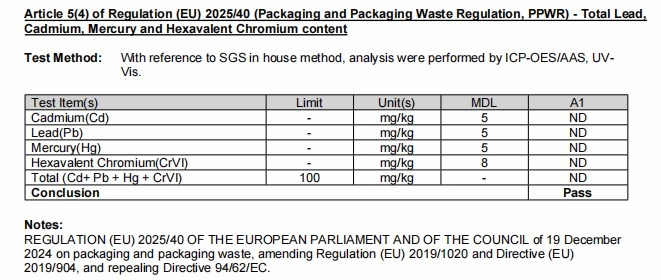
Article 5(4) of the PPWR maintains a combined limit of 100 mg/kg for four heavy metals in packaging or packaging components:
- lead;
- cadmium;
- mercury;
- hexavalent chromium.
Buyers should check whether the report:
- identifies the correct packaging sample;
- lists all four substances;
- reports the applicable method detection limits;
- assesses their combined concentration against 100 mg/kg;
- can be connected to the material proposed for the order.
Ancheng has available SGS reports for OPP bags, PE bags and paper boxes. The submitted samples passed the specified PPWR Article 5(4) heavy-metal test requirements stated in those reports.
From 12 August 2026, PPWR Article 5(5) will restrict PFAS in food-contact packaging at the applicable thresholds. PFAS are a large group of fluorinated substances, and buyers may encounter several types of evidence, including supplier declarations, risk assessments, targeted PFAS analysis and total-fluorine screening.
It is important to understand one point: Total fluorine is not the same as PFAS.
Total-fluorine testing measures fluorine from all detected sources in the sample. That fluorine may come from PFAS or from other fluorine-containing substances. It is a broad screening tool, not a list of every PFAS in the material.
Likewise, “ND,” or not detected, does not mean mathematical zero. It means the result was below the method detection limit stated in the report.
| Point of comparison | Total-fluorine screening | Targeted PFAS analysis |
|---|---|---|
| What is measured? | The total amount of fluorine detected in the sample | Specific PFAS substances included in the laboratory’s test list |
| Does it identify individual PFAS? | No | Yes, but only the PFAS substances included in the analytical scope |
| Can the fluorine come from non-PFAS sources? | Yes. Total fluorine may include fluorine from PFAS and other fluorine-containing substances | The result is linked to the specific PFAS compounds being tested |
| Main purpose | Broad screening against the PPWR total-fluorine threshold | Measuring specified PFAS against individual or sum-of-PFAS thresholds |
| Typical result format | Total fluorine expressed in mg/kg, or “ND” below the method detection limit | Individual PFAS results and/or the sum of tested PFAS, usually expressed in μg/kg or mg/kg |
| What does an “ND” result mean? | Total fluorine was not detected above the stated method detection limit | The tested PFAS substances were not detected above their respective detection limits |
| What can the result demonstrate? | Compliance with the stated total-fluorine test requirement for the submitted sample | Compliance with the stated limits for the PFAS substances included in the test scope |
When reviewing PFAS-related evidence, buyers should ask:
1. Was total fluorine tested, targeted PFAS tested, or both?
2. What was the method detection limit?
3. Which PFAS substances were included in a targeted analysis?
4. Does the report apply to the actual packaging material being ordered?
5. Has the formulation, coating, ink or material supplier changed since testing?
An importer does not need to be a laboratory specialist, but several fields should always be checked.
| Report field | Why it matters |
|---|---|
| Sample description | Confirms whether the report concerns an OPP bag, PE bag, paper box or another material |
| Report number and date | Supports authenticity and version control |
| Test requirement | Shows which PPWR article or limit was used |
| Test method | Identifies how the analysis was performed |
| Limit | Shows the acceptance threshold used in the report |
| MDL | Shows the lowest level the method can reliably detect |
| Result | Shows the measured value or “ND” |
| Conclusion | Shows whether SGS issued “Pass” or directed the reader to detailed results |
An SGS test report is third-party test evidence. SGS is an international testing, inspection and certification organization, but it is not an EU regulator. The responsible economic operator must still determine whether the complete packaging and documentation satisfy all applicable requirements.
For this reason, buyers should avoid relying on a certificate logo or the word “Pass” alone. The sample, test scope and final packaging specification must match.
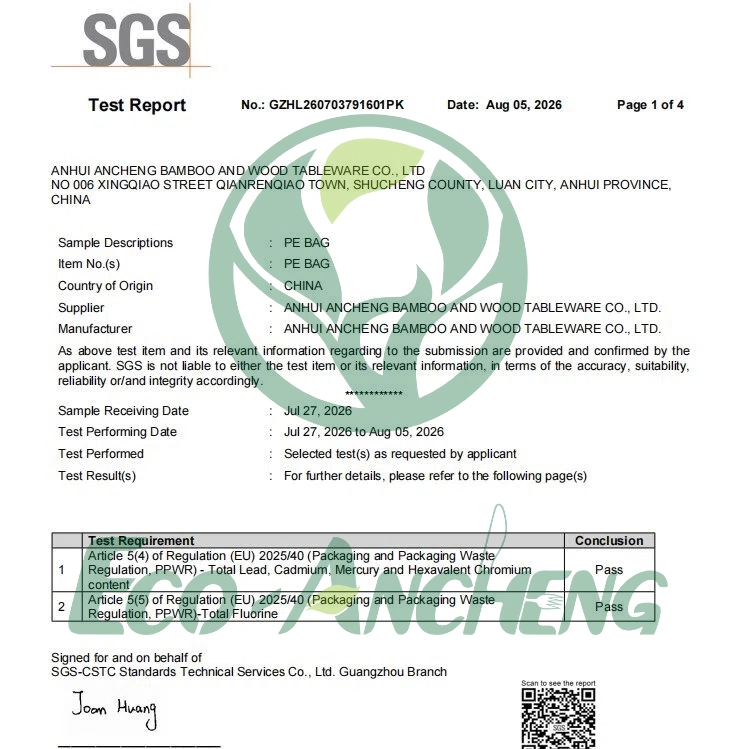
Ancheng has obtained SGS test reports for selected packaging samples used in its packaging programs:
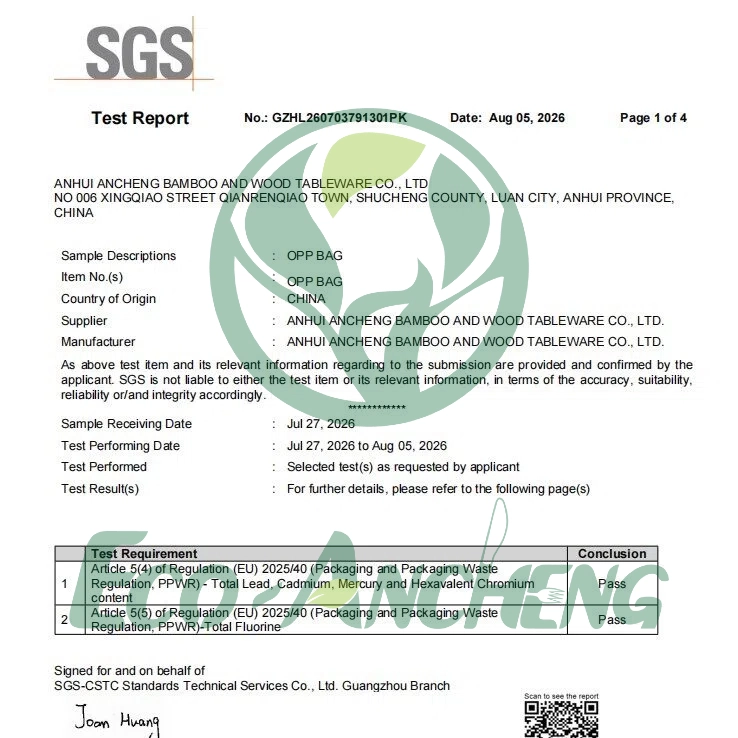
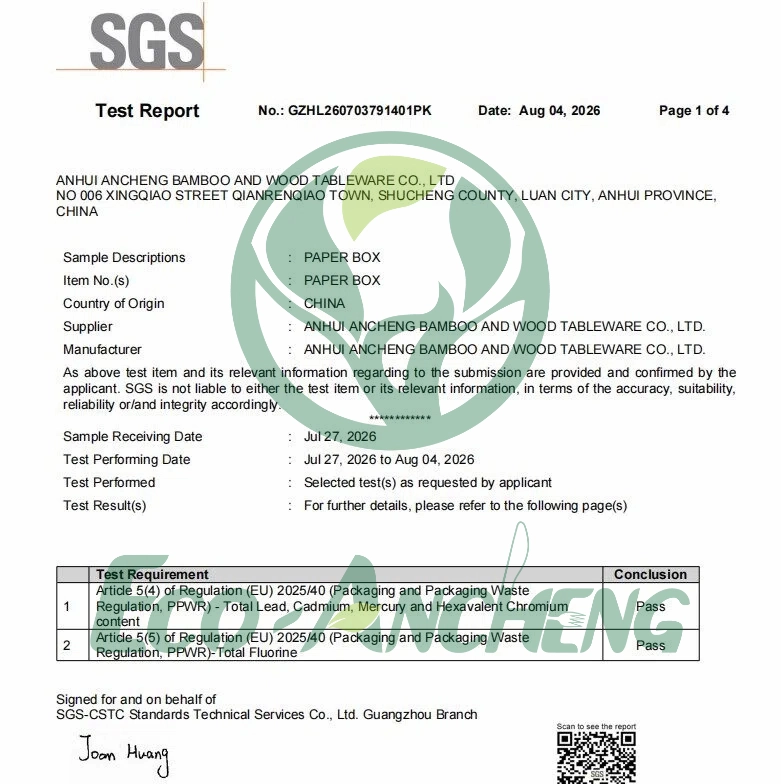
| Tested sample | PPWR Article 5(4) heavy metals | PPWR Article 5(5) total fluorine |
|---|---|---|
| OPP bag | Pass | Pass |
| PE bag | Pass | Pass |
| Paper box | Pass | Pass |
These reports demonstrate that Ancheng is preparing objective evidence rather than relying only on general environmental claims. Customers can contact us to obtain the full report.
Review Ancheng’s Available SGS Test Evidence
Get material information and available test evidence.
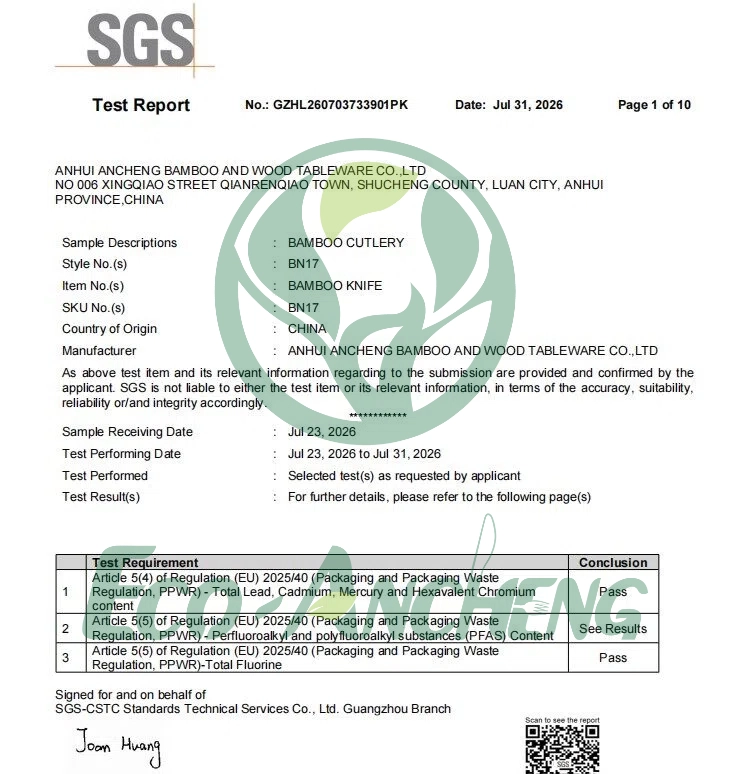
To further demonstrate the reliability of our products, we have also conducted relevant tests on our bamboo and wood cutlery. Please contact our team for more details.

A well-prepared supplier should be able to organize information in a format that the buyer, importer or responsible manufacturer can use. Depending on the packaging and legal role, buyers may request the following.
This should identify the packaging components used for the agreed product and packing configuration. It helps the buyer understand what needs to be assessed and what must be reported.
Specifications may include:
- dimensions;
- thickness or paper grade;
- unit weight;
- material structure;
- printing information;
- carton quantity;
- intended use.
Reports should be connected to the material or sample they represent. Buyers should review the test scope rather than assume that one report covers every packaging variation.
Depending on the packaging, these may address:
- material composition;
- intentionally added substances;
- recycled content;
- coatings, inks or adhesives;
- applicable chemical restrictions;
- production or material changes.
PPWR conformity is supported by technical documentation. A supplier may need to provide specifications, declarations and test evidence to the responsible manufacturer or importer preparing that file.
The PPWR provides for an EU Declaration of Conformity for packaging. The party responsible for issuing it depends on the legal role and final packaging arrangement.
Ancheng can provide supplier-side packaging information and available evidence to support the applicable technical documentation and declaration process.
The company responsible for EPR in a Member State may need material and weight data for registration, reporting and fees. A PPWR technical file does not replace EPR registration, and EPR registration does not replace packaging conformity documentation.
The buyer should be able to connect:
packaging material → approved specification → product SKU → production order → shipment
This makes it easier to manage repeat orders and investigate changes.
Documentation is only one part of PPWR preparation. Packaging design also matters.
Ancheng supports customers with:
- paper-sleeve packaging options;
- reduced-plastic packaging discussions;
- custom retail and private-label packaging design;
- packaging dimensions adapted to the product format;
- carton-size review;
- product stacking and packing-quantity review;
- reduction of unnecessary carton empty space;
- packaging information prepared for the agreed configuration.
| Buyer concern | Ancheng support |
|---|---|
| Too much plastic packaging | Paper-sleeve and reduced-plastic options can be discussed |
| Oversized cartons | Carton dimensions and packing configuration can be reviewed |
| Unclear material composition | Packaging material lists can be prepared |
| Missing chemical evidence | Available SGS reports can be supplied for review |
| Private-label requirements | Packaging design support is available |
| EPR data preparation | Packaging component and weight information can be organized |
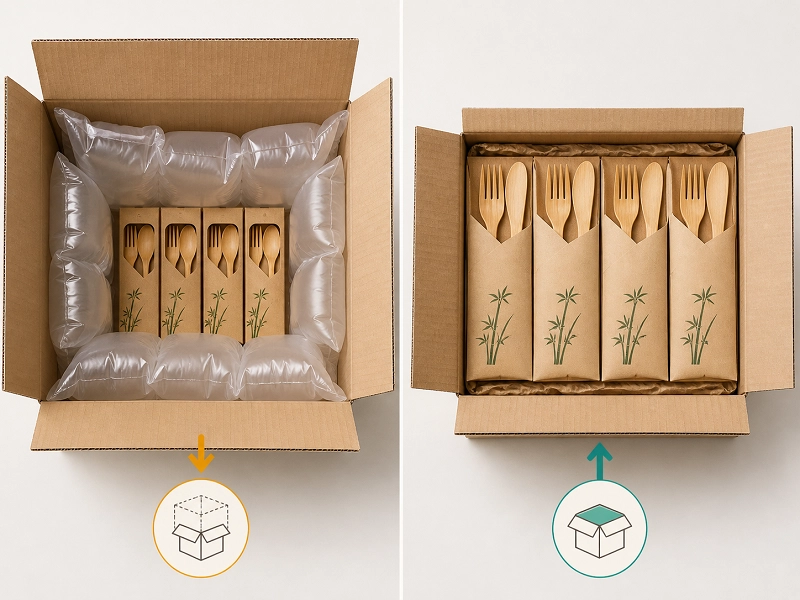
PPWR packaging-minimization requirements are phased in. For grouped, transport and e-commerce packaging, the regulation introduces a maximum 50% empty-space ratio by the later applicable deadline. Space filled with materials such as shredded paper, air cushions, bubble wrap and foam is still treated as empty space for this calculation.
Sales packaging follows a separate minimization approach rather than an immediate universal 50% numerical limit. In every case, packaging must still provide the protection, hygiene and functionality required for the product.
For bamboo and wooden cutlery, efficient stacking, appropriate sleeve dimensions and correctly sized cartons can reduce both unnecessary packaging and shipping volume.
PPWR focuses on packaging, but it does not replace other applicable legislation.
Depending on the packaging material, intended use and destination market, buyers may also request information concerning:
- applicable REACH restrictions or SVHC communication duties;
- food-contact safety;
- national packaging and EPR requirements;
- customer-specific restricted-substance policies.
These requirements should be reviewed separately. A REACH declaration, food-contact report or FSC certificate may support a wider compliance program, but it does not replace PPWR packaging evidence.
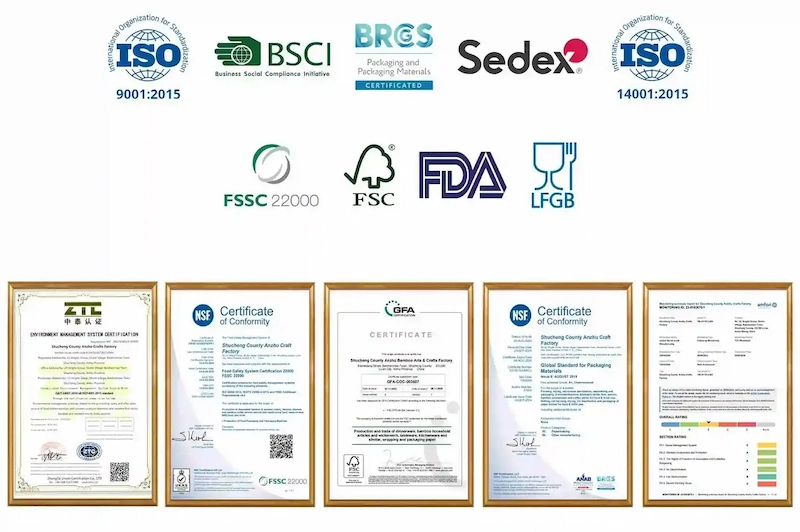
PPWR documentation is part of a broader supplier-qualification process. For relevant products and destination markets, Ancheng can also provide available documentation relating to:
- FDA-related test documentation;
- LFGB-related test documentation;
- DGCCRF-related test documentation;
- bamboo and wooden product test reports.
- BRCGS;
- ISO 9001;
- BSCI;
- Sedex-related audit information.
- FSC documentation;
- EUDR-related traceability support for relevant wooden products.
These documents do not replace PPWR evidence. They demonstrate Ancheng’s broader capabilities in quality management, food-contact documentation, responsible sourcing and supply-chain transparency.
Before approving a disposable bamboo or wooden cutlery order for the EU market, buyers should confirm:
[1] What product SKU is being ordered?
[ 2] What is the destination country?
[3] Which packaging components will be used?
[4] Is a packaging BOM or material list available?
[5] Are dimensions, thicknesses and weights recorded?
[6] Are coatings, inks, labels and adhesives identified where used?
[7] Which test reports are available?
[8] Do the reports match the proposed packaging material?
[9] Are supplier declarations required?
[10] Who is responsible for the PPWR technical file?
[11] Who will issue the applicable EU Declaration of Conformity?
[12] Who is responsible for EPR registration and reporting?
[13] Can the packaging or carton be reduced without affecting protection?
[14] Have the final artwork and packaging specification been approved?
[15] Will a material or supplier change require a new review?
The best time to answer these questions is before packaging is printed and before mass production begins.
PPWR generally applies to the packaging rather than the bamboo or wooden utensil itself. The bag, sleeve, retail box, carton and other packaging components should therefore be reviewed. The cutlery remains subject to applicable food-contact and product-safety requirements.
The appropriate file may include a packaging BOM, specifications, supplier declarations, available test reports, packaging weights, traceability information and documents supporting the applicable technical file and EU Declaration of Conformity.
No. Total fluorine measures fluorine from all detected sources. It is a screening tool and does not identify every individual PFAS.
No. ND means “not detected” below the method detection limit shown in the report.
Not automatically. The report should be reviewed against the actual material, specification, supplier and packaging configuration proposed for the order.
The responsible party depends on the legal role and packaging arrangement. The packaging manufacturer, brand owner, importer and EPR producer may have different responsibilities. Ancheng can provide supplier-side information and available evidence to support the process.
Ancheng can provide available SGS reports for selected OPP bags, PE bags and paper boxes, as well as packaging material information for agreed packaging configurations. Paper-sleeve options, packaging design, carton optimization and customer-specific testing support are also available.
If you are preparing a disposable bamboo or wooden cutlery order for the EU market, send us:
- your destination country;
- product type and SKU;
- required quantity;
- preferred packaging format;
- private-label or artwork requirements;
- required test reports or supplier documents.
Ancheng can provide available SGS packaging reports, organize packaging material information and discuss appropriate packaging options before mass production.
Importing Disposable Bamboo or Wooden Cutlery into Europe?
Swap plastics for premium wholesale natural tableware

Hello, I'm Sven Wang, the Manager of Ancheng. With extensive expertise in raw materials and production processes, I'm dedicated to advancing sustainable tableware and constantly improving eco-friendly options for the modern catering industry. You can trust that Ancheng is committed to providing the highest quality. Welcome!

Factory: Qian Renqiao Industrial Park, Shucheng County, Luan City, Anhui Province, China
Office: Building 11, Max Science Park, Shushan Dist, Hefei, Anhui, China
Copyright ©2026 Anhui Ancheng Bamboo and Wood Tableware Co., Ltd. Privacy Policy


 Index
Index Product
 Resources
 About
About