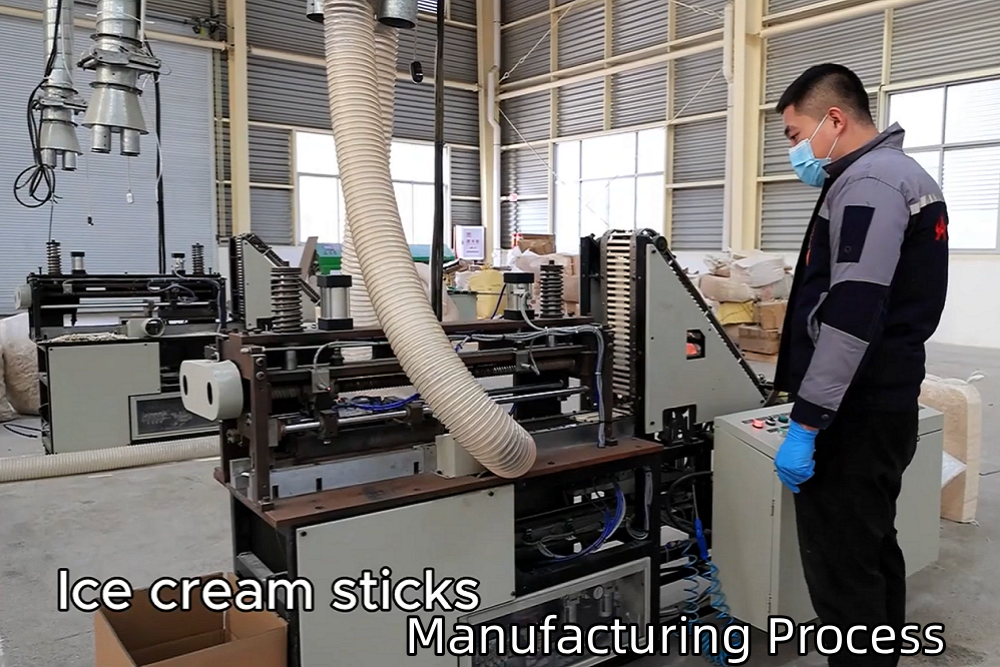
Wooden ice cream sticks are made by preparing birch wood, rotary peeling it into veneer, cutting the veneer into the required shape, drying the blanks, polishing the surfaces, rounding the ends, and removing defective pieces before packing.
For frozen dessert manufacturers, understanding this workflow is more than technical background. Each manufacturing and inspection stage affects whether a stick feeds reliably into production equipment, stays stable during freezing, and gives consumers a smooth experience.
This guide explains how birch wood ice cream sticks are produced, what is checked before shipment, and why application testing matters before bulk production begins.
You can get a quick overview of the manufacturing process for wooden ice cream sticks from the table below.
Production Stage |
Main Purpose |
Quality Issues Controlled |
|---|---|---|
Birch wood selection |
Choose suitable food-contact raw material |
Decay, mildew, insects, stains, and abnormal odor |
Log preparation |
Prepare and soften wood for processing |
Bark residue, cracks, and uneven material condition |
Rotary peeling |
Convert logs into veneer of controlled thickness |
Uneven veneer, holes, and grain defects |
Shape cutting |
Form the length, width, and end profile |
Incorrect dimensions and incomplete edges |
Drying |
Stabilize the wood before finishing |
Excess moisture, deformation, and cracking |
Polishing |
Smooth the surface and remove raised fibers |
Burrs, roughness, and residual wood dust |
End rounding |
Form smooth, consistent rounded ends |
Sharp corners and irregular end profiles |
Machine sorting |
Separate obvious dimensional and shape defects |
Bent, incomplete, or incorrectly formed pieces |
Manual inspection |
Remove unacceptable visible defects |
Splinters, cracks, stains, and poor appearance |
Packing |
Protect approved sticks for transport and use |
Mixed products, incorrect quantities, and moisture exposure |
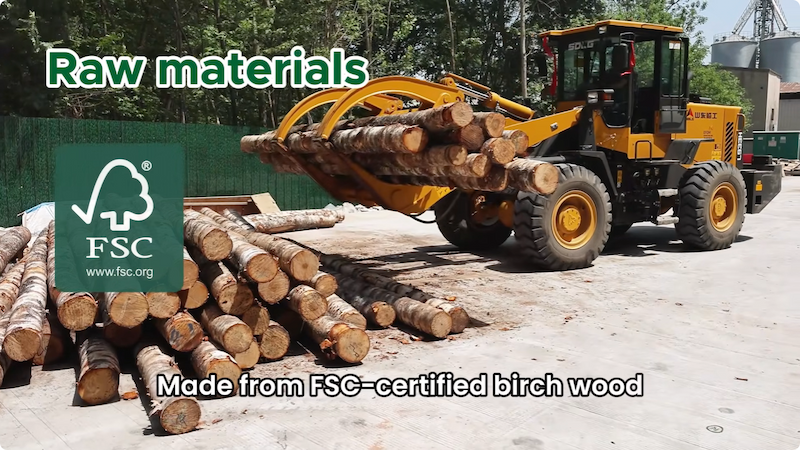
Eco-Ancheng produces its wooden popsicle sticks from birch wood.
Birch is widely used because its fine grain peels into thin, uniform veneer and polishes to a smooth finish. Its naturally light color also suits unprinted sticks, branded frozen desserts, and retail packs.
Incoming wood is checked for cracks, decay, mildew, insect damage, bark residue, dark stains, unusual odor, unsuitable grain, or uneven moisture. Raw material inspection matters because polishing cannot fix deep defects or abnormal odors once material moves further down the line.
Birch logs are cut into lengths suited to the rotary peeling equipment, with bark and unsuitable outer wood removed beforehand. In conventional stick production, logs may also be softened through soaking, steaming, or heating so the wood peels continuously with less risk of splitting.
Log preparation directly influences veneer continuity, thickness consistency, grain direction, waste levels, and how many defects carry into later stages. A poorly prepared log can produce uneven veneer even when downstream cutting equipment runs properly.
A prepared birch log rotates against a cutting blade to produce a continuous sheet of veneer at the thickness required by the stick specification.
Veneer thickness affects finished stick rigidity, handling feel, mold and insertion compatibility, resistance to bending, and bundle or carton count. Before cutting into blanks, the veneer is checked for serious cracks, holes, bark remnants, and weak spots. Grain should run primarily along the length of the stick so fibers are less likely to split across the width or lift during finishing.
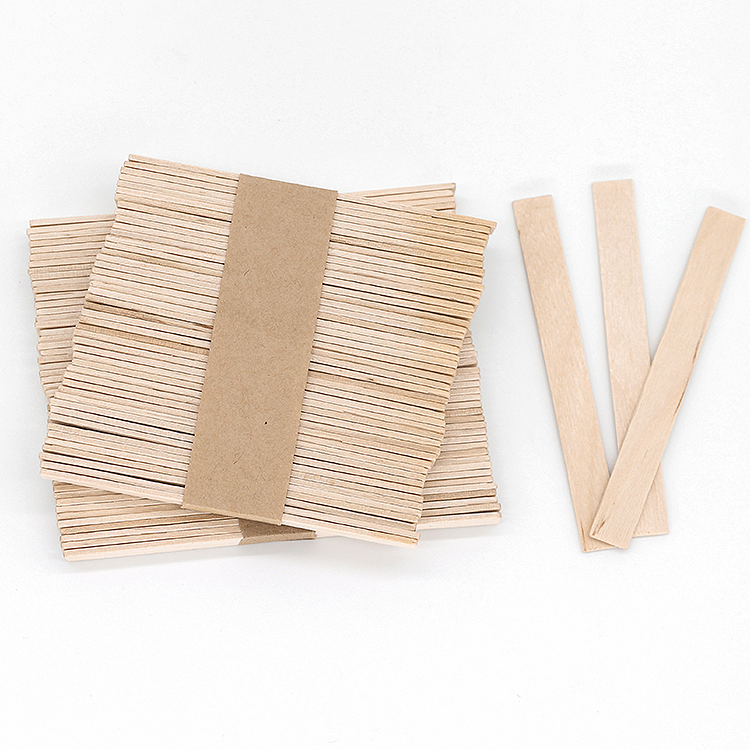
The veneer is cut or punched into the required dimensions and outline using tooling matched to straight sticks, wider formats, spoon shapes, or custom end profiles.
Eco-Ancheng's standard ice cream stick range includes reference sizes such as:
1. 93 x 10 x 2 mm and 114 x 10 x 2 mm, commonly used as handles for ice cream bars and frozen desserts
2. 60 x 15 mm, 75 x 15 mm, and 94 x 15 mm, used for ice cream sticks, spoons, or scoops depending on design and application
Beyond overall length, buyers may need to specify width, thickness, end radius, side profile, waist width for shaped sticks, exposed handle length, grain direction, and allowable tolerances. On automated lines, even minor dimensional shifts can disrupt stacking, separation, alignment, and insertion.
Need Ice Cream Sticks for Your Production Line?
Match the dimensions, shape and packaging to your mold and frozen product.
Freshly cut wood holds moisture that must be reduced and stabilized before polishing, sorting, and long-distance storage.
If moisture stays too high or varies widely within a batch, sticks face higher risks of warping, mold during storage or transit, dimensional shifts, odor development, or weight changes after packing. Over-drying or uneven drying can cause brittleness, cracks, and broken ends instead. At eco Ancheng, the moisture content of raw materials is maintained between 8% and 12%, and the moisture content range and testing methods for finished products are strictly controlled to ensure compliance with final requirements.
After drying, stick blanks are polished to reduce raised fibers, rough patches, and cutting marks.
Because consumers touch and may place this part in their mouths, inspection looks for burrs, splinters, loose fibers, rough surfaces, residual wood dust, sharp side edges, excessive sanding, or missing material. Polishing should smooth the surface without thinning the stick or altering its profile, as a shiny surface cannot make up for an undersized or weakened piece. Eco-Ancheng's natural birch sticks are supplied without wax, oil, or other surface coatings, relying on wood selection and mechanical processing for their finish.
Both ends are shaped into the specified rounded profile to remove sharp corners and improve consistency for production and consumer use.
Finished ends should be even, smooth, centered, free from splinters or chips, and consistent with the approved sample. In automatic insertion equipment, uneven end profiles can interfere with stick separation and positioning, while rough ends feel unfinished to consumers.
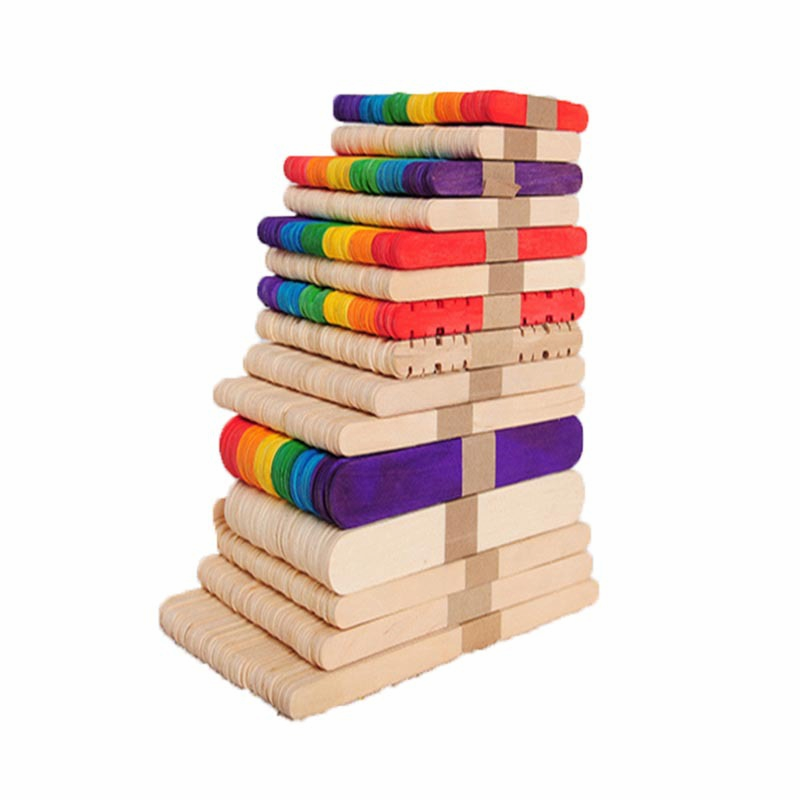
After the basic shape and surface have been approved, wooden sticks can be customized for branded frozen dessert projects.
Available options may include:
- Printed logos or text
- Hot stamping
- Laser engraving
- Single- or double-sided branding
- Food-contact colored sticks
- Custom shapes
- Promotional messages or codes
Decoration adds inspection checkpoints for print placement, clarity, alignment, and food contact suitability in the target market. Custom samples should be approved before mass production, especially where artwork sits above the frozen dessert or within a tight exposed handle area.
Manufacturing shapes the stick, while inspection verifies whether the batch meets the agreed specification. Eco-Ancheng combines machine sorting with manual inspection to screen out unacceptable dimensions, deformation, and surface flaws.
Sorting equipment can help identify and separate obvious abnormalities such as:
- Incorrectly formed pieces
- Incomplete shapes
- Significant dimensional variation
- Bent or deformed sticks
- Pieces that do not feed or align correctly
- Broken or severely damaged products
Machine sorting improves consistency, but natural wood defects are not always uniform or easy for equipment to identify. Manual inspection therefore remains necessary.
Because natural wood defects are not uniform enough for sorting machines alone, inspectors also check batches visually for burrs, splinters, cracks, broken ends, warping, twisting, missing material, rough surfaces, dark stains, mold, discoloration, unusual odor, or off-spec end shapes. Defective sticks are separated from qualified stock, with visual defect standards displayed at inspection stations to keep grading consistent.
A stick that passes visual inspection can still run into trouble in cold, wet, or automated dessert lines. Application testing bridges general quality checks and real operating conditions.
For automatic or semi-automatic lines, trial sticks should be checked for reliable magazine feeding, orientation, separation, smooth insertion, resistance to splitting during insertion, insertion depth, and position stability before freezing. Testing on the buyer's actual machine is essential because feeders, molds, and insertion mechanisms vary across lines.
As the product freezes, the stick should stay straight, hold its insertion depth, support the weight of the dessert, resist splitting or warping, leave enough handle exposed, and release cleanly during demolding. Heavier chocolate-coated bars or large fruit pops may call for different width or thickness than smaller bars.
Because wood is a natural food contact material, sensory performance should be checked in the real frozen recipe rather than relying solely on a generic water test. According to Industry sensory guidance, freezing and thawing can bring out odor, taste, color, or surface fiber changes that differ across acids, fats, flavorings, and colors.
Applicable high-temperature treatment is part of Eco-Ancheng's production workflow alongside drying, finishing, and hygiene control, though high-temperature treatment should not be treated as a general "sterilization" claim unless a specific validated process is defined. Routine hygiene also covers clean handling after finishing, worker hygiene and protective gear, separation of qualified and rejected sticks, clean packing zones, dust and foreign matter control, dry storage, and batch traceability. Food contact documentation such as FDA, LFGB, or DGCCRF reports can be arranged based on the product and destination market.
Packaging protects the sticks during transit and shapes how smoothly they move into production or retail shelves. Options include individually packed sticks, banded or bundled sticks, inner bags, bulk export cartons, retail packs, and custom labels or cartons.
Industrial buyers should confirm bundle or inner pack counts, stick orientation, inner bag material, carton dimensions, batch markings, pallet layout, moisture protection, and compatibility with feeding equipment. Bundles should not squeeze or bend sticks, and cartons need enough strength and dryness for storage and international shipping.
Before approving a bulk order, buyers can turn these checkpoints into a written specification:
Inspection Area |
What to Confirm |
|---|---|
Material & finish |
Natural, uncoated birch wood matching approved color and surface standard |
Dimensions & shape |
Length, width, thickness, end radius, profile, straightness, and agreed tolerances |
Surface & defects |
No burrs, splinters, sharp edges, cracks, missing material, mildew, stains, or off-odor |
Moisture & decoration |
Moisture controlled to spec; print, engraving, or color aligned and approved |
Line & frozen testing |
Verified on actual insertion equipment, molds, and frozen formulation |
Packaging & compliance |
Correct count, orientation, labels, strong cartons, matched food contact docs, and retained sample |
In practice, pre-production approval works best through four steps:
1. Define specs and equipment needs: Confirm frozen product size and weight, mold or insertion requirements, stick dimensions and tolerances, branding or color needs, packaging format, and required food contact documents.
2. Approve physical samples: Inspect sample sticks for natural appearance, surface finish, dimensions, and artwork placement.
3. Run line and frozen trials: Test samples on the actual insertion line and in the real frozen formulation and storage conditions.
4. Lock packaging and reference sample: Finalize pack count, stick orientation, and carton marks, and retain an approved reference sample to benchmark bulk shipments.
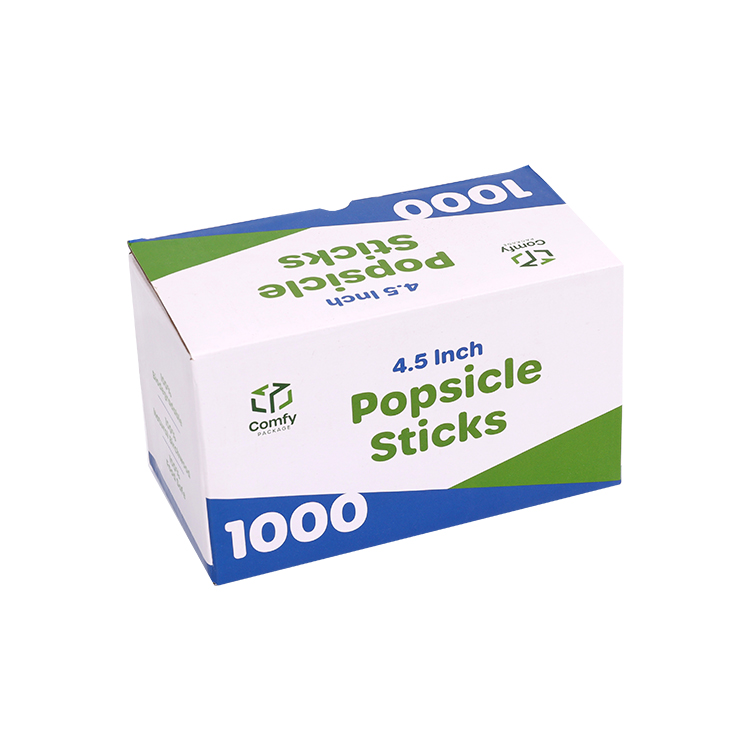
Eco-Ancheng supplies natural, uncoated birch wood ice cream sticks for frozen dessert makers, importers, wholesalers, and private label brands, with support for standard or custom sizes, colors, logo printing, engraving, hot stamping, individual or bundled packaging, custom cartons, machine and manual sorting, and applicable food contact documentation.
Standard MOQ is approximately 1,000,000 pieces, and production lead time is typically 30 to 45 days after specification, samples, packaging, and artwork are approved, excluding shipping time.
Eco-Ancheng uses birch wood for its wooden ice cream sticks, moving from birch raw material through veneer preparation, shaping, drying, polishing, end rounding, sorting, and packing.
No. Eco-Ancheng's standard natural birch ice cream sticks are uncoated, with their smooth surface achieved through wood selection and mechanical processing.
Finished sticks go through machine sorting and manual inspection to separate pieces with unacceptable dimensions, deformation, cracks, burrs, splinters, stains, or other visible defects from qualified stock.
Yes, provided compatibility is verified on the specific machine. Buyers should test samples for feeding, separation, orientation, insertion depth, and breakage before approving bulk production.
Real formulations vary in acidity, fat, flavoring, color, and freezing behavior, so testing in the finished product helps catch potential changes in odor, taste, appearance, stability, and insertion performance.
Yes. Length, width, thickness, end profile, and overall shape can be tailored to match the frozen product, mold, and production equipment.
Making a quality wooden ice cream stick takes more than cutting birch wood into a familiar outline. Veneer quality, drying, polishing, end rounding, dimensional accuracy, and defect removal all affect how well the stick feeds, freezes, demolds, and feels in use.
Factory checks confirm raw material, dimensions, surface condition, and packing, while trials in the actual recipe, mold, and equipment confirm real-world performance before bulk production. Eco-Ancheng supports standard and custom birch wood ice cream sticks, application sampling, branded options, and bulk packaging for frozen dessert projects—share your product dimensions, mold details, and packaging needs to start a specification for testing and quotation.
Source Birch Ice Cream Sticks in Bulk
Natural uncoated sticks with custom sizes, branding and packaging.

Hello, I'm Sven Wang, the Manager of Ancheng. With extensive expertise in raw materials and production processes, I'm dedicated to advancing sustainable tableware and constantly improving eco-friendly options for the modern catering industry. You can trust that Ancheng is committed to providing the highest quality. Welcome!

Factory: Qian Renqiao Industrial Park, Shucheng County, Luan City, Anhui Province, China
Office: Building 11, Max Science Park, Shushan Dist, Hefei, Anhui, China
Copyright ©2026 Anhui Ancheng Bamboo and Wood Tableware Co., Ltd. Privacy Policy



 Index
 Product
 Resources
 About