8 oz equals 1 cup.
This is the standard U.S. liquid measurement used in cooking, baking, and drink preparation. When a recipe calls for 8 oz of water, milk, or juice, it means you should fill one full cup.
But this simple rule only works for liquids that have a density close to water. Many ingredients, like flour, cheese, or pasta, do not follow the 1:1 rule. They weigh 8 oz, but their volume changes because air, shape, or texture affects how tightly they pack into a cup. This is why 8 oz of flour becomes more than 1 cup, while 8 oz of butter is exactly 1 cup.
In real life, this conversion helps home cooks, baristas, and restaurant staff measure ingredients fast. It also explains why 8 oz cups are often used as small coffee cups or sample-size cups in food service.
When we say “8 oz,” we are talking about fluid ounces, a unit used to measure the volume of liquids. It tells you how much space a liquid takes up, not how much it weighs. This is why 8 oz of water and 8 oz of honey fill the same amount of space, even though honey is much heavier.
A common point of confusion is the difference between fluid ounces and weight ounces. Many people see the word “ounce” and assume the number is always the same, but in cooking, these two units behave very differently. Liquid ounces measure volume. Weight ounces measure mass. Some foods, like butter, match both systems perfectly. Others, like flour or shredded cheese, don’t match at all because they contain air pockets or pack loosely.
Another source of confusion comes from the term “8 oz cup.” An “8 oz cup” does not always mean the cup can hold exactly 8 oz of liquid. Many cups are labeled by their “nominal” size, but the actual usable volume can be smaller because manufacturers leave room at the top to prevent spills. This rim space is important in cafés, juice shops, and restaurants.
For cooks, bakers, and food service buyers, knowing what 8 oz really represents helps avoid mistakes when scaling recipes, choosing cup sizes, or reading packaging.
Here is a simple chart that shows how many cups different ounce amounts equal. This table helps you measure liquids quickly when you don’t want to do math in your head.
Oz to Cups Conversion Table
These numbers come from the U.S. measurement system, where 1 cup always equals 8 oz. This chart works well for water, juice, milk, and most other liquids with similar density.
For dry ingredients, the numbers can change because each ingredient settles differently in a cup. That is why flour, shredded cheese, or pasta do not follow the exact 1 cup = 8 oz rule.
If you work in a kitchen, café, or food service setting, this chart can help you scale recipes, portion drinks, and choose the right cup size without guessing.
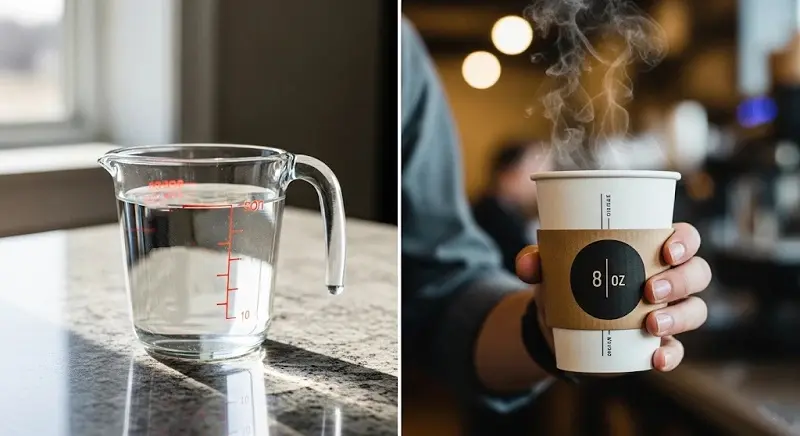
In real life, 8 oz is one of the most common sizes used in home kitchens, cafés, and food service businesses. It is small enough for single servings but large enough for many everyday recipes.
Many recipes use 8 oz as a standard amount for liquids such as milk, broth, and water. When a recipe lists “1 cup,” it usually means 8 oz. This size is helpful when mixing pancake batter, making sauces, or preparing drinks at home. For soups or baking mixtures, 8 oz helps keep portions consistent and prevents overfilling.
In cafés, 8 oz is widely used as the small hot coffee size. It is ideal for customers who want a lighter portion or a stronger drink without too much liquid. Some juice shops and smoothie bars also use 8 oz cups for kids’ drinks or small fresh juice servings. Because 8 oz cups are compact and easy to handle, staff can serve drinks quickly without spills.
Food service buyers often order cups by size—8 oz, 12 oz, 16 oz, and 24 oz are common SKUs. An 8 oz cup is used for children’s meals, sample drinks, or side beverages. Buyers usually look for cups with consistent sizing, stable quality, and reliable supply.
This is where manufacturers like Ancheng are commonly chosen, because they offer a full range of cup sizes, steady production, and customizable materials for different food service needs.
The 8 oz cup sits right in the small-to-medium range of drink sizes. It is smaller than most café-size iced drinks but larger than sample cups. Understanding how it compares to other sizes helps you choose the right portion for your drink or recipe.
Common Cup Size Comparison
An 8 oz cup is perfect for single hot drinks that don’t need a large serving. Many cafés use this size for cappuccinos, flat whites, and house coffee. It allows stronger flavor without too much dilution. For juice bars, 8 oz is often the children’s size or the “small fresh juice” option. It gives enough volume for a healthy serving without wasting ingredients.
Restaurants or bubble tea shops require cups of various sizes to accommodate different customer needs and operational requirements. Food service businesses usually stock 8 oz, 12 oz, 16 oz, and 24 oz together. This helps them serve everything from hot drinks to iced drinks and smoothies.
Buyers often choose suppliers who can produce all sizes with consistent quality, which is why companies like Ancheng are popular for custom multi-size drink cup programs.
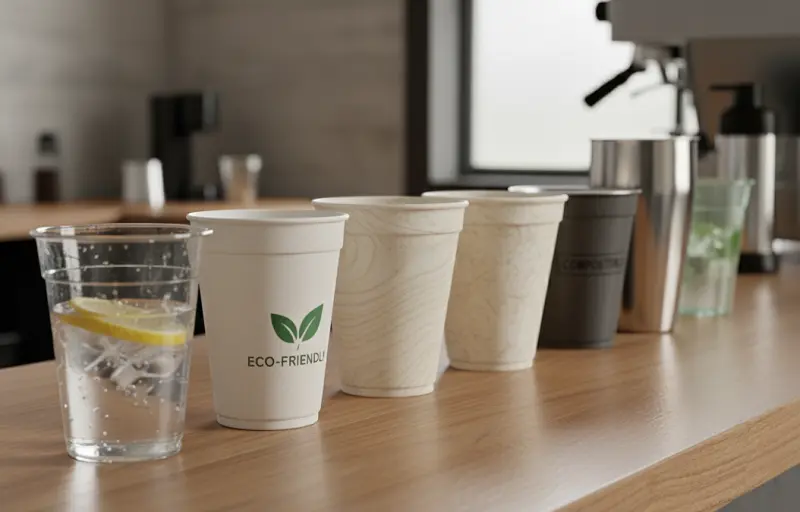
Cups come in many materials, and each one behaves differently with hot drinks, cold drinks, or food. Understanding the strengths and limits of each material helps you choose the right 8 oz cup for home use, cafés, or food service.
PET (Polyethylene Terephthalate)
Used mostly for cold drinks. PET is clear, smooth, and looks premium.
Good for: iced coffee, iced tea, juice
Not good for: hot drinks
Why: PET softens at high heat and cannot handle steam
PP (Polypropylene)
Common for hot drinks because it handles heat well.
Good for: hot coffee, tea, soup
Not good for: strong alcohol or very hot frying liquids
Why: PP is heat-tolerant but still lightweight
PS (Polystyrene)
Very clear and rigid, but cracks more easily.
Good for: tasting cups, small cold drinks
Not good for: hot drinks
Why: PS becomes brittle with heat
Plastic cups are cheap and widely used, but they are not biodegradable.
Paper cups are the most common type of disposable cup.
PE-lined paper cups
These have a plastic lining that stops leaks.
Good for: hot and cold drinks
Not eco-friendly because the PE layer is hard to separate during recycling
PLA-lined paper cups
PLA is a biobased lining made from corn starch.
Good for: cold or warm drinks
Not suitable for: temperatures above 50–60°C
Eco benefit: compostable in industrial facilities
Standard paper cups
Simple, lightweight, and used in many cafés.
Affordable but less resistant to moisture without a lining
Bamboo pulp cups
Strong, odor-free, and naturally renewable
Good for 8 oz hot coffee or juice
Often chosen by brands that focus on sustainability
Smooth texture and stable shape
Suitable for both hot and cold drinks
A popular choice for food service chains that want natural-looking packaging
Heat-resistant and biodegradable
Works well for both drinks and small food servings
Manufacturers like Ancheng offer bamboo and wood pulp cups, along with 4–24 oz full-size ranges, because food service buyers often need matching sizes for all drink categories.
Glass cups
Reusable, clean, and great at keeping flavor pure.
Not portable and easily breaks.
Stainless steel cups
Durable and keeps drinks hot or cold longer.
More expensive and not used for disposable service.
The choice of cup size is a strategic decision impacting material costs, operational flow, and brand perception. The goal is to maximize efficiency while ensuring a quality customer experience.
Determine the "golden volume" that best serves your core offerings and profit goals.
Premium Beverages: Use smaller sizes (e.g., 6 oz - 8 oz ceramic cups) for espresso and specialty drinks to emphasize quality and justify higher pricing.
Corporate/Universal Use: 8 oz (240 ml) is a highly efficient choice. It accommodates standard servings (tea bags, instant coffee) without excessive volume, acting as a crucial tool for controlling commodity costs (coffee, milk, sugar).
High-Volume Service: Standardize 2-3 tiered sizes (12 oz, 16 oz) to meet demand, but always audit volume to prevent the cost of over-serving.
Reduce complexity in procurement and storage by streamlining your size selection.
Minimize SKUs: Limit cup specifications to 2-3 core sizes. Too many variations increase inventory risk, complicate ordering, and prevent you from realizing maximum bulk purchasing discounts.
Accessory Compatibility: Ensure that lids, sleeves, and holders are interchangeable across your core sizes (especially for takeaway cups) to reduce waste from mismatched parts.
Focus Purchasing: Treat the most frequently used size (often the 8 oz office/small-serve cup) as a strategic SKU for large-volume, cost-saving contracts.
The cup's size dictates how clients perceive the value of the beverage inside.
Avoid "Empty Space": Using an oversized cup for a standard serving creates a perception of low value or being cheated. Match cup size to actual drink volume precisely.
Operational Fit: The cup must fit your equipment (coffee machine spouts, cup dispensers) and operational standards. Standard sizes, like the 8 oz, enable staff to execute drink recipes quickly and accurately, minimizing errors.
Temperature Stability: For takeaway or delivery, select a size that couples well with quality insulation or thick materials. Maintaining temperature is a direct component of service quality.
1. How much is 8 cups of water in oz?
8 cups of water equals 64 oz.
Water follows a simple rule where 1 cup equals 8 oz because its density stays stable. This makes large-volume conversions very easy, especially for hydration tracking and cooking. Since water does not trap air or change texture, the measurement is always accurate. This conversion is also used in many meal-prep and nutrition guides.
2. How much is 8 oz of flour in cups?
8 oz of flour is about 1.7 cups.
Flour is lighter than water because it traps air, so 8 oz takes up more space. The exact volume depends on whether the flour is scooped or spooned. This difference matters in baking because extra flour can change texture. Spoon-filling the cup gives a more accurate result for home users.
3. How many cups is 8 oz butter?
8 oz of butter equals 1 cup.
Butter has stable density and does not trap air, so its 1:1 conversion is very accurate. This works for salted and unsalted butter. In the U.S., 8 oz also equals two sticks, which makes recipe measuring simple.
4. How many cups is 8 oz pasta?
8 oz of dry pasta equals about 2 cups.
Pasta shapes vary, but most dry pasta expands in volume because pieces leave air gaps. This makes 8 oz appear larger than expected. The rule is helpful because pasta usually doubles when cooked, allowing easier meal planning.
5. How much is 8 oz of cream cheese in cups?
8 oz of cream cheese equals 1 cup.
Cream cheese is dense and smooth, and it packs into a cup without leaving much air. This makes the conversion reliable for cheesecakes and dips. Softening it slightly makes measuring easier.
6. How much is 8 oz sour cream in cups?
8 oz of sour cream equals 1 cup.
Sour cream has a thick texture similar to cream cheese, so its weight-to-volume ratio is stable. It spreads evenly into a cup, making measurement easy for dips, sauces, and baking.
7. How much is 8 oz of cheese in cups?
8 oz of cheese equals 1–2 cups, depending on type.
Shredded cheese traps air, making its volume larger than block cheese. Hard cheeses create less volume, while soft shredded cheeses fluff up more. Knowing the cheese type helps prevent measurement errors.
Choosing the right cup size is easier when you understand how volume, material, and drink type work together. If you are running a café, a juice bar, or a food service business, having reliable cup options can help you serve drinks more smoothly and keep your costs under control.
At Ancheng, you can explore full-size cup collections from 4 oz to 24 oz, along with choices such as bamboo pulp, wood pulp, bagasse, and custom-printed paper cups. These options help you match your brand style while keeping your operations simple and consistent.
If you want a stable supply, custom packaging, or expert guidance on choosing drinkware, talk with our team today. We are here to help you find the cup that fits your drinks and your business perfectly.

Hello, I'm Sven Wang, the Manager of Ancheng. With extensive expertise in raw materials and production processes, I'm dedicated to advancing sustainable tableware and constantly improving eco-friendly options for the modern catering industry. You can trust that Ancheng is committed to providing the highest quality. Welcome!

Factory: Qian Renqiao Industrial Park, Shucheng County, Luan City, Anhui Province, China
Office: Building 11, Max Science Park, Shushan Dist, Hefei, Anhui, China
Copyright ©2026 Anhui Ancheng Bamboo and Wood Tableware Co., Ltd. Privacy Policy


 Index
Index Product
 Resources
 About
About