Toothpicks may look simple, but producing them consistently requires several carefully controlled steps. The raw material must be converted into thin, straight rods, dried to a suitable moisture level, polished to remove rough fibres, sharpened accurately and inspected before packaging.
Bamboo and birch wood toothpicks share many finishing processes, but they do not begin in the same way. Bamboo is split and sliced along its natural fibres, while birch logs are rotary-peeled into thin veneer before being cut into slender wooden rods.
This guide explains how Eco-Ancheng manufactures bamboo and birch wood toothpicks, and helps you choose the right materials.
The main difference between bamboo and birch toothpick manufacturing occurs before the material is shaped into small round rods.
| Production Stage | Bamboo Toothpicks | Birch Wood Toothpicks |
|---|---|---|
| Starting material | Bamboo culms | Birch logs |
| Initial processing | Cross-cutting and splitting | Cutting and debarking |
| Thin material preparation | Sliced into bamboo strips | Rotary-peeled into veneer |
| Rod formation | Strips are passed through rod-making equipment | Veneer is cut and formed into narrow rods |
| Shared finishing stages | Drying, cutting, polishing, sharpening, inspection and packaging | Drying, cutting, polishing, sharpening, inspection and packaging |
Once both materials have been formed into straight rods of the required diameter, their remaining production stages become more similar.
Production begins with bamboo suitable for making thin, straight sticks. The material is checked for visible mold, insect damage, decay, major cracks and other defects that could affect the finished toothpick.
The bamboo culms are then cross-cut into shorter sections that can be handled by the splitting and slicing equipment.
Industrial bamboo toothpick production commonly begins with cross-cutting, splitting, rod formation, drying, polishing and sharpening.
The cut bamboo sections are split lengthwise into narrower pieces.
Bamboo fibres naturally run along the length of the culm. Splitting in the same direction helps preserve the continuous fibre structure needed to produce slender toothpicks.
Protruding nodes or unsuitable sections are removed or avoided where they would interfere with consistent rod formation.
The split bamboo pieces are processed into progressively thinner strips.
The outer and inner layers may require adjustment or removal so that the material entering the rod-making equipment has a suitable thickness and relatively uniform structure.
This stage is important because excessively thick, uneven or damaged strips can produce irregular toothpick diameters or rough surfaces later in production.
The thin bamboo strips are passed through sizing or rod-making equipment. The machines gradually shape the material into long, slender rods with a round cross-section.
The target diameter depends on the finished specification. Eco-Ancheng supports common toothpick diameters of:
- 1.8mm
- 2.0mm
- 2.2mm
Diameter affects both appearance and handling. A slimmer toothpick provides a lighter profile, while a thicker option offers greater rigidity.
The formed bamboo rods are cleaned and dried before further processing.
Drying helps control moisture, dimensional stability and the risk of mold during storage. Moisture is checked during production rather than judged only by the appearance of the bamboo.
Birch toothpicks follow a different material-preparation route because wood logs cannot be split into natural hollow sections like bamboo.
Birch is commonly used for wooden toothpicks because it has a relatively uniform structure, can be machined accurately and can achieve a smooth surface after polishing.
Incoming logs are checked for decay, mold, insect damage, large cracks and other defects that could reduce the usable yield or affect finished-product quality.
The selected birch logs are cut into manageable sections and the bark is removed.
The prepared logs may be softened with controlled heat or moisture before peeling. This makes the wood easier to process into continuous, thin sheets without excessive cracking.
Each prepared log is mounted in rotary-peeling equipment. As the log rotates, a peeling knife removes a continuous thin layer of wood known as veneer.
This is one of the most important differences between bamboo and birch toothpick manufacturing:
- Bamboo is split and sliced into strips along the culm.
- Birch logs are peeled into thin sheets of veneer.
The veneer is checked for major knots, cracks, discoloration and damaged areas before it moves to the next stage.
The birch veneer is cut into narrow strips and processed into long wooden rods with the required cross-section.
Accurate cutting helps maintain consistent diameter and reduces defects such as missing material, uneven edges and weak points.
The rods are then prepared for drying, length cutting and finishing.
The wooden rods are dried to control their moisture content before being cut and sharpened.
Poor moisture control can contribute to deformation, mold or cracking during later storage and transportation. Samples are therefore checked during the relevant production stages.
After the bamboo or birch material has been formed and dried, the long rods are cut into the required finished length.
Eco-Ancheng’s standard toothpick length is 65mm.
During cutting, the equipment must produce consistent lengths without crushing the rods or creating badly split ends. Cut samples are checked against the order specification before continuous production proceeds.
Custom requirements should be confirmed before production because length, diameter, point style and packaging must work together.
The cut toothpick blanks are polished to remove loose fibres, rough areas and sharp longitudinal edges.
Polishing is particularly important because toothpicks come into contact with the mouth and are handled directly by consumers. A finished toothpick should have:
- A smooth surface
- No obvious burrs
- No loose splinters
- No major cracks
- No sharp ridges along the body
- A clean and natural appearance
Polishing must also be controlled carefully. Insufficient polishing leaves rough fibres, while excessive processing can reduce diameter or weaken the product.
After polishing, the ends are shaped according to the required toothpick style.
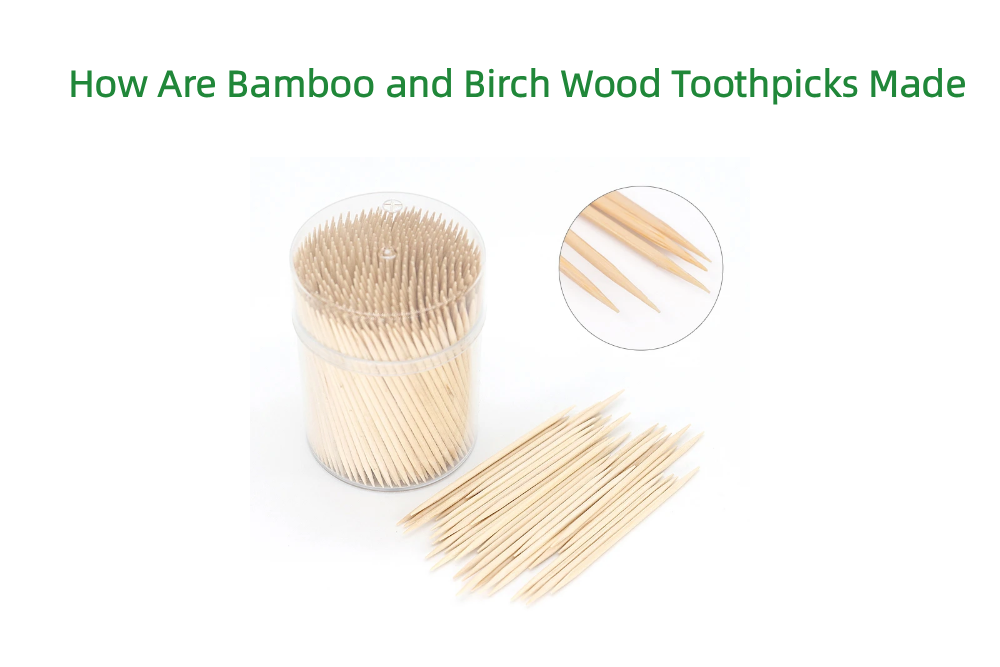
Double-point toothpicks are sharpened at both ends. They are widely used in restaurants, catering, household retail packs and general foodservice applications.
The sharpening equipment must create consistent points without leaving split tips or excessively fragile ends.
Single-point toothpicks have one sharpened end and one blunt or decorative end. Depending on the design, the blunt end may include grooves or other shaping.
These toothpicks are often selected for food presentation, cocktail service or product formats where users need a more comfortable gripping end.
Mint can be applied to one or both ends according to the product specification.
Mint-tip toothpicks require additional control over the treated area, appearance and packaging so that the finished product matches the approved sample.
After the main shaping and finishing stages, the toothpicks are cleaned and prepared for hygienic packaging.
Eco-Ancheng uses UV disinfection after polishing and product screening and before final packaging. Employees handling cleaned products follow hygiene procedures and use the required protective clothing.
UV treatment forms part of the factory’s hygiene controls, but it does not replace material inspection, moisture control, food-contact testing or clean packaging practices. These controls work together rather than functioning as one isolated step.
Finished toothpicks are inspected before packaging. Defective pieces are removed from the qualified product flow.
The inspection may cover:
- Correct length and diameter
- Straightness
- Smooth surface condition
- Consistent point formation
- Split, barbed or broken tips
- Cracks and loose fibres
- Mold, stains or insect damage
- Abnormal odor
- Moisture condition
- Overall cleanliness
Single-point and double-point toothpicks require slightly different end inspections, but both must be checked for point consistency and safe handling.
Inspection is especially important for natural materials because small variations in color and grain are normal, while structural defects and rough surfaces are not.
Bleaching is not a universal step in toothpick manufacturing.
Some factories use additional treatments to obtain a more uniform light color, while others rely on material selection, cleaning, drying and sorting. Treatment methods can vary according to material, product specification and manufacturer.
Buyers who have specific requirements concerning color treatment or chemical processing should confirm the following before ordering:
- Whether bleaching is used
- Which treatment method is applied
- Whether the product has an additional coating
- Which food-contact reports apply to the finished product
- Whether an untreated natural appearance is available
After inspection and UV disinfection, qualified toothpicks are counted or filled into the approved packaging.
Eco-Ancheng supports several packaging formats.
Bulk bags are suitable for foodservice distributors, repacking operations and high-volume hospitality use.
Paper boxes are a familiar retail format and can be customized with brand artwork, product information, barcodes and market-specific labeling.
The MOQ for boxed toothpick products starts from 5,000 boxes.
Bottled toothpicks are suitable for household retail, supermarkets and foodservice counters. Bottle style, cap color, label and toothpick count can be adapted to the project.
The MOQ for bottled products starts from 20,000 bottles.
Toothpicks can be individually wrapped in:
- Paper wrappers
- Film wrappers
Individual wrapping is commonly selected by restaurants, hotels, airlines, takeaway brands and catering suppliers that require convenient single-use distribution.
One toothpick is normally placed in each wrapper, while wrapper printing and pack quantity can be customized.
Packaging inspection confirms more than the external appearance of the pack.
Before shipment, the team checks:
- Toothpick quantity
- Inner-pack configuration
- Packaging cleanliness
- Seal integrity
- Label information
- Barcode number and scan result
- Private-label artwork
- Batch and order details
- Outer-carton markings
- Carton condition
The approved packaging specification is checked against the finished order to reduce errors during retail distribution and warehouse receiving.
Both materials can be made into smooth, food-contact toothpicks, but their natural structure remains different.
Bamboo has long, continuous fibres and is formed from split culm strips. It generally produces a firm toothpick with visible natural bamboo characteristics.
Birch toothpicks are formed from rotary-peeled veneer. Birch provides a pale, relatively uniform wooden appearance and can be processed into consistent slender shapes.
The better choice depends on:
- Target market preference
- Required appearance
- Diameter and rigidity
- Packaging position
- Brand material story
- Applicable documentation
- Order cost and volume
Material alone does not determine finished quality. Drying, polishing, sharpening, screening and packaging control have a direct effect on the product buyers receive.
No. Bamboo is cross-cut, split, sliced and formed into rods. Birch logs are debarked and rotary-peeled into veneer before being cut and shaped into rods. Their finishing stages, including drying, length cutting, polishing, sharpening and inspection, are more similar.
Eco-Ancheng’s standard length is 65mm, with diameter options of 1.8mm, 2.0mm and 2.2mm. Of course, we can customize other sizes to meet customer needs.
Yes. Both single-point and double-point formats are available. The correct option depends on the intended use and market preference.
Yes. One toothpick can be packed in an individual paper or film wrapper. Custom printing is available for hospitality and private-label projects.
Yes. Paper boxes, bottles, individual wrappers and outer cartons can be customized with logos, colors, barcodes and product information.
No. Bleaching and color-control practices vary by manufacturer and product specification. Buyers should ask the supplier to confirm whether treatment is used for the toothpick being quoted.
Eco-Ancheng manufactures bamboo and birch wood toothpicks for foodservice, retail and private-label customers. Available options include single-point and double-point styles, mint tips, multiple diameters and a range of bulk, boxed, bottled and individually wrapped packaging formats.
Contact our team to discuss toothpick material, size, point style, packaging and documentation for your target market.

Hello, I'm Sven Wang, the Manager of Ancheng. With extensive expertise in raw materials and production processes, I'm dedicated to advancing sustainable tableware and constantly improving eco-friendly options for the modern catering industry. You can trust that Ancheng is committed to providing the highest quality. Welcome!

Factory: Qian Renqiao Industrial Park, Shucheng County, Luan City, Anhui Province, China
Office: Building 11, Max Science Park, Shushan Dist, Hefei, Anhui, China
Copyright ©2026 Anhui Ancheng Bamboo and Wood Tableware Co., Ltd. Privacy Policy



 Index
 Product
 Resources
 About