For importers and distributors, the quality of disposable tableware is ensured not only by final inspections but, more importantly, by the rigor of the manufacturer’s quality control processes.
Eco-Ancheng applies quality controls throughout the production of wooden and bamboo tableware, from incoming materials to final packaging. The process combines first-piece confirmation, scheduled workshop inspections, manual screening, moisture testing, AQL sampling and shipping-detail verification.
This article takes you inside that process and explains how we work to maintain consistent quality across bulk orders.
Our raw materials are FSC-certified, and our staff conduct traceability checks and verify the relevant records. Each batch of wood or bamboo material is inspected before it enters production.
The incoming quality control team checks:
- Insect damage, decay, mold and bark residue
- Cracks, stains, discoloration and unusual odors
- Material thickness, width and length
- Moisture content
- Knots, splits and other natural material defects
- Quantity and consistency with purchasing documents
For incoming wooden materials, moisture content is generally controlled within 8–12%. Managing moisture at this stage helps reduce the risk of cracking, deformation and mold during later processing and storage.
Materials that do not meet the applicable requirements are rejected or isolated before production.
Quality inspection continues when production begins.
The first finished piece from a new production run is checked before continuous processing. Another first-piece confirmation is performed when production conditions change, such as:
- Starting a new material batch
- Replacing a cutting tool
- Changing a grinding wheel or sanding belt
- Adjusting the machine or product specification
This allows dimensional, forming or surface problems to be identified before they affect a larger quantity of products.
The first-piece inspection may include length, width, thickness, cutting tolerance, shape, curvature and surface condition, depending on the product being manufactured.
After the first piece is approved, quality inspectors conduct routine workshop inspections throughout production.
Inspections are normally performed every two hours across the wooden and bamboo tableware production lines. The inspector checks both the products and the relevant production conditions, records the findings and follows up when corrective action is needed.
During cutting and rough processing, the main checks include:
- Cutting dimensions and tolerance
- Split or damaged edges
- Missing material
- Surface contamination
- Burrs caused by cutting
- Moisture content of semi-finished products
During forming, inspectors examine the product shape, curvature, thickness and overall dimensions. Warping, cracks, chipped edges, oil marks and visible contamination are also checked.
Scheduled inspections help identify variation during production instead of waiting until the whole batch has been completed.
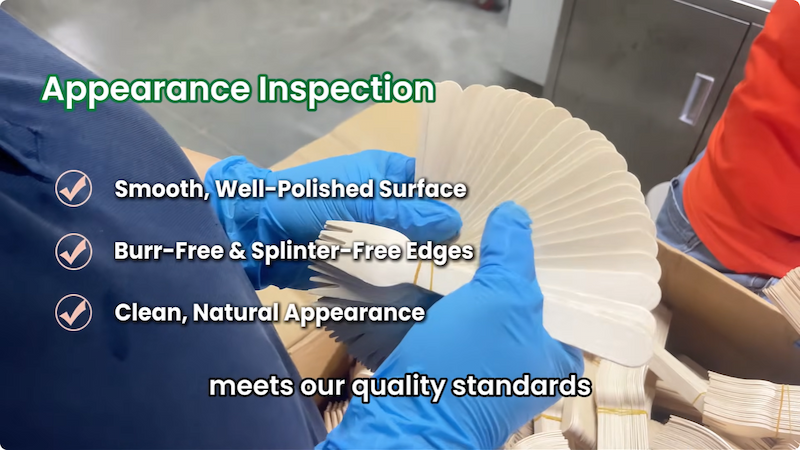
Surface quality is especially important for disposable wooden and bamboo tableware because the product comes into direct contact with food and users’ hands and mouths.
Inspectors check whether the finished pieces have:
- Smooth, properly polished surfaces
- Burr-free and splinter-free edges
- No sharp corners
- No cracks or chipped areas
- No mold, insect holes or visible contamination
- No abnormal stains or odors
- A clean and natural appearance
Both sides and all edges are examined. Inspectors may also touch the product surface to identify rough areas that are difficult to detect visually.
Over-polishing is also considered a defect when it removes too much material or affects the intended shape and dimensions.

Quality control also includes hygiene procedures for employees handling cleaned or finished products.
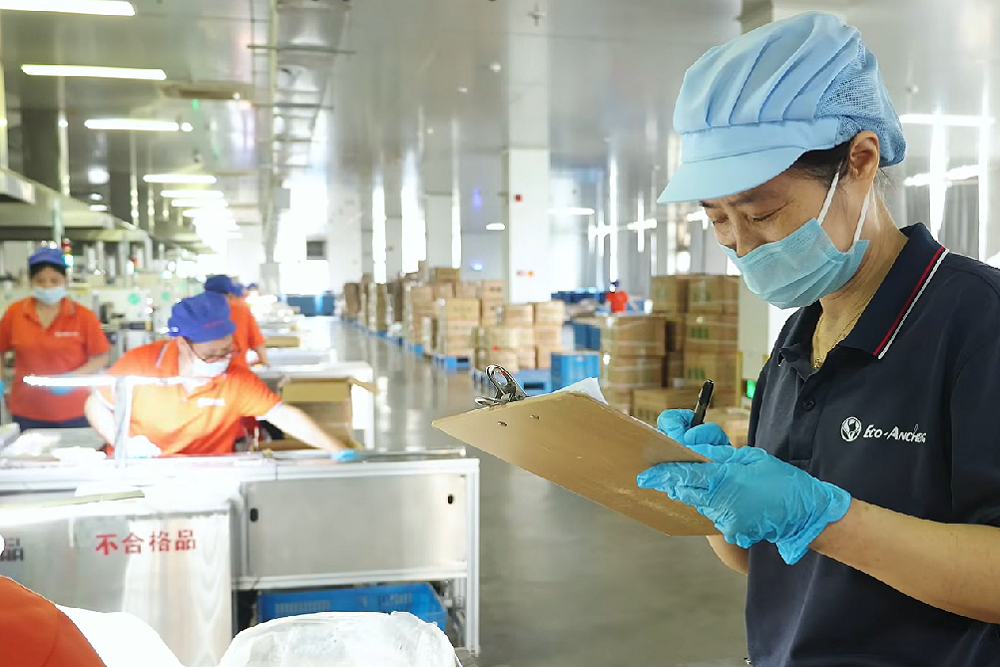
Before entering designated production areas, workers wash their hands and put on the required protective clothing, caps, masks and gloves. They then pass through an air shower room to reduce the transfer of dust and other contaminants into the controlled work area.
Clean work surfaces and appropriate product storage are maintained during screening, inspection and packaging.
These measures complement product inspection. A well-polished item still needs to be handled and packed under suitable hygienic conditions.
Automated equipment supports efficient production, but manual screening remains important for detecting natural material defects and small appearance variations.
Workers screen the products and separate qualified items from B-grade and defective pieces. A second manual screening may be conducted before products move to the next stage or enter packaging.
Examples of unacceptable defects are displayed in the workshop to help employees recognize recurring problems consistently. These references may include:
- Cracks and breakage
- Missing sections
- Heavy discoloration
- Deformation
- Rough or incomplete polishing
- Chipped fork tines
- Damaged spoon bowls
- Incorrect forming
Dedicated containers and clearly identified non-conforming product areas prevent rejected pieces from being mixed with qualified products.
This separation is not simply a final sorting exercise. Defect findings can also help production teams identify which process requires adjustment.
Finished products are checked against the approved order specifications.
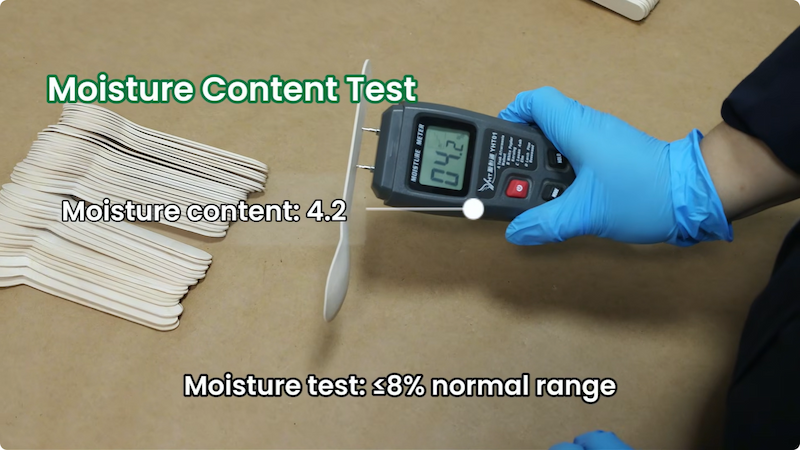
Finished wooden tableware is tested with a moisture meter. Our moisture content requirements for finished products are stricter than industry standards, minimizing storage risks for disposable tableware as much as possible.
This differs from the wider incoming-material range because raw material and finished products are measured at different stages of processing. Proper control after drying helps reduce the risk of mold, cracking and dimensional change during storage and transportation.
Inspectors check the product’s:
- Total length
- Width
- Thickness
- Shape and curvature
- Order-specific dimensional tolerance
Dimensional consistency is particularly important for retail packs, cutlery sets, automatic packaging and customized orders.
Samples may also undergo practical physical checks, including:
- A controlled bending check to identify pieces that break too easily
- A simple drop test to check for cracking or damage
- Product-specific performance checks where required
The exact inspection method depends on the product and order requirements.
Review Quality Before Placing a Bulk Order
Request samples, test documents and product specifications.
After production is completed, finished products undergo inspection before packaging and shipment.
Every production batch is checked using AQL sampling procedures. The inspection covers appearance, dimensions, physical condition and packaging requirements without publicly disclosing customer-specific sampling plans or acceptance limits.
Typical finished-product acceptance points include:
- No mold, cracks or insect damage
- No burrs, splinters or sharp edges
- No missing corners or damaged forming
- No abnormal odor
- Correct size and product style
- Clean and complete packaging
- Correct quantity per pack and carton
If an inspection identifies non-conforming products, they are isolated for evaluation and appropriate handling rather than being released as qualified goods.
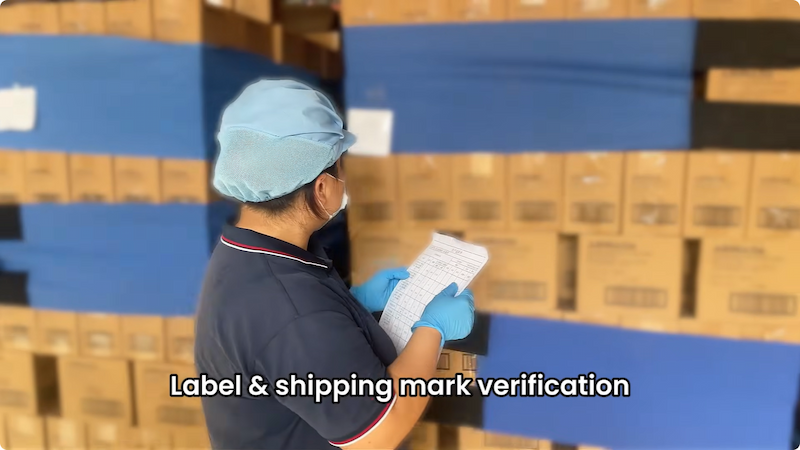
Eco-Ancheng’s quality inspection does not end when the tableware itself is approved. We are well aware that packaging errors can still create serious problems for importers, retailers and distribution centers.
Before shipment, inspectors verify:
- Inner-pack and carton quantities
- Packaging cleanliness and integrity
- Product and size information
- Customer labels
- Batch and order references
- FSC labels and claims, where applicable
- Outer-carton shipping marks
- Barcode numbers and scan results
- Carton condition and signs of moisture exposure
Barcodes are scanned to confirm that they can be read and that the encoded number matches the approved packaging information.
Labels and shipping marks are checked against order records before cartons are released for shipment.
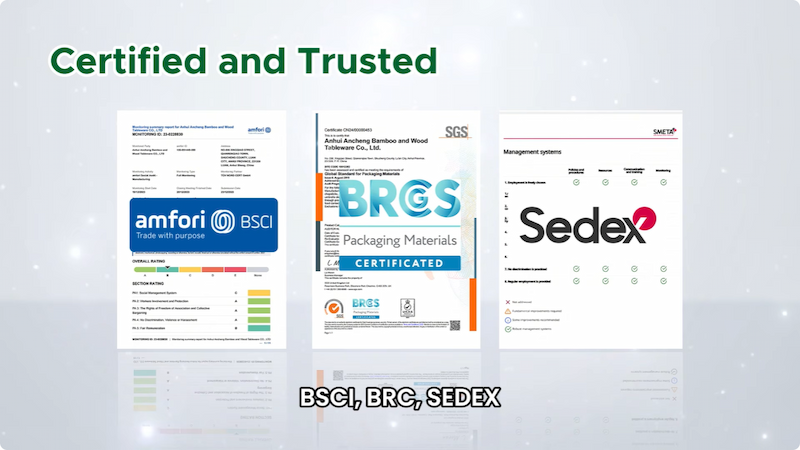
Factory inspections confirm whether each production batch meets the approved specifications, while management certifications and third-party reports provide additional evidence at the system and product-compliance levels.
Eco-Ancheng maintains quality management and factory audit documentation, including ISO 9001 and relevant BRC reports. For selected wooden and bamboo tableware, market-specific food-contact reports such as FDA, LFGB and DGCCRF are also available.
Depending on the product, destination market and customer requirements, third-party testing covers areas such as:
- Sensory characteristics
- Overall migration
- Formaldehyde migration
- Heavy-metal migration
- Preservative residues
- Microbiological indicators
These documents serve different purposes:
- ISO 9001 supports the factory’s quality management system.
- BRC-related reports support reviews of manufacturing and hygiene controls.
- FDA, LFGB and DGCCRF reports relate to applicable food-contact requirements for specific materials and products.
- FSC documentation supports responsible sourcing and material traceability rather than finished-product performance.
- SEDEX and BSCI reports relate mainly to social compliance and factory assessment, not product food safety.
For current document availability and scope, visit Eco-Ancheng’s Certifications page.
Natural wood and bamboo have unavoidable variations in grain and color. Quality control does not attempt to make natural materials look artificial. Its purpose is to keep functional and safety-related characteristics within the approved requirements.
By combining material inspection, first-piece confirmation, two-hour workshop patrols, manual screening, moisture control, AQL sampling and packaging verification, Eco-Ancheng works to control the variations that matter to B2B buyers:
- Product dimensions
- Surface smoothness
- Burr and splinter risk
- Strength and breakage
- Moisture condition
- Pack quantity
- Label and barcode accuracy
- Consistency between approved samples and bulk production
This is particularly important for repeat orders, retail packaging and long-term supply programs where one acceptable sample is not enough.
For a shorter overview of our quality management approach, visit our Quality Control page.
As a leading manufacturer of disposable tableware in China, Eco Ancheng fully understands the importance of high-quality products for both our customers and the environment. We ensure that every product we ship meets your needs. If you have specific specifications, inspection requirements, or target markets, please contact us to discuss these details before placing a bulk order.
Looking for a Reliable Tableware Manufacturer?
Explore our production and quality control capabilities.

Hello, I'm Sven Wang, the Manager of Ancheng. With extensive expertise in raw materials and production processes, I'm dedicated to advancing sustainable tableware and constantly improving eco-friendly options for the modern catering industry. You can trust that Ancheng is committed to providing the highest quality. Welcome!

Factory: Qian Renqiao Industrial Park, Shucheng County, Luan City, Anhui Province, China
Office: Building 11, Max Science Park, Shushan Dist, Hefei, Anhui, China
Copyright ©2026 Anhui Ancheng Bamboo and Wood Tableware Co., Ltd. Privacy Policy



 Index
 Product
 Resources
 About