Selecting the right wooden skewer depends on direct alignment with application scenarios, food type and weight, and compliance with food safety standards. Prioritize material toughness for heavy or high temperature foods, compact sizing for small bite foods, and certified food grade materials for all food contact use. Wholesale buyers should partner with professional manufacturers for consistent quality and scalable supply.
Wooden skewers are essential disposable food tools for food service and retail sectors. They serve diverse applications from barbecue and kebab preparation to cocktail and appetizer presentation. The wrong choice of wooden skewer leads to issues such as breakage during use, poor food presentation and even food safety risks. This guide details the key factors for selecting wooden skewers for different scenarios, and provides practical sourcing advice for wholesale buyers and food service operators.
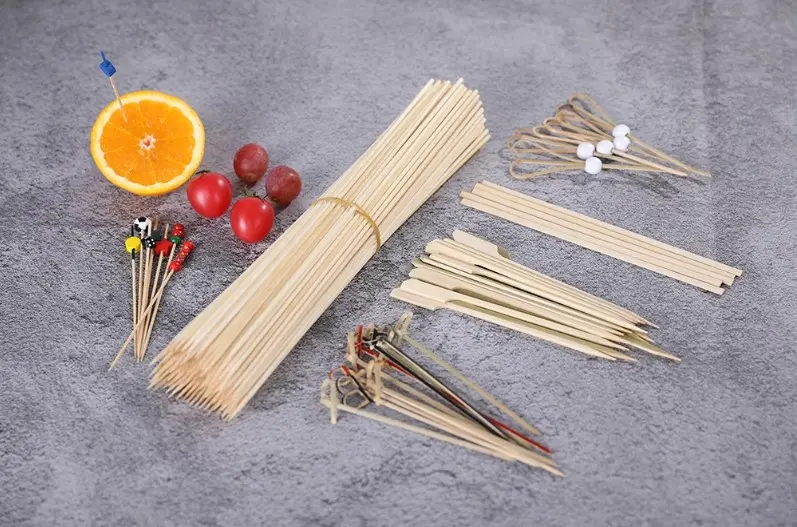
A wooden skewer is a slim stick made from natural wood or bamboo, commonly used to hold, pierce, or present food items. Wooden skewers are usually disposable and are designed for single use in food contact situations.
a) Bamboo
Bamboo skewers are the most common type on the global market. Bamboo grows quickly, has good tensile strength, and produces skewers that are smooth and resistant to splintering. Bamboo skewers are widely used as barbecue skewers, kebab skewers, and food skewers.
Bamboo also possesses natural heat resistance. When used as barbecue skewers or a bbq skewer, bamboo performs better than most woods under direct flame or high heat. It is less likely to become brittle when exposed to moisture and heat simultaneously. For any application involving a grill or an oven, a bamboo skewer is generally the superior option.
b) Birch Wood
Birch wood skewers are often used for cocktail picks, appetizer picks, and decorative food picks. Birch has a uniform texture and can be polished to achieve a clean appearance, which makes it suitable for food presentation.
The surface of a birch skewer is often smoother than bamboo. This makes them ideal for delicate food items where splinters could be a significant concern. Birch is commonly used for cocktail picks or appetizer picks because it does not impart any flavor to the food and looks very clean in a formal setting.
c) Poplar Wood
Poplar wood is lightweight and easy to process. However, poplar wood is more prone to breaking under heavy loads compared to bamboo. It is often used for short wooden picks, sandwich picks, and simple disposable skewer products where high strength is not required.
Plastic skewers are the most widely used alternative to wooden skewers due to their low cost and high strength. They are suitable for cold food scenarios such as fruit cups, cold snacks and fast food packaging. However, their poor heat resistance makes them unsuitable for barbecue, hot pot and other high temperature applications. They also pose environmental risks due to difficult degradation.
Compared with metal or plastic alternatives, wooden skewers offer several practical benefits. They are disposable, biodegradable, and suitable for direct food contact. They are also cost effective, easy to transport, and available in a wide range of sizes and designs.
Ready to get sustainable wooden skewers?
Start with a low minimum order quantity
Size and specification are critical for matching wooden skewers to specific foods. Length and diameter are the two core dimensional parameters.
1. Barbecue and kebab skewers: A diameter of 3mm to 5mm and a length of 20cm to 30cm is recommended. This specification provides sufficient load bearing capacity for meat and vegetable chunks, and resists breakage over open flame or grill heat.
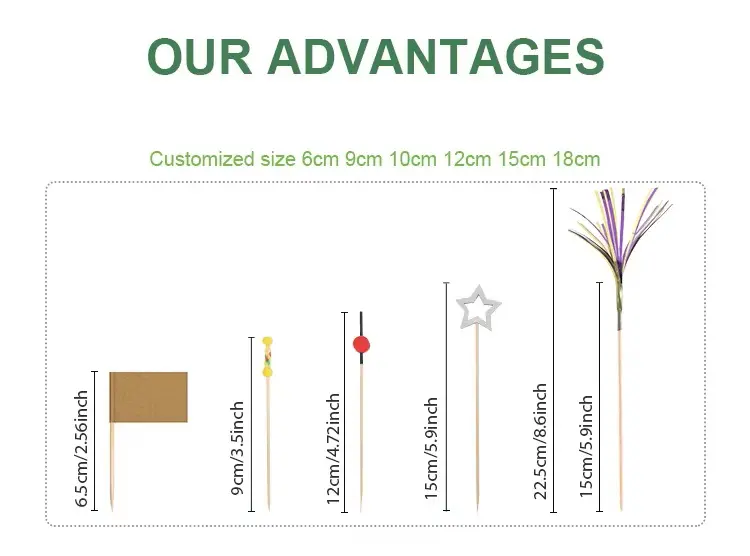
2. Cocktail picks and appetizer picks: Small size options work best. Lengths from 5cm to 12cm and diameters from 1.5mm to 2mm are suitable for fruit cubes, cheese bites and small appetizers.
3. Sandwich picks and burger skewers: Require short and sturdy designs. 8cm to 10cm lengths and 2mm to 3mm diameters hold layered foods together without protruding excessively.
4. Flat skewers: A special specification for wide or thin food pieces. They prevent food rotation during cooking and ensure even heat distribution for items such as bacon and vegetable slices.
The shape of the skewer determines how the food behaves during the cooking or serving process. Using the wrong shape can lead to frustration in the kitchen.
The round wooden skewer is the standard design. It is versatile and inexpensive. It works well for soft foods like fruit, marshmallows, or small pieces of meat. It is the cheapest and most common disposable food pick.
To solve the problem of rotating food, a flat skewer is the best choice. The flat surface creates more friction and surface area inside the food. When the skewer is turned, the food turns with it. This is particularly important for large kebab skewers or heavy items like shrimp and thick cuts of beef. If you are a wooden skewer wholesale buyer for a steakhouse or a Mediterranean restaurant, flat skewers are a necessary inventory item.
A paddle skewer, also known as a gun shape or teppo gushi, features one pointed end and one flat, wide end. The flat end serves as a handle. This design is perfect for burger skewers or sandwich picks. The handle provides a grip for the consumer and also offers a space for branding. Many restaurants use the flat area to stamp a logo. These are frequently used as food picks for appetizers because they are easy to pick up from a tray.
Knotted skewers are purely decorative. The top of the bamboo is tied into a knot. These are used almost exclusively as cocktail picks or for high end catering. They add a touch of elegance to olives in a drink or a small piece of cheese. Because the knot is handcrafted, these skewers suggest a level of attention to detail that standard round picks do not.
Flag picks are useful when branding, country flags, menu labels or promotional designs are required. They are common in burgers, sandwiches, food festivals and event catering.
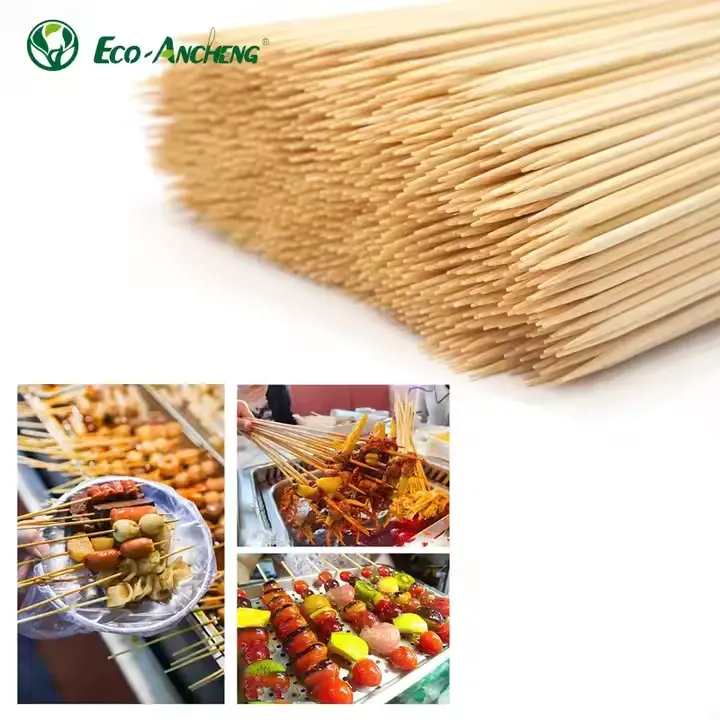
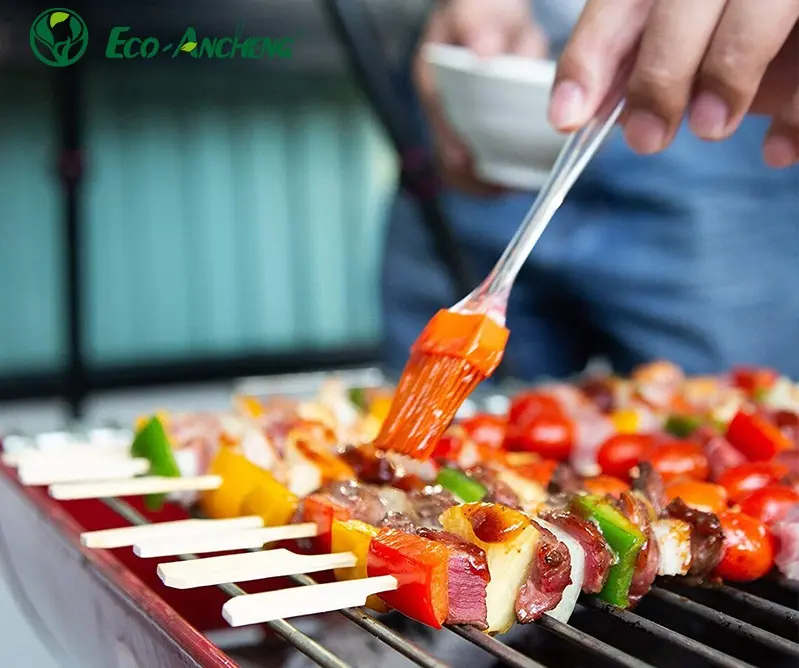
When using skewers on a grill, heat management is the priority. Bamboo skewer products are the preferred choice for grilling and barbecue. They offer sufficient strength and are less likely to burn quickly compared to softer woods. Round skewers are versatile and cost-effective for general grilling. Flat skewers help reduce food rotation, which is useful for heavier or wider food pieces.
A common professional tip is to soak the skewers in water for at least 30 minutes before use. This adds moisture to the fibers and prevents the wood from catching fire. For large portions, use a thick diameter to ensure the skewer can support the weight of the meat as it softens during the cooking process.
Bars and hotels rely on cocktail skewers and food picks for drink and snack presentation.
Focus on compact size and clean appearance, with smooth surfaces to avoid damaging drink garnishes such as fruit slices and mint leaves.
Some scenarios use decorative wooden picks to match the venue’s style, with the core requirement of food-grade material compliance.
The length should be slightly longer than the width of the glass to ensure the pick does not fall into the liquid.
Catering and restaurant applications cover diverse needs from main course cooking to appetizer presentation.
Hot food service: Use the same heavy-duty skewers used for barbecues.
Cold food and appetizer service: Prefer small and aesthetically consistent food picks to enhance plate presentation.
For supermarket BBQ packs, ecommerce retail packs and distributor programs, packaging becomes especially important. The product itself must be consistent, but the pack also needs to support shelf display, barcode labeling, quantity control and brand presentation.
Disposable skewers for supermarket fruit cuts and pre packaged snacks need individual or small batch packaging to maintain hygiene.
The skewers must have uniform size and shape to ensure a consistent consumer experience.

Food safety and compliance are non negotiable for all wooden skewer selections. Not all skewers are manufactured to the same standard. When purchasing from a wooden skewer manufacturer, quality control is essential for food safety.
A premium skewer must be polished. Any presence of splinters is a major safety hazard for the consumer. High quality manufacturing processes include multiple sanding stages to ensure a smooth finish. This is especially important for disposable skewer products used in children's meals.
The tip of the skewer should be sharp enough to pierce food easily without tearing it. However, it should not be so sharp that it poses a danger to the person eating. A consistent, tapered point is the sign of a well made product.
The moisture content of the wood or bamboo must be carefully controlled during manufacturing. If the skewers are too dry, they become brittle and snap easily. If they are too damp, they may develop mold during storage. A reliable wooden skewer manufacturer will use kiln drying to achieve the perfect balance.
1) All wooden skewers used for food contact must pass third party testing for food safety standards. Key certifications include FDA 21 CFR for the US market and EU 1935/2004 and LFGB for the European market.
2) These certifications confirm the absence of harmful chemicals and heavy metals in the wooden skewers.
3) Reputable manufacturers implement strict production process controls, including high temperature sterilization and surface polishing, to eliminate burrs and microbial contamination.
4) Buyers should request original test reports and certification documents from suppliers to verify compliance.
For wholesale buyers, selecting the right wooden skewer manufacturer is as important as choosing the product itself. Professional wooden skewer manufacturers offer consistent product quality, scalable production capacity and comprehensive after sales service.
Key evaluation factors for manufacturers:
1) Production scale: Check factory area and monthly output to ensure the manufacturer can meet bulk order demands.
2) Quality control system: Verify coverage of raw material sourcing, production process inspection and finished product testing.
3) Sustainable sourcing: Prefer manufacturers using wood from sustainably managed forests to align with global environmental standards.
4) Certifications: Confirm compliance with international food safety standards (FDA, LFGB, EU 1935/2004).
1. Confirm clear product requirements: Include material, size, specification and order volume based on end use scenarios.
2. Verify manufacturer credentials: Request original food safety test reports and factory production data.
3. Evaluate sample quality: Test skewer toughness, surface smoothness and tip sharpness to ensure alignment with requirements.
4. Confirm supply chain and after sales service: Check lead times, shipping options and quality guarantee policies for bulk orders.
1. Prioritizing price over quality: Low toughness skewers break easily during use and increase replacement costs.
2. Ignoring specification matching: Using overly thin skewers for heavy foods or overly long skewers for small appetizers leads to poor functionality and presentation.
3. Neglecting food safety certification: Purchasing non food grade wooden skewers poses health risks and regulatory non compliance for food service businesses.
4. Ignoring Packaging Requirements: A product that works for bulk restaurant supply may not be ready for retail sale. Retail buyers should confirm pack quantity, label design, barcode and carton details early.
Bamboo BBQ skewers, flat skewers and longer grilling skewers are common choices for BBQ. The best option depends on food weight, portion size and whether the product is used in restaurants, catering or retail packs.
Cocktail picks are used for drink garnish, olives, cherries, fruit, cheese cubes, appetizers and bar snacks. Decorative styles such as loop picks, ring picks, heart picks and beaded picks are common in bars, hotels and event catering.
Yes. Depending on the product type, customization may include logo on the stick, printed flag picks, private-label packaging, labels, header cards or retail pack design. The best method depends on the product structure and buyer’s branding requirements.
Common packaging options include bulk bags, inner bags, master cartons, retail packs, header card bags, label packs and private-label packaging. Buyers should confirm packing quantity and carton requirements before production.
For Ancheng, bamboo skewers are generally 500,000 pcs MOQ, while pick-style products are generally 300,000 pcs MOQ. Final MOQ depends on the product style, size, packaging and customization requirements.
The selection of wooden skewers follows a clear logical framework: match material to use temperature and food weight, match size and specification to food type and presentation needs, and ensure all products meet food safety certification standards. Food service operators can improve user experience and reduce operational risks by following these selection principles. Wholesale buyers can secure stable supply and consistent quality by partnering with professional and certified wooden skewer manufacturers.
As a leading wooden skewer manufacturer with over twenty years of experience, Ancheng provides a wide range of high quality disposable products for the global food service industry. Explore our full range of food grade wooden skewers, including barbecue skewers, cocktail picks, appetizer picks and disposable skewers with all standard and custom specifications.
Our manufacturing process prioritizes food safety and environmental responsibility. We ensure that every disposable skewer we produce meets strict quality standards, providing smooth surfaces and reliable strength for any application. We offer wooden skewer wholesale services to distributors and restaurant chains worldwide, with options for custom branding and various packaging sizes.
Would you like me to provide a price quote for a specific type of food skewer or send you a sample pack to test the quality of our bamboo skewer products for your business? Our team is ready to provide personalized advice based on your specific application needs and order requirements.
Ready to implement wooden skewers?
Start with a low minimum order quantity!

Hello, I'm Sven Wang, the Manager of Ancheng. With extensive expertise in raw materials and production processes, I'm dedicated to advancing sustainable tableware and constantly improving eco-friendly options for the modern catering industry. You can trust that Ancheng is committed to providing the highest quality. Welcome!

Factory: Qian Renqiao Industrial Park, Shucheng County, Luan City, Anhui Province, China
Office: Building 11, Max Science Park, Shushan Dist, Hefei, Anhui, China
Copyright ©2026 Anhui Ancheng Bamboo and Wood Tableware Co., Ltd. Privacy Policy


 Index
Index Product
 Resources
 About
About